

wastes. The water quality of the percolate in the landfill is determined to be that as
shown in Table 5.122, according to the Standard for Pollution Control on the
Landfill Site for Hazardous Wastes (GB18598-2001) and the percolate water
quality of other hazardous wastes landfills.
D. Percolate treatment plants
The percolate treatment plant processes the percolate and the flushing water of the
solidifying workshop by the process of “oxidation reduction + neutralization + flocculation + precipitation + sand filtration + activated carbon filtration”.
Each reaction tank is installed with mixer to make the reagents fully react with the
heavy metal wastewater. The raw water is removed of the major harmful pollutants
after the settlement and treatment of the wastewater, reaching the Class I standard of
Integrated Wastewater Discharge Standard (GB8978–1996). It is then imported
into the effluent sump, into which chlorine dioxide is added for disinfection. The
wastewater, after treated up to standard, is partly reused in production (mainly for
stabilization pretreatment), and is partly conveyed to the secondary sewage treatment works of the new area via the municipal sewage network for centralized
treatment, with the tail water discharged into the Beishan River.
II. Flushing water of solidifying workshop
The flushing wastewater of the solidifying workshop is 90% of the amount of
consumption, with the primary pollutants including the CODs, SSs, heavy metals,
and the like. It is pretreated in the percolate treatment plant. The discharge of the
wastewater is shown in Table 5.120.
III. Other flushing waters and laboratory wastewater
Other flushing waters include road and vehicle flushing water and equipment
flushing water, as are calculated based on 90% of the consumption, primarily
containing pollutants including CODs, SSs, etc. The laboratory wastewater is
mainly polluted by substances such as pH, CODs, SSs and so on. Other flushing
wastewaters and laboratory wastewater are pretreated by neutralization and precipitation, with the discharge as listed in Table 5.121.
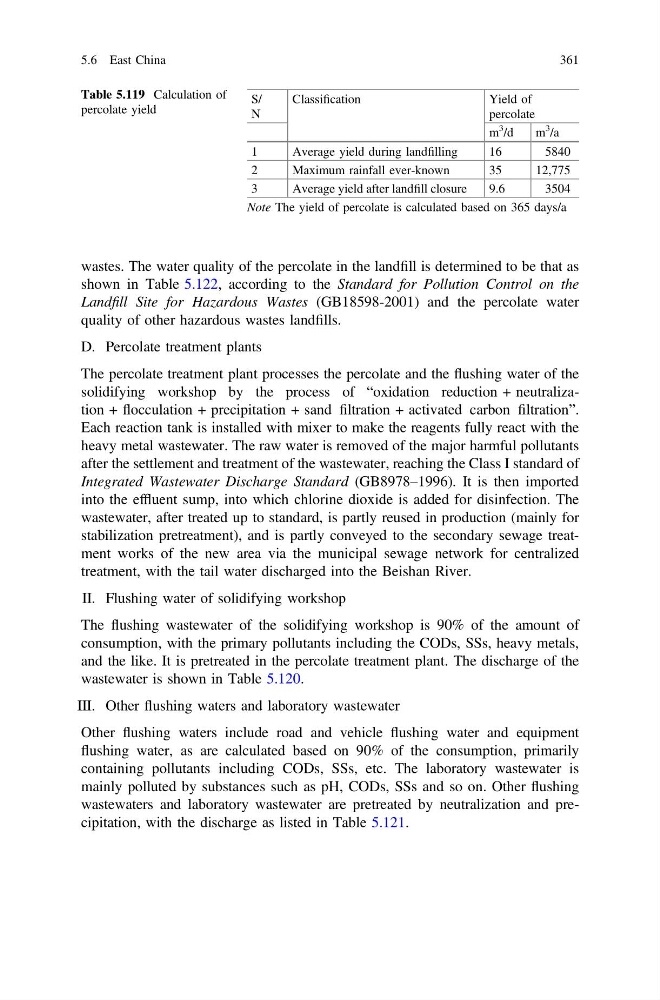
Table 5.119 Calculation of
percolate yield
S/
N
Classification
Yield of
percolate
m
3
/d
m
3
/a
1
Average yield during landfilling
16
5840
2
Maximum rainfall ever-known
35
12,775
3
Average yield after landfill closure
9.6
3504
Note The yield of percolate is calculated based on 365 days/a
5.6 East China
361
shown in Table 5.122, according to the Standard for Pollution Control on the
Landfill Site for Hazardous Wastes (GB18598-2001) and the percolate water
quality of other hazardous wastes landfills.
D. Percolate treatment plants
The percolate treatment plant processes the percolate and the flushing water of the
solidifying workshop by the process of “oxidation reduction + neutralization + flocculation + precipitation + sand filtration + activated carbon filtration”.
Each reaction tank is installed with mixer to make the reagents fully react with the
heavy metal wastewater. The raw water is removed of the major harmful pollutants
after the settlement and treatment of the wastewater, reaching the Class I standard of
Integrated Wastewater Discharge Standard (GB8978–1996). It is then imported
into the effluent sump, into which chlorine dioxide is added for disinfection. The
wastewater, after treated up to standard, is partly reused in production (mainly for
stabilization pretreatment), and is partly conveyed to the secondary sewage treatment works of the new area via the municipal sewage network for centralized
treatment, with the tail water discharged into the Beishan River.
II. Flushing water of solidifying workshop
The flushing wastewater of the solidifying workshop is 90% of the amount of
consumption, with the primary pollutants including the CODs, SSs, heavy metals,
and the like. It is pretreated in the percolate treatment plant. The discharge of the
wastewater is shown in Table 5.120.
III. Other flushing waters and laboratory wastewater
Other flushing waters include road and vehicle flushing water and equipment
flushing water, as are calculated based on 90% of the consumption, primarily
containing pollutants including CODs, SSs, etc. The laboratory wastewater is
mainly polluted by substances such as pH, CODs, SSs and so on. Other flushing
wastewaters and laboratory wastewater are pretreated by neutralization and precipitation, with the discharge as listed in Table 5.121.
Table 5.119 Calculation of
percolate yield
S/
N
Classification
Yield of
percolate
m
3
/d
m
3
/a
1
Average yield during landfilling
16
5840
2
Maximum rainfall ever-known
35
12,775
3
Average yield after landfill closure
9.6
3504
Note The yield of percolate is calculated based on 365 days/a
5.6 East China
361