

Road in the east, the main urban area in the west, the southern Gangnan Road in the
south, and the Yangtze River in the north. The planned total land area is 69 m
2 ,
including 55 m
2 area of industrial land under key planning.
① Economic profile of the city concerned
Since the reform and opening up, the city’s economy after rapid growth was
incorporated into the South of Jiangsu economic plate at the end of 2000, and
realized the “four major breaks” in 2001, namely the city’s GDP breaking 50 billion
yuan (reaching 50.52 billion yuan, with a per capita GDP of 18,946 yuan); the fiscal
revenue breaking 4 billion yuan; and the committed amount of foreign investment
breaking 1 billion US dollars (reaching 1.08 billion US dollars). In 2012, the total
GDP was 281.5 billion yuan and the per capita GDP was 90,415 yuan, ranking 18th
in China and the 4th in Jiangsu Province. The actual accumulated inflow of foreign
investment amounted to 3.5 billion US dollars in the city, where a large number of
large-scale foreign funded projects have been built and 11 of the world’s top 500
enterprises have set up offices. The four pillar industries including chemical,
papermaking, aluminum and building materials industries have taken initial shape
in the city, which becomes home to the world’s major base for anchor chain
production, the Asia’s largest papermaking base, the production base for engineering plastics and the China’s key acetic acid and beverage can production base.
In addition, the Hengshun vinegar is well-known both home and abroad.
② Economic profile of the New Area concerned
The New Area of the city (the economic and technological development zone of the
city) located in the east of the city, was formed in June 1998 by combining the
economic development zone of the city established in 1992 and the Dagang economic development zone set up in 1993, and was upgraded to a national economic
and technological development zone by April 2010. It has 3 towns and 2 streets
under its jurisdiction, covering a total area of 218.9 m
2 and inhabited by a
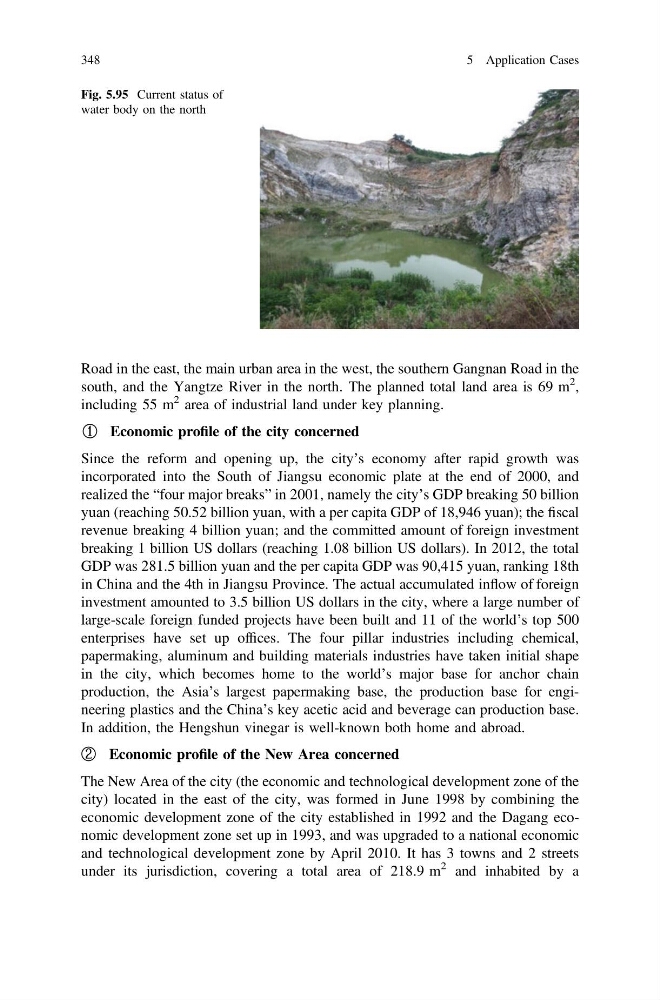
Fig. 5.95 Current status of
water body on the north
348
5 Application Cases
south, and the Yangtze River in the north. The planned total land area is 69 m
2 ,
including 55 m
2 area of industrial land under key planning.
① Economic profile of the city concerned
Since the reform and opening up, the city’s economy after rapid growth was
incorporated into the South of Jiangsu economic plate at the end of 2000, and
realized the “four major breaks” in 2001, namely the city’s GDP breaking 50 billion
yuan (reaching 50.52 billion yuan, with a per capita GDP of 18,946 yuan); the fiscal
revenue breaking 4 billion yuan; and the committed amount of foreign investment
breaking 1 billion US dollars (reaching 1.08 billion US dollars). In 2012, the total
GDP was 281.5 billion yuan and the per capita GDP was 90,415 yuan, ranking 18th
in China and the 4th in Jiangsu Province. The actual accumulated inflow of foreign
investment amounted to 3.5 billion US dollars in the city, where a large number of
large-scale foreign funded projects have been built and 11 of the world’s top 500
enterprises have set up offices. The four pillar industries including chemical,
papermaking, aluminum and building materials industries have taken initial shape
in the city, which becomes home to the world’s major base for anchor chain
production, the Asia’s largest papermaking base, the production base for engineering plastics and the China’s key acetic acid and beverage can production base.
In addition, the Hengshun vinegar is well-known both home and abroad.
② Economic profile of the New Area concerned
The New Area of the city (the economic and technological development zone of the
city) located in the east of the city, was formed in June 1998 by combining the
economic development zone of the city established in 1992 and the Dagang economic development zone set up in 1993, and was upgraded to a national economic
and technological development zone by April 2010. It has 3 towns and 2 streets
under its jurisdiction, covering a total area of 218.9 m
2 and inhabited by a
Fig. 5.95 Current status of
water body on the north
348
5 Application Cases