

Typical site
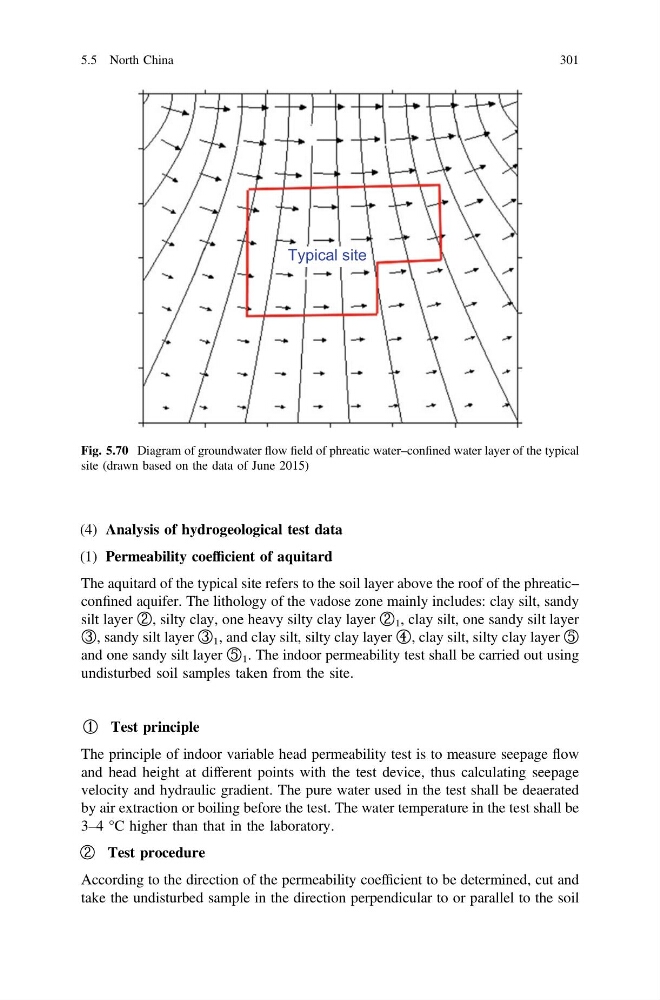
Fig. 5.70 Diagram of groundwater flow field of phreatic water–confined water layer of the typical
site (drawn based on the data of June 2015)
(4) Analysis of hydrogeological test data
(1) Permeability coefficient of aquitard
The aquitard of the typical site refers to the soil layer above the roof of the phreatic–
confined aquifer. The lithology of the vadose zone mainly includes: clay silt, sandy
silt layer ②, silty clay, one heavy silty clay layer ② 1 , clay silt, one sandy silt layer
③, sandy silt layer ③ 1 , and clay silt, silty clay layer ④, clay silt, silty clay layer ⑤
and one sandy silt layer ⑤ 1 . The indoor permeability test shall be carried out using
undisturbed soil samples taken from the site.
① Test principle
The principle of indoor variable head permeability test is to measure seepage flow
and head height at different points with the test device, thus calculating seepage
velocity and hydraulic gradient. The pure water used in the test shall be deaerated
by air extraction or boiling before the test. The water temperature in the test shall be
3–4 °C higher than that in the laboratory.
② Test procedure
According to the direction of the permeability coefficient to be determined, cut and
take the undisturbed sample in the direction perpendicular to or parallel to the soil
5.5 North China
301
Fig. 5.70 Diagram of groundwater flow field of phreatic water–confined water layer of the typical
site (drawn based on the data of June 2015)
(4) Analysis of hydrogeological test data
(1) Permeability coefficient of aquitard
The aquitard of the typical site refers to the soil layer above the roof of the phreatic–
confined aquifer. The lithology of the vadose zone mainly includes: clay silt, sandy
silt layer ②, silty clay, one heavy silty clay layer ② 1 , clay silt, one sandy silt layer
③, sandy silt layer ③ 1 , and clay silt, silty clay layer ④, clay silt, silty clay layer ⑤
and one sandy silt layer ⑤ 1 . The indoor permeability test shall be carried out using
undisturbed soil samples taken from the site.
① Test principle
The principle of indoor variable head permeability test is to measure seepage flow
and head height at different points with the test device, thus calculating seepage
velocity and hydraulic gradient. The pure water used in the test shall be deaerated
by air extraction or boiling before the test. The water temperature in the test shall be
3–4 °C higher than that in the laboratory.
② Test procedure
According to the direction of the permeability coefficient to be determined, cut and
take the undisturbed sample in the direction perpendicular to or parallel to the soil
5.5 North China
301