

The security landfill site adopts the reinforced concrete structure, and the pit wall
is provided with buttress. In order to resist the upper buoyancy, uplift piles are
arranged at the bottom of the pit. The concrete at the bottom and in the wall of the
pit shall be impervious concrete added with waterproof agent, and the inner wall
shall be coated with waterproof paint. In order to prevent rainwater from entering,
the landfill pit is provided with a movable gate-type steel pipe rack shed to cover
the landfill pit, thus saving the investment of leachate treatment system and leachate
treatment costs.
According to the Standard for Pollution Control on the Security Landfill Site for
Hazardous Wastes, if the saturated infiltration coefficient of the base layer is greater
than 1.0 Â 10
−6 cm/s, a double-layer artificial lining must be used. The saturated
infiltration coefficient of the base layer of the typical site is 1.5 Â 10
−6 cm/s, and
the double-layer seepage prevention must be adopted.
(1) Primary impermeable layer. The primary impermeable layer is a 2.0 mm thick
HDPE film with non-woven fabrics on both sides for protection.
(2) Primary protective layer. In order to protect the primary impermeable layer
from damages during landfill operation, a protective lining layer shall be added.
Since the rigid landfill pit is provided with a rain-proof awning, the landfill will
not contain excess water after solidification treatment, and therefore there is no
leachate in the landfill pit, and it is not necessary to establish a leachate collection and drainage system. Only 300 mm thick clay is added to the bottom of
the pit to protect the primary impermeable layer. Composite HDPE mesh
(non-woven fabric + HDPE mesh + non-woven fabric) is used to protect the
primary impermeable layer on the side wall of the landfill pit.
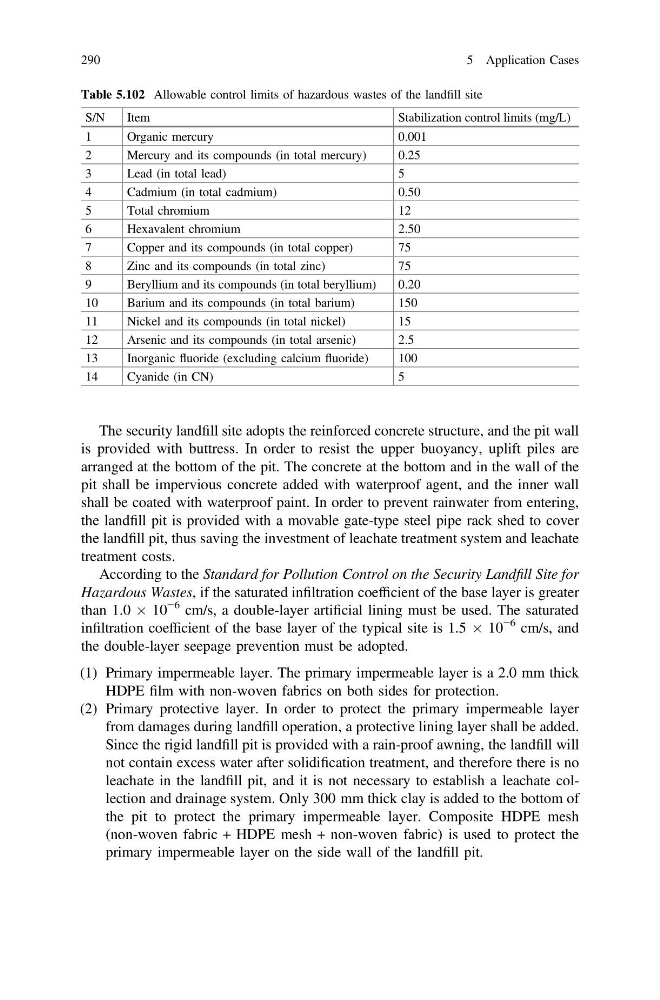
Table 5.102 Allowable control limits of hazardous wastes of the landfill site
S/N
Item
Stabilization control limits (mg/L)
1
Organic mercury
0.001
2
Mercury and its compounds (in total mercury)
0.25
3
Lead (in total lead)
5
4
Cadmium (in total cadmium)
0.50
5
Total chromium
12
6
Hexavalent chromium
2.50
7
Copper and its compounds (in total copper)
75
8
Zinc and its compounds (in total zinc)
75
9
Beryllium and its compounds (in total beryllium)
0.20
10
Barium and its compounds (in total barium)
150
11
Nickel and its compounds (in total nickel)
15
12
Arsenic and its compounds (in total arsenic)
2.5
13
Inorganic fluoride (excluding calcium fluoride)
100
14
Cyanide (in CN)
5
290
5 Application Cases
is provided with buttress. In order to resist the upper buoyancy, uplift piles are
arranged at the bottom of the pit. The concrete at the bottom and in the wall of the
pit shall be impervious concrete added with waterproof agent, and the inner wall
shall be coated with waterproof paint. In order to prevent rainwater from entering,
the landfill pit is provided with a movable gate-type steel pipe rack shed to cover
the landfill pit, thus saving the investment of leachate treatment system and leachate
treatment costs.
According to the Standard for Pollution Control on the Security Landfill Site for
Hazardous Wastes, if the saturated infiltration coefficient of the base layer is greater
than 1.0 Â 10
−6 cm/s, a double-layer artificial lining must be used. The saturated
infiltration coefficient of the base layer of the typical site is 1.5 Â 10
−6 cm/s, and
the double-layer seepage prevention must be adopted.
(1) Primary impermeable layer. The primary impermeable layer is a 2.0 mm thick
HDPE film with non-woven fabrics on both sides for protection.
(2) Primary protective layer. In order to protect the primary impermeable layer
from damages during landfill operation, a protective lining layer shall be added.
Since the rigid landfill pit is provided with a rain-proof awning, the landfill will
not contain excess water after solidification treatment, and therefore there is no
leachate in the landfill pit, and it is not necessary to establish a leachate collection and drainage system. Only 300 mm thick clay is added to the bottom of
the pit to protect the primary impermeable layer. Composite HDPE mesh
(non-woven fabric + HDPE mesh + non-woven fabric) is used to protect the
primary impermeable layer on the side wall of the landfill pit.
Table 5.102 Allowable control limits of hazardous wastes of the landfill site
S/N
Item
Stabilization control limits (mg/L)
1
Organic mercury
0.001
2
Mercury and its compounds (in total mercury)
0.25
3
Lead (in total lead)
5
4
Cadmium (in total cadmium)
0.50
5
Total chromium
12
6
Hexavalent chromium
2.50
7
Copper and its compounds (in total copper)
75
8
Zinc and its compounds (in total zinc)
75
9
Beryllium and its compounds (in total beryllium)
0.20
10
Barium and its compounds (in total barium)
150
11
Nickel and its compounds (in total nickel)
15
12
Arsenic and its compounds (in total arsenic)
2.5
13
Inorganic fluoride (excluding calcium fluoride)
100
14
Cyanide (in CN)
5
290
5 Application Cases