

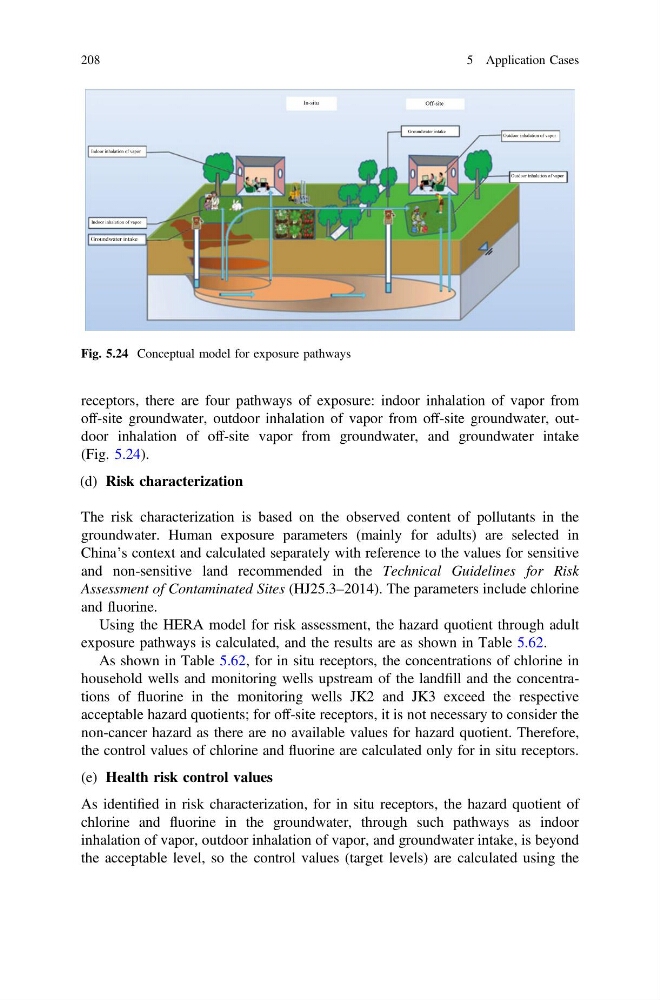
receptors, there are four pathways of exposure: indoor inhalation of vapor from
off-site groundwater, outdoor inhalation of vapor from off-site groundwater, outdoor inhalation of off-site vapor from groundwater, and groundwater intake
(Fig. 5.24).
(d) Risk characterization
The risk characterization is based on the observed content of pollutants in the
groundwater. Human exposure parameters (mainly for adults) are selected in
China’s context and calculated separately with reference to the values for sensitive
and non-sensitive land recommended in the Technical Guidelines for Risk
Assessment of Contaminated Sites (HJ25.3–2014). The parameters include chlorine
and fluorine.
Using the HERA model for risk assessment, the hazard quotient through adult
exposure pathways is calculated, and the results are as shown in Table 5.62.
As shown in Table 5.62, for in situ receptors, the concentrations of chlorine in
household wells and monitoring wells upstream of the landfill and the concentrations of fluorine in the monitoring wells JK2 and JK3 exceed the respective
acceptable hazard quotients; for off-site receptors, it is not necessary to consider the
non-cancer hazard as there are no available values for hazard quotient. Therefore,
the control values of chlorine and fluorine are calculated only for in situ receptors.
(e) Health risk control values
As identified in risk characterization, for in situ receptors, the hazard quotient of
chlorine and fluorine in the groundwater, through such pathways as indoor
inhalation of vapor, outdoor inhalation of vapor, and groundwater intake, is beyond
the acceptable level, so the control values (target levels) are calculated using the
In-situ
Off-site
Indoor inhalation of vapor
Indoor inhalation of vapor
Outdoor inhalation of vapor
Outdoor inhalation of vapor
Groundwater intake
Groundwater intake
Fig. 5.24 Conceptual model for exposure pathways
208
5 Application Cases
off-site groundwater, outdoor inhalation of vapor from off-site groundwater, outdoor inhalation of off-site vapor from groundwater, and groundwater intake
(Fig. 5.24).
(d) Risk characterization
The risk characterization is based on the observed content of pollutants in the
groundwater. Human exposure parameters (mainly for adults) are selected in
China’s context and calculated separately with reference to the values for sensitive
and non-sensitive land recommended in the Technical Guidelines for Risk
Assessment of Contaminated Sites (HJ25.3–2014). The parameters include chlorine
and fluorine.
Using the HERA model for risk assessment, the hazard quotient through adult
exposure pathways is calculated, and the results are as shown in Table 5.62.
As shown in Table 5.62, for in situ receptors, the concentrations of chlorine in
household wells and monitoring wells upstream of the landfill and the concentrations of fluorine in the monitoring wells JK2 and JK3 exceed the respective
acceptable hazard quotients; for off-site receptors, it is not necessary to consider the
non-cancer hazard as there are no available values for hazard quotient. Therefore,
the control values of chlorine and fluorine are calculated only for in situ receptors.
(e) Health risk control values
As identified in risk characterization, for in situ receptors, the hazard quotient of
chlorine and fluorine in the groundwater, through such pathways as indoor
inhalation of vapor, outdoor inhalation of vapor, and groundwater intake, is beyond
the acceptable level, so the control values (target levels) are calculated using the
In-situ
Off-site
Indoor inhalation of vapor
Indoor inhalation of vapor
Outdoor inhalation of vapor
Outdoor inhalation of vapor
Groundwater intake
Groundwater intake
Fig. 5.24 Conceptual model for exposure pathways
208
5 Application Cases