

5.3 Southwest China
Case 5 Groundwater pollution investigation, source intensity evaluation and risk
assessment of a landfill in Sichuan Province
This simple shoal-type landfill covers an area of about 46,667 m
2 and has a storage
capacity of 400,000 m
3 and a service life of about 15 years. As leachate drainage or
seepage control system are not adopted to protect the groundwater environment,
leachate can directly infiltrate into the groundwater system through the underlying
permeable media. Groundwater in the hydrogeological units of the landfill serves as
dispersed sources for water supply.
(1) Natural environment and hydrogeology
(a) Geological location
This landfill of central Sichuan Province is located on the first terrace of the Jinma
River system on the alluvial fan of the Lancang River. It is adjacent to the Jinma
River on the east side. It is high in the west and low in the east, with an elevation of
633.51 to 666.85 m and a relative height difference of 33.34 m. The topographic
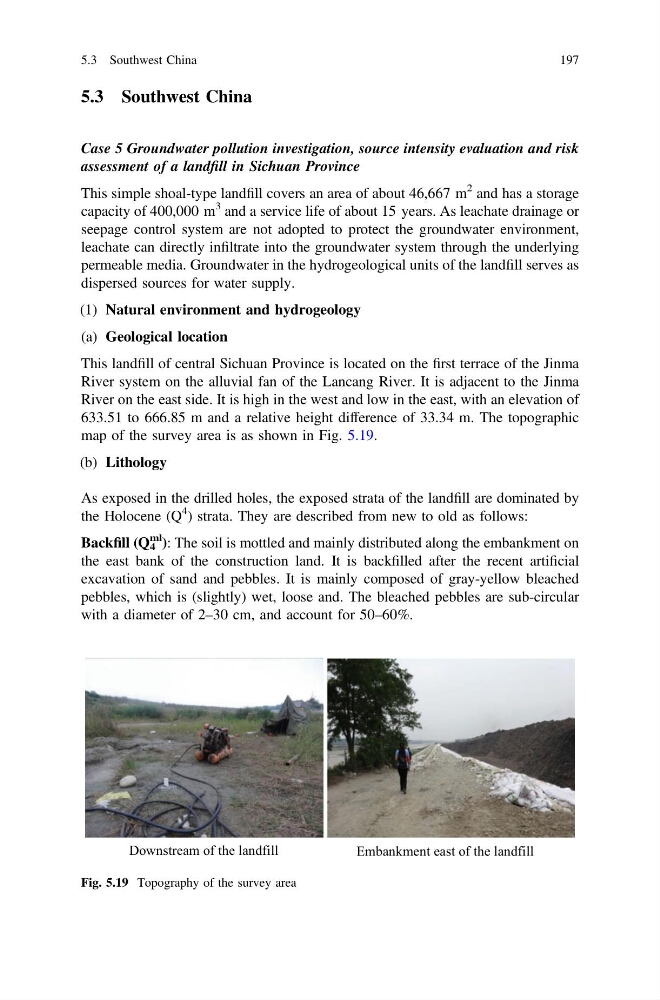
map of the survey area is as shown in Fig. 5.19.
(b) Lithology
As exposed in the drilled holes, the exposed strata of the landfill are dominated by
the Holocene (Q
4 ) strata. They are described from new to old as follows:
Backfill (Q 4
ml ): The soil is mottled and mainly distributed along the embankment on
the east bank of the construction land. It is backfilled after the recent artificial
excavation of sand and pebbles. It is mainly composed of gray-yellow bleached
pebbles, which is (slightly) wet, loose and. The bleached pebbles are sub-circular
with a diameter of 2–30 cm, and account for 50–60%.
Downstream of the landfill
Embankment east of the landfill
Fig. 5.19 Topography of the survey area
5.3 Southwest China
197
Case 5 Groundwater pollution investigation, source intensity evaluation and risk
assessment of a landfill in Sichuan Province
This simple shoal-type landfill covers an area of about 46,667 m
2 and has a storage
capacity of 400,000 m
3 and a service life of about 15 years. As leachate drainage or
seepage control system are not adopted to protect the groundwater environment,
leachate can directly infiltrate into the groundwater system through the underlying
permeable media. Groundwater in the hydrogeological units of the landfill serves as
dispersed sources for water supply.
(1) Natural environment and hydrogeology
(a) Geological location
This landfill of central Sichuan Province is located on the first terrace of the Jinma
River system on the alluvial fan of the Lancang River. It is adjacent to the Jinma
River on the east side. It is high in the west and low in the east, with an elevation of
633.51 to 666.85 m and a relative height difference of 33.34 m. The topographic
map of the survey area is as shown in Fig. 5.19.
(b) Lithology
As exposed in the drilled holes, the exposed strata of the landfill are dominated by
the Holocene (Q
4 ) strata. They are described from new to old as follows:
Backfill (Q 4
ml ): The soil is mottled and mainly distributed along the embankment on
the east bank of the construction land. It is backfilled after the recent artificial
excavation of sand and pebbles. It is mainly composed of gray-yellow bleached
pebbles, which is (slightly) wet, loose and. The bleached pebbles are sub-circular
with a diameter of 2–30 cm, and account for 50–60%.
Downstream of the landfill
Embankment east of the landfill
Fig. 5.19 Topography of the survey area
5.3 Southwest China
197