

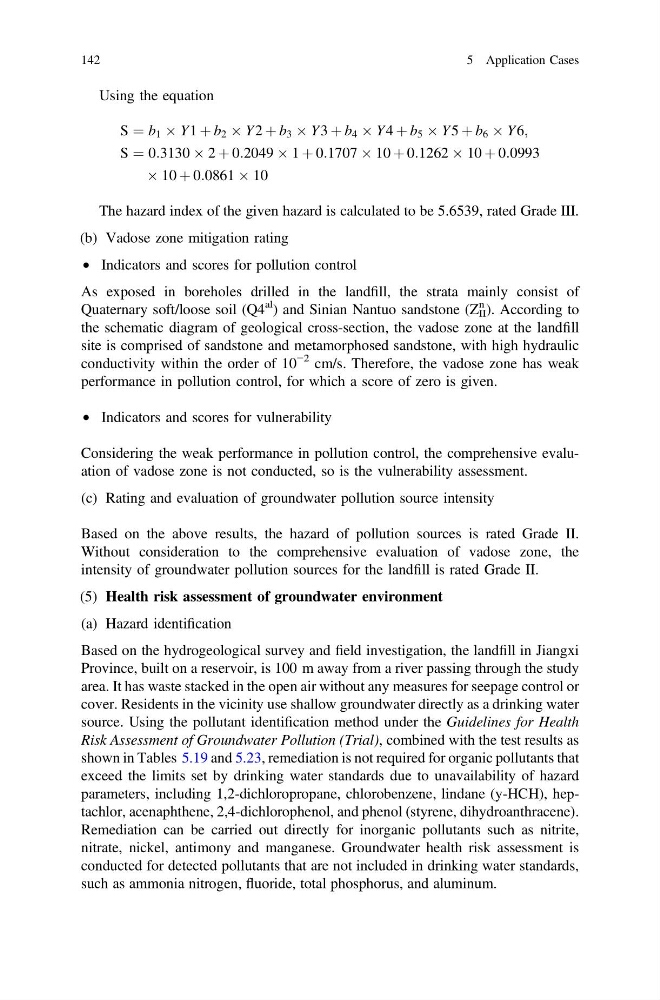
Using the equation
S ¼ b 1 Â Y1 þ b 2 Â Y2 þ b 3 Â Y3 þ b 4 Â Y4 þ b 5 Â Y5 þ b 6 Â Y6;
S ¼ 0:3130 Â 2 þ 0:2049 Â 1 þ 0:1707 Â 10 þ 0:1262 Â 10 þ 0:0993
 10 þ 0:0861  10
The hazard index of the given hazard is calculated to be 5.6539, rated Grade III.
(b) Vadose zone mitigation rating
• Indicators and scores for pollution control
As exposed in boreholes drilled in the landfill, the strata mainly consist of
Quaternary soft/loose soil (Q4
al
) and Sinian Nantuo sandstone (Z II
n ). According to
the schematic diagram of geological cross-section, the vadose zone at the landfill
site is comprised of sandstone and metamorphosed sandstone, with high hydraulic
conductivity within the order of 10
−2 cm/s. Therefore, the vadose zone has weak
performance in pollution control, for which a score of zero is given.
• Indicators and scores for vulnerability
Considering the weak performance in pollution control, the comprehensive evaluation of vadose zone is not conducted, so is the vulnerability assessment.
(c) Rating and evaluation of groundwater pollution source intensity
Based on the above results, the hazard of pollution sources is rated Grade II.
Without consideration to the comprehensive evaluation of vadose zone, the
intensity of groundwater pollution sources for the landfill is rated Grade II.
(5) Health risk assessment of groundwater environment
(a) Hazard identification
Based on the hydrogeological survey and field investigation, the landfill in Jiangxi
Province, built on a reservoir, is 100 m away from a river passing through the study
area. It has waste stacked in the open air without any measures for seepage control or
cover. Residents in the vicinity use shallow groundwater directly as a drinking water
source. Using the pollutant identification method under the Guidelines for Health
Risk Assessment of Groundwater Pollution (Trial), combined with the test results as
shown in Tables 5.19 and 5.23, remediation is not required for organic pollutants that
exceed the limits set by drinking water standards due to unavailability of hazard
parameters, including 1,2-dichloropropane, chlorobenzene, lindane (y-HCH), heptachlor, acenaphthene, 2,4-dichlorophenol, and phenol (styrene, dihydroanthracene).
Remediation can be carried out directly for inorganic pollutants such as nitrite,
nitrate, nickel, antimony and manganese. Groundwater health risk assessment is
conducted for detected pollutants that are not included in drinking water standards,
such as ammonia nitrogen, fluoride, total phosphorus, and aluminum.
142
5 Application Cases
S ¼ b 1 Â Y1 þ b 2 Â Y2 þ b 3 Â Y3 þ b 4 Â Y4 þ b 5 Â Y5 þ b 6 Â Y6;
S ¼ 0:3130 Â 2 þ 0:2049 Â 1 þ 0:1707 Â 10 þ 0:1262 Â 10 þ 0:0993
 10 þ 0:0861  10
The hazard index of the given hazard is calculated to be 5.6539, rated Grade III.
(b) Vadose zone mitigation rating
• Indicators and scores for pollution control
As exposed in boreholes drilled in the landfill, the strata mainly consist of
Quaternary soft/loose soil (Q4
al
) and Sinian Nantuo sandstone (Z II
n ). According to
the schematic diagram of geological cross-section, the vadose zone at the landfill
site is comprised of sandstone and metamorphosed sandstone, with high hydraulic
conductivity within the order of 10
−2 cm/s. Therefore, the vadose zone has weak
performance in pollution control, for which a score of zero is given.
• Indicators and scores for vulnerability
Considering the weak performance in pollution control, the comprehensive evaluation of vadose zone is not conducted, so is the vulnerability assessment.
(c) Rating and evaluation of groundwater pollution source intensity
Based on the above results, the hazard of pollution sources is rated Grade II.
Without consideration to the comprehensive evaluation of vadose zone, the
intensity of groundwater pollution sources for the landfill is rated Grade II.
(5) Health risk assessment of groundwater environment
(a) Hazard identification
Based on the hydrogeological survey and field investigation, the landfill in Jiangxi
Province, built on a reservoir, is 100 m away from a river passing through the study
area. It has waste stacked in the open air without any measures for seepage control or
cover. Residents in the vicinity use shallow groundwater directly as a drinking water
source. Using the pollutant identification method under the Guidelines for Health
Risk Assessment of Groundwater Pollution (Trial), combined with the test results as
shown in Tables 5.19 and 5.23, remediation is not required for organic pollutants that
exceed the limits set by drinking water standards due to unavailability of hazard
parameters, including 1,2-dichloropropane, chlorobenzene, lindane (y-HCH), heptachlor, acenaphthene, 2,4-dichlorophenol, and phenol (styrene, dihydroanthracene).
Remediation can be carried out directly for inorganic pollutants such as nitrite,
nitrate, nickel, antimony and manganese. Groundwater health risk assessment is
conducted for detected pollutants that are not included in drinking water standards,
such as ammonia nitrogen, fluoride, total phosphorus, and aluminum.
142
5 Application Cases