

• Rural solid waste, including recyclable waste, kitchen waste, hazardous waste
and other waste. Recyclable waste includes paper, metal, plastic, glass, etc.;
kitchen waste includes leftovers, bones, vegetable roots, etc.; hazardous waste
includes waste batteries, waste fluorescent tubes, waste mercury thermometers,
expired medicines, etc.; and other waste includes bricks, ceramics, muck, waste
toilet paper and human waste;
• Animal husbandry waste mainly covers the feathers, manure and feed of livestock and poultry, and mats for animal housing.
• Agro-industrial waste mainly refers to farmland and orchard residues, such as
crop straws, fruit branches, weeds, fallen leaves, and fruit shells.
• Toxic and hazardous waste mainly refers to chemical fertilizers, pesticides, and
agricultural film residues.
The survey found that in Luanshiwan Village, the daily production of waste
reaches 1.5 kg per person, of which plant ash accounts for 22.8%, dregs 40.13%,
kitchen waste 30.12%, bricks and ceramics 0.01%, paper 2.73%, plastic rubber
2.92%, textile 0.25%, glass 0.25%, metal 0.50%, wood 0.29%.
(c) Pollutant discharge
As waste is stacked in the open air without any seepage control and cover, the
resulting landfill leachate is discharged directly into the Dongsheng River along the
surface runoff. The landfill leachate is black and smelly, with the chemical oxygen
demand (COD) up to 4000 mg/L. It is easily leaked into the groundwater which
exists shallow in the form of fissure water. In addition, the landfill volume is
expanding, increasing the possibility of large-scale groundwater contamination. The
survey found that the farmers near the landfill extract shallow groundwater for
drinking purpose and the well walls are simply made of stones without any protective measures. The landfill leachate will directly threaten the drinking water
safety of downstream residents if it contaminates groundwater near the site and
flows into the river.
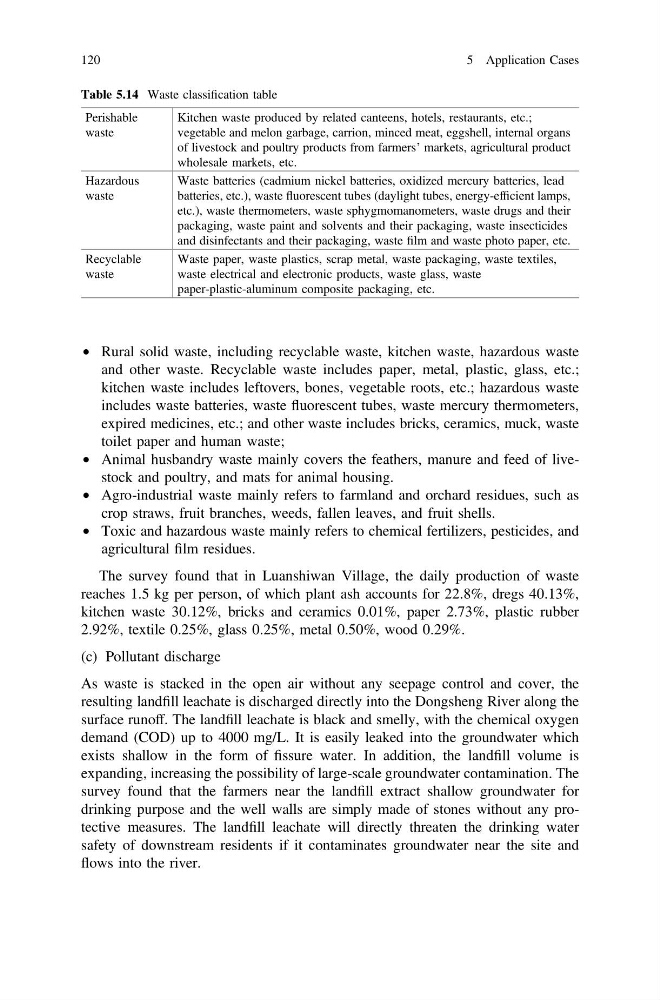
Table 5.14 Waste classification table
Perishable
waste
Kitchen waste produced by related canteens, hotels, restaurants, etc.;
vegetable and melon garbage, carrion, minced meat, eggshell, internal organs
of livestock and poultry products from farmers’ markets, agricultural product
wholesale markets, etc.
Hazardous
waste
Waste batteries (cadmium nickel batteries, oxidized mercury batteries, lead
batteries, etc.), waste fluorescent tubes (daylight tubes, energy-efficient lamps,
etc.), waste thermometers, waste sphygmomanometers, waste drugs and their
packaging, waste paint and solvents and their packaging, waste insecticides
and disinfectants and their packaging, waste film and waste photo paper, etc.
Recyclable
waste
Waste paper, waste plastics, scrap metal, waste packaging, waste textiles,
waste electrical and electronic products, waste glass, waste
paper-plastic-aluminum composite packaging, etc.
120
5 Application Cases
and other waste. Recyclable waste includes paper, metal, plastic, glass, etc.;
kitchen waste includes leftovers, bones, vegetable roots, etc.; hazardous waste
includes waste batteries, waste fluorescent tubes, waste mercury thermometers,
expired medicines, etc.; and other waste includes bricks, ceramics, muck, waste
toilet paper and human waste;
• Animal husbandry waste mainly covers the feathers, manure and feed of livestock and poultry, and mats for animal housing.
• Agro-industrial waste mainly refers to farmland and orchard residues, such as
crop straws, fruit branches, weeds, fallen leaves, and fruit shells.
• Toxic and hazardous waste mainly refers to chemical fertilizers, pesticides, and
agricultural film residues.
The survey found that in Luanshiwan Village, the daily production of waste
reaches 1.5 kg per person, of which plant ash accounts for 22.8%, dregs 40.13%,
kitchen waste 30.12%, bricks and ceramics 0.01%, paper 2.73%, plastic rubber
2.92%, textile 0.25%, glass 0.25%, metal 0.50%, wood 0.29%.
(c) Pollutant discharge
As waste is stacked in the open air without any seepage control and cover, the
resulting landfill leachate is discharged directly into the Dongsheng River along the
surface runoff. The landfill leachate is black and smelly, with the chemical oxygen
demand (COD) up to 4000 mg/L. It is easily leaked into the groundwater which
exists shallow in the form of fissure water. In addition, the landfill volume is
expanding, increasing the possibility of large-scale groundwater contamination. The
survey found that the farmers near the landfill extract shallow groundwater for
drinking purpose and the well walls are simply made of stones without any protective measures. The landfill leachate will directly threaten the drinking water
safety of downstream residents if it contaminates groundwater near the site and
flows into the river.
Table 5.14 Waste classification table
Perishable
waste
Kitchen waste produced by related canteens, hotels, restaurants, etc.;
vegetable and melon garbage, carrion, minced meat, eggshell, internal organs
of livestock and poultry products from farmers’ markets, agricultural product
wholesale markets, etc.
Hazardous
waste
Waste batteries (cadmium nickel batteries, oxidized mercury batteries, lead
batteries, etc.), waste fluorescent tubes (daylight tubes, energy-efficient lamps,
etc.), waste thermometers, waste sphygmomanometers, waste drugs and their
packaging, waste paint and solvents and their packaging, waste insecticides
and disinfectants and their packaging, waste film and waste photo paper, etc.
Recyclable
waste
Waste paper, waste plastics, scrap metal, waste packaging, waste textiles,
waste electrical and electronic products, waste glass, waste
paper-plastic-aluminum composite packaging, etc.
120
5 Application Cases