

(2) Environmental background investigation of the landfill
(a) Landfill overview
Built in September 1999, the given landfill is 9 km from the city center and covers
an area of 8 ha. It has a storage capacity of 1.5 million m
3 and a daily garbage
disposal capacity of 350 tons. While about 1.2 million tons of waste has been
landfilled, the garbage almost fill the entire mountain. Due to the simple landfill
treatment, a large amount of biogas has been generated during the degradation
process of organic matter and discharged directly into the atmosphere. In 2007, the
municipal government invested 10 million yuan to introduce the 3R comprehensive
treatment technology for landfill. Biogas has therefore been produced by intercepting, recirculating and leading landfill leachate into the closed circulation system. In October 2009, the landfill was fully closed for reforestation by planting trees
and grass. According to the recent field investigation, a driving training base has
been built in the east of the landfill. The installed biogas pipeline has been broken,
making the previous biogas collection and utilization project failed to proceed.
Newly filled waste is also particularly conspicuous. Rainwater converges in ditches
on the east and west sides, and then flows to the south side where the terrain is
relatively low. It is then collected by pipelines and discharged to the leachate tank at
the southern end along with the leachate produced by the simple landfill treatment.
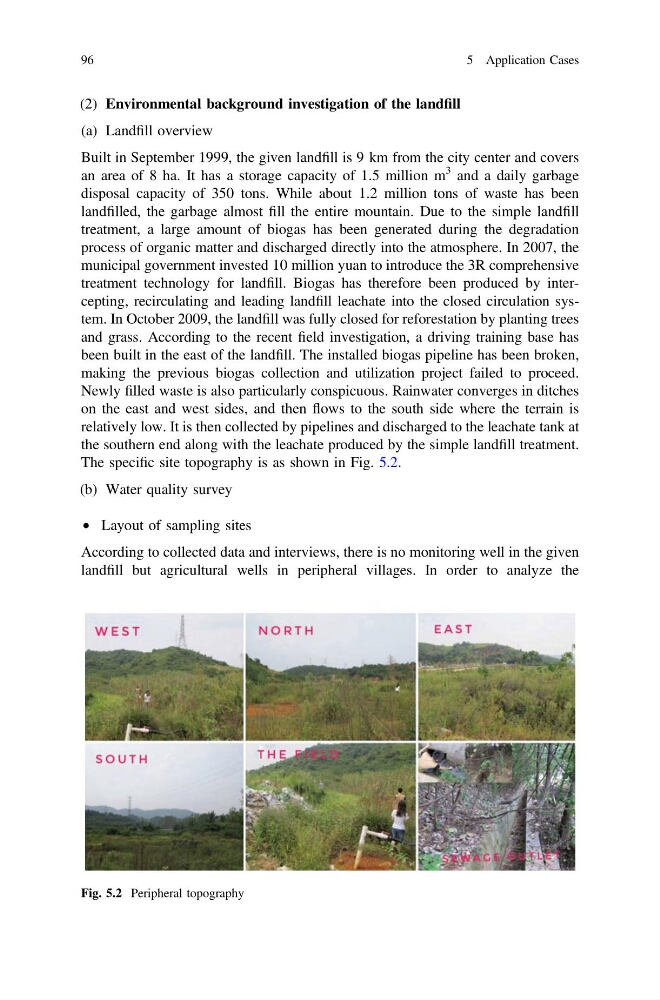
The specific site topography is as shown in Fig. 5.2.
(b) Water quality survey
• Layout of sampling sites
According to collected data and interviews, there is no monitoring well in the given
landfill but agricultural wells in peripheral villages. In order to analyze the
Fig. 5.2 Peripheral topography
96
5 Application Cases
(a) Landfill overview
Built in September 1999, the given landfill is 9 km from the city center and covers
an area of 8 ha. It has a storage capacity of 1.5 million m
3 and a daily garbage
disposal capacity of 350 tons. While about 1.2 million tons of waste has been
landfilled, the garbage almost fill the entire mountain. Due to the simple landfill
treatment, a large amount of biogas has been generated during the degradation
process of organic matter and discharged directly into the atmosphere. In 2007, the
municipal government invested 10 million yuan to introduce the 3R comprehensive
treatment technology for landfill. Biogas has therefore been produced by intercepting, recirculating and leading landfill leachate into the closed circulation system. In October 2009, the landfill was fully closed for reforestation by planting trees
and grass. According to the recent field investigation, a driving training base has
been built in the east of the landfill. The installed biogas pipeline has been broken,
making the previous biogas collection and utilization project failed to proceed.
Newly filled waste is also particularly conspicuous. Rainwater converges in ditches
on the east and west sides, and then flows to the south side where the terrain is
relatively low. It is then collected by pipelines and discharged to the leachate tank at
the southern end along with the leachate produced by the simple landfill treatment.
The specific site topography is as shown in Fig. 5.2.
(b) Water quality survey
• Layout of sampling sites
According to collected data and interviews, there is no monitoring well in the given
landfill but agricultural wells in peripheral villages. In order to analyze the
Fig. 5.2 Peripheral topography
96
5 Application Cases