

528
M. Matsumoto et al.
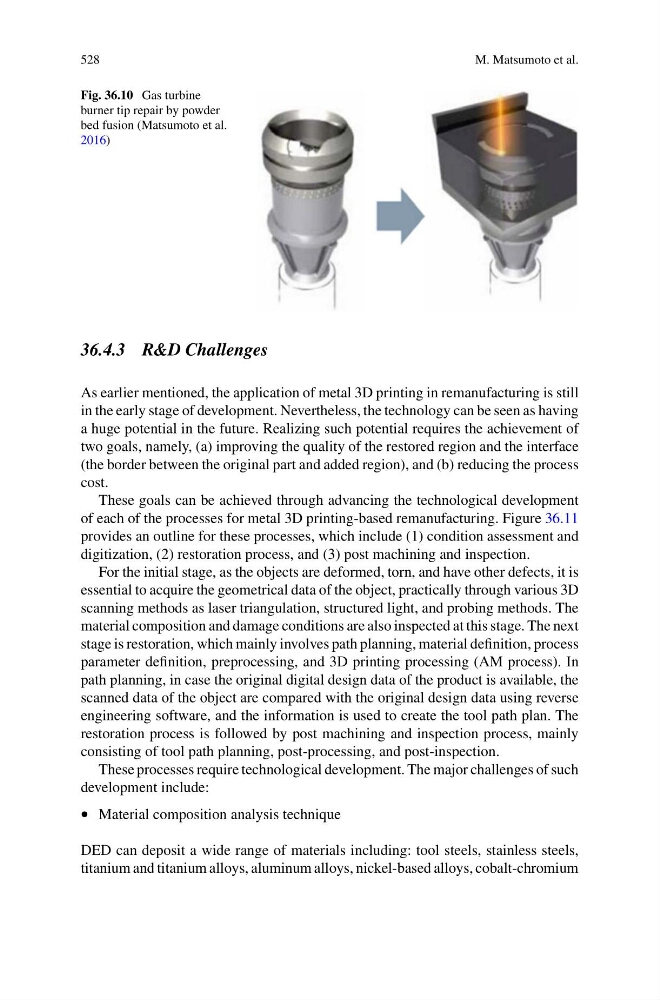
Fig. 36.10 Gas turbine
burner tip repair by powder
bed fusion (Matsumoto et al.
2016)
36.4.3 R&D Challenges
As earlier mentioned, the application of metal 3D printing in remanufacturing is still
in the early stage of development. Nevertheless, the technology can be seen as having
a huge potential in the future. Realizing such potential requires the achievement of
two goals, namely, (a) improving the quality of the restored region and the interface
(the border between the original part and added region), and (b) reducing the process
cost.
These goals can be achieved through advancing the technological development
of each of the processes for metal 3D printing-based remanufacturing. Figure 36.11
provides an outline for these processes, which include (1) condition assessment and
digitization, (2) restoration process, and (3) post machining and inspection.
For the initial stage, as the objects are deformed, torn, and have other defects, it is
essential to acquire the geometrical data of the object, practically through various 3D
scanning methods as laser triangulation, structured light, and probing methods. The
material composition and damage conditions are also inspected at this stage. The next
stage is restoration, which mainly involves path planning, material definition, process
parameter definition, preprocessing, and 3D printing processing (AM process). In
path planning, in case the original digital design data of the product is available, the
scanned data of the object are compared with the original design data using reverse
engineering software, and the information is used to create the tool path plan. The
restoration process is followed by post machining and inspection process, mainly
consisting of tool path planning, post-processing, and post-inspection.
These processes require technological development. The major challenges of such
development include:
• Material composition analysis technique
DED can deposit a wide range of materials including: tool steels, stainless steels,
titanium and titanium alloys, aluminum alloys, nickel-based alloys, cobalt-chromium
M. Matsumoto et al.
Fig. 36.10 Gas turbine
burner tip repair by powder
bed fusion (Matsumoto et al.
2016)
36.4.3 R&D Challenges
As earlier mentioned, the application of metal 3D printing in remanufacturing is still
in the early stage of development. Nevertheless, the technology can be seen as having
a huge potential in the future. Realizing such potential requires the achievement of
two goals, namely, (a) improving the quality of the restored region and the interface
(the border between the original part and added region), and (b) reducing the process
cost.
These goals can be achieved through advancing the technological development
of each of the processes for metal 3D printing-based remanufacturing. Figure 36.11
provides an outline for these processes, which include (1) condition assessment and
digitization, (2) restoration process, and (3) post machining and inspection.
For the initial stage, as the objects are deformed, torn, and have other defects, it is
essential to acquire the geometrical data of the object, practically through various 3D
scanning methods as laser triangulation, structured light, and probing methods. The
material composition and damage conditions are also inspected at this stage. The next
stage is restoration, which mainly involves path planning, material definition, process
parameter definition, preprocessing, and 3D printing processing (AM process). In
path planning, in case the original digital design data of the product is available, the
scanned data of the object are compared with the original design data using reverse
engineering software, and the information is used to create the tool path plan. The
restoration process is followed by post machining and inspection process, mainly
consisting of tool path planning, post-processing, and post-inspection.
These processes require technological development. The major challenges of such
development include:
• Material composition analysis technique
DED can deposit a wide range of materials including: tool steels, stainless steels,
titanium and titanium alloys, aluminum alloys, nickel-based alloys, cobalt-chromium