

484
B. Kianian and C. Andersson
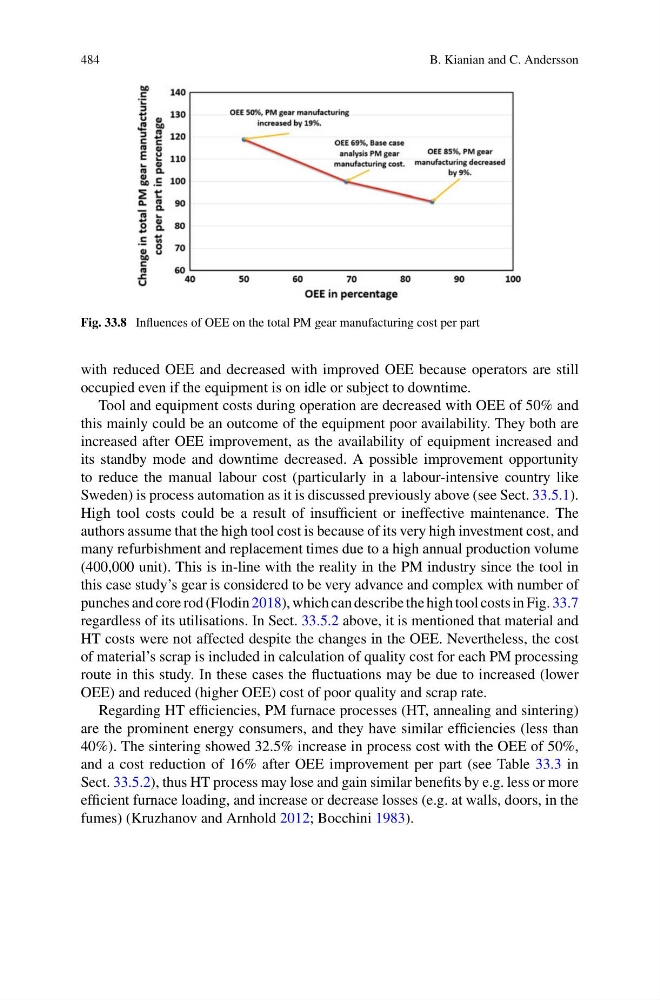
Fig. 33.8 Influences of OEE on the total PM gear manufacturing cost per part
with reduced OEE and decreased with improved OEE because operators are still
occupied even if the equipment is on idle or subject to downtime.
Tool and equipment costs during operation are decreased with OEE of 50% and
this mainly could be an outcome of the equipment poor availability. They both are
increased after OEE improvement, as the availability of equipment increased and
its standby mode and downtime decreased. A possible improvement opportunity
to reduce the manual labour cost (particularly in a labour-intensive country like
Sweden) is process automation as it is discussed previously above (see Sect. 33.5.1).
High tool costs could be a result of insufficient or ineffective maintenance. The
authors assume that the high tool cost is because of its very high investment cost, and
many refurbishment and replacement times due to a high annual production volume
(400,000 unit). This is in-line with the reality in the PM industry since the tool in
this case study’s gear is considered to be very advance and complex with number of
punches and core rod (Flodin 2018), which can describe the high tool costs in Fig. 33.7
regardless of its utilisations. In Sect. 33.5.2 above, it is mentioned that material and
HT costs were not affected despite the changes in the OEE. Nevertheless, the cost
of material’s scrap is included in calculation of quality cost for each PM processing
route in this study. In these cases the fluctuations may be due to increased (lower
OEE) and reduced (higher OEE) cost of poor quality and scrap rate.
Regarding HT efficiencies, PM furnace processes (HT, annealing and sintering)
are the prominent energy consumers, and they have similar efficiencies (less than
40%). The sintering showed 32.5% increase in process cost with the OEE of 50%,
and a cost reduction of 16% after OEE improvement per part (see Table 33.3 in
Sect. 33.5.2), thus HT process may lose and gain similar benefits by e.g. less or more
efficient furnace loading, and increase or decrease losses (e.g. at walls, doors, in the
fumes) (Kruzhanov and Arnhold 2012; Bocchini 1983).
B. Kianian and C. Andersson
Fig. 33.8 Influences of OEE on the total PM gear manufacturing cost per part
with reduced OEE and decreased with improved OEE because operators are still
occupied even if the equipment is on idle or subject to downtime.
Tool and equipment costs during operation are decreased with OEE of 50% and
this mainly could be an outcome of the equipment poor availability. They both are
increased after OEE improvement, as the availability of equipment increased and
its standby mode and downtime decreased. A possible improvement opportunity
to reduce the manual labour cost (particularly in a labour-intensive country like
Sweden) is process automation as it is discussed previously above (see Sect. 33.5.1).
High tool costs could be a result of insufficient or ineffective maintenance. The
authors assume that the high tool cost is because of its very high investment cost, and
many refurbishment and replacement times due to a high annual production volume
(400,000 unit). This is in-line with the reality in the PM industry since the tool in
this case study’s gear is considered to be very advance and complex with number of
punches and core rod (Flodin 2018), which can describe the high tool costs in Fig. 33.7
regardless of its utilisations. In Sect. 33.5.2 above, it is mentioned that material and
HT costs were not affected despite the changes in the OEE. Nevertheless, the cost
of material’s scrap is included in calculation of quality cost for each PM processing
route in this study. In these cases the fluctuations may be due to increased (lower
OEE) and reduced (higher OEE) cost of poor quality and scrap rate.
Regarding HT efficiencies, PM furnace processes (HT, annealing and sintering)
are the prominent energy consumers, and they have similar efficiencies (less than
40%). The sintering showed 32.5% increase in process cost with the OEE of 50%,
and a cost reduction of 16% after OEE improvement per part (see Table 33.3 in
Sect. 33.5.2), thus HT process may lose and gain similar benefits by e.g. less or more
efficient furnace loading, and increase or decrease losses (e.g. at walls, doors, in the
fumes) (Kruzhanov and Arnhold 2012; Bocchini 1983).