

30 Development of Electrostatic Linear Motor for Insect-Type …
427
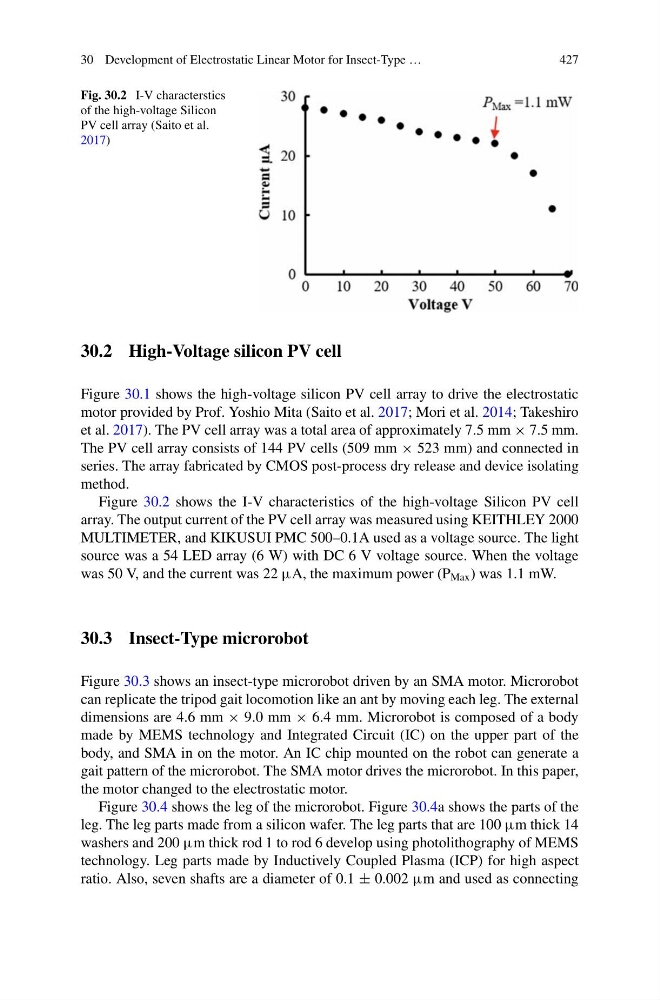
Fig. 30.2 I-V characterstics
of the high-voltage Silicon
PV cell array (Saito et al.
2017)
30.2 High-Voltage silicon PV cell
Figure 30.1 shows the high-voltage silicon PV cell array to drive the electrostatic
motor provided by Prof. Yoshio Mita (Saito et al. 2017; Mori et al. 2014; Takeshiro
et al. 2017). The PV cell array was a total area of approximately 7.5 mm × 7.5 mm.
The PV cell array consists of 144 PV cells (509 mm × 523 mm) and connected in
series. The array fabricated by CMOS post-process dry release and device isolating
method.
Figure 30.2 shows the I-V characteristics of the high-voltage Silicon PV cell
array. The output current of the PV cell array was measured using KEITHLEY 2000
MULTIMETER, and KIKUSUI PMC 500–0.1A used as a voltage source. The light
source was a 54 LED array (6 W) with DC 6 V voltage source. When the voltage
was 50 V, and the current was 22 µA, the maximum power (P Max ) was 1.1 mW.
30.3 Insect-Type microrobot
Figure 30.3 shows an insect-type microrobot driven by an SMA motor. Microrobot
can replicate the tripod gait locomotion like an ant by moving each leg. The external
dimensions are 4.6 mm × 9.0 mm × 6.4 mm. Microrobot is composed of a body
made by MEMS technology and Integrated Circuit (IC) on the upper part of the
body, and SMA in on the motor. An IC chip mounted on the robot can generate a
gait pattern of the microrobot. The SMA motor drives the microrobot. In this paper,
the motor changed to the electrostatic motor.
Figure 30.4 shows the leg of the microrobot. Figure 30.4a shows the parts of the
leg. The leg parts made from a silicon wafer. The leg parts that are 100 µm thick 14
washers and 200 µm thick rod 1 to rod 6 develop using photolithography of MEMS
technology. Leg parts made by Inductively Coupled Plasma (ICP) for high aspect
ratio. Also, seven shafts are a diameter of 0.1 ± 0.002 µm and used as connecting
427
Fig. 30.2 I-V characterstics
of the high-voltage Silicon
PV cell array (Saito et al.
2017)
30.2 High-Voltage silicon PV cell
Figure 30.1 shows the high-voltage silicon PV cell array to drive the electrostatic
motor provided by Prof. Yoshio Mita (Saito et al. 2017; Mori et al. 2014; Takeshiro
et al. 2017). The PV cell array was a total area of approximately 7.5 mm × 7.5 mm.
The PV cell array consists of 144 PV cells (509 mm × 523 mm) and connected in
series. The array fabricated by CMOS post-process dry release and device isolating
method.
Figure 30.2 shows the I-V characteristics of the high-voltage Silicon PV cell
array. The output current of the PV cell array was measured using KEITHLEY 2000
MULTIMETER, and KIKUSUI PMC 500–0.1A used as a voltage source. The light
source was a 54 LED array (6 W) with DC 6 V voltage source. When the voltage
was 50 V, and the current was 22 µA, the maximum power (P Max ) was 1.1 mW.
30.3 Insect-Type microrobot
Figure 30.3 shows an insect-type microrobot driven by an SMA motor. Microrobot
can replicate the tripod gait locomotion like an ant by moving each leg. The external
dimensions are 4.6 mm × 9.0 mm × 6.4 mm. Microrobot is composed of a body
made by MEMS technology and Integrated Circuit (IC) on the upper part of the
body, and SMA in on the motor. An IC chip mounted on the robot can generate a
gait pattern of the microrobot. The SMA motor drives the microrobot. In this paper,
the motor changed to the electrostatic motor.
Figure 30.4 shows the leg of the microrobot. Figure 30.4a shows the parts of the
leg. The leg parts made from a silicon wafer. The leg parts that are 100 µm thick 14
washers and 200 µm thick rod 1 to rod 6 develop using photolithography of MEMS
technology. Leg parts made by Inductively Coupled Plasma (ICP) for high aspect
ratio. Also, seven shafts are a diameter of 0.1 ± 0.002 µm and used as connecting