

426
G. Osada et al.
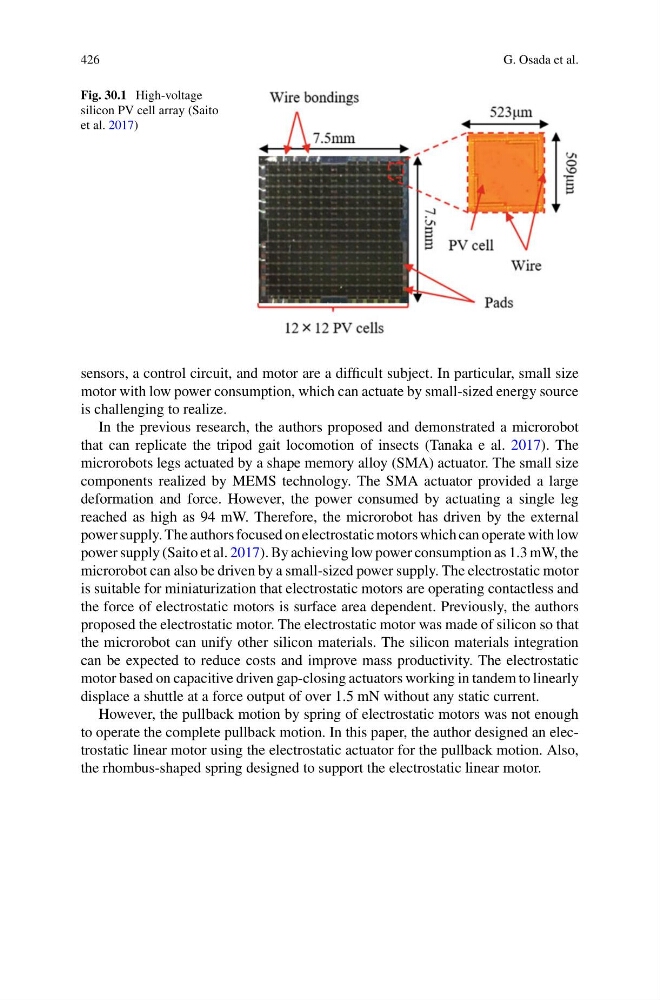
Fig. 30.1 High-voltage
silicon PV cell array (Saito
et al. 2017)
sensors, a control circuit, and motor are a difficult subject. In particular, small size
motor with low power consumption, which can actuate by small-sized energy source
is challenging to realize.
In the previous research, the authors proposed and demonstrated a microrobot
that can replicate the tripod gait locomotion of insects (Tanaka e al. 2017). The
microrobots legs actuated by a shape memory alloy (SMA) actuator. The small size
components realized by MEMS technology. The SMA actuator provided a large
deformation and force. However, the power consumed by actuating a single leg
reached as high as 94 mW. Therefore, the microrobot has driven by the external
power supply. The authors focused on electrostatic motors which can operate with low
power supply (Saito et al. 2017). By achieving low power consumption as 1.3 mW, the
microrobot can also be driven by a small-sized power supply. The electrostatic motor
is suitable for miniaturization that electrostatic motors are operating contactless and
the force of electrostatic motors is surface area dependent. Previously, the authors
proposed the electrostatic motor. The electrostatic motor was made of silicon so that
the microrobot can unify other silicon materials. The silicon materials integration
can be expected to reduce costs and improve mass productivity. The electrostatic
motor based on capacitive driven gap-closing actuators working in tandem to linearly
displace a shuttle at a force output of over 1.5 mN without any static current.
However, the pullback motion by spring of electrostatic motors was not enough
to operate the complete pullback motion. In this paper, the author designed an electrostatic linear motor using the electrostatic actuator for the pullback motion. Also,
the rhombus-shaped spring designed to support the electrostatic linear motor.
G. Osada et al.
Fig. 30.1 High-voltage
silicon PV cell array (Saito
et al. 2017)
sensors, a control circuit, and motor are a difficult subject. In particular, small size
motor with low power consumption, which can actuate by small-sized energy source
is challenging to realize.
In the previous research, the authors proposed and demonstrated a microrobot
that can replicate the tripod gait locomotion of insects (Tanaka e al. 2017). The
microrobots legs actuated by a shape memory alloy (SMA) actuator. The small size
components realized by MEMS technology. The SMA actuator provided a large
deformation and force. However, the power consumed by actuating a single leg
reached as high as 94 mW. Therefore, the microrobot has driven by the external
power supply. The authors focused on electrostatic motors which can operate with low
power supply (Saito et al. 2017). By achieving low power consumption as 1.3 mW, the
microrobot can also be driven by a small-sized power supply. The electrostatic motor
is suitable for miniaturization that electrostatic motors are operating contactless and
the force of electrostatic motors is surface area dependent. Previously, the authors
proposed the electrostatic motor. The electrostatic motor was made of silicon so that
the microrobot can unify other silicon materials. The silicon materials integration
can be expected to reduce costs and improve mass productivity. The electrostatic
motor based on capacitive driven gap-closing actuators working in tandem to linearly
displace a shuttle at a force output of over 1.5 mN without any static current.
However, the pullback motion by spring of electrostatic motors was not enough
to operate the complete pullback motion. In this paper, the author designed an electrostatic linear motor using the electrostatic actuator for the pullback motion. Also,
the rhombus-shaped spring designed to support the electrostatic linear motor.