

404
S. Chiba et al.
Researchers have advocated for DE floor power generation for more than 20 years,
but since DEs also act as a speaker and a sensor, it is usually utilized as a floor speaker.
However, if the noise is undesirable, it is possible to reverse the vibrator function
and cut off external noise (Chiba 2007a). Users can use the sensor function to take
measures against theft while still being able to use the power generation function.
Moreover, it is possible to thin the film of the DE, attach it to a body such as
a person or an animal, and generate power by those movements. An artificial film
with a width of 5 cm and a length of 25 cm (about 0.5 g), and one rotation (Stretch
and contract) per second can take about 55 mJ of energy. As mentioned above, a
thin rubbery DE generating sheet can be laid under roads (including passageways of
buildings) and can generate power by using the vibration and pressure changes due
to vehicle and foot traffic.
It can generate electric power by using solar heat in the form of heat accumulated
on the surfaces of buildings or roads in the summer. Also, it is possible to generate
electricity similarly with waste heat and drainage. We consider a new type of solar
heat generator based on DE which has a simple structure compared with existing
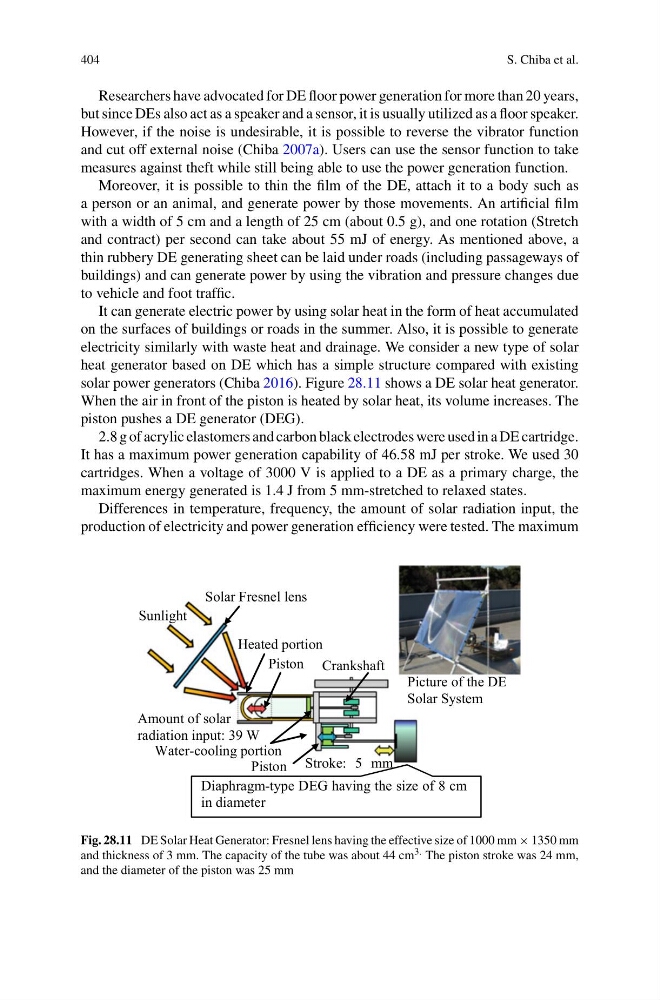
solar power generators (Chiba 2016). Figure 28.11 shows a DE solar heat generator.
When the air in front of the piston is heated by solar heat, its volume increases. The
piston pushes a DE generator (DEG).
2.8 g of acrylic elastomers and carbon black electrodes were used in a DE cartridge.
It has a maximum power generation capability of 46.58 mJ per stroke. We used 30
cartridges. When a voltage of 3000 V is applied to a DE as a primary charge, the
maximum energy generated is 1.4 J from 5 mm-stretched to relaxed states.
Differences in temperature, frequency, the amount of solar radiation input, the
production of electricity and power generation efficiency were tested. The maximum
Picture of the DE
Solar System
Diaphragm-type DEG having the size of 8 cm
in diameter
Stroke: 5 mm
Sunlight
Solar Fresnel lens
Heated portion
Amount of solar
radiation input: 39 W
Piston Crankshaft
Water-cooling portion
Piston
Fig. 28.11 DE Solar Heat Generator: Fresnel lens having the effective size of 1000 mm × 1350 mm
and thickness of 3 mm. The capacity of the tube was about 44 cm 3. The piston stroke was 24 mm,
and the diameter of the piston was 25 mm
S. Chiba et al.
Researchers have advocated for DE floor power generation for more than 20 years,
but since DEs also act as a speaker and a sensor, it is usually utilized as a floor speaker.
However, if the noise is undesirable, it is possible to reverse the vibrator function
and cut off external noise (Chiba 2007a). Users can use the sensor function to take
measures against theft while still being able to use the power generation function.
Moreover, it is possible to thin the film of the DE, attach it to a body such as
a person or an animal, and generate power by those movements. An artificial film
with a width of 5 cm and a length of 25 cm (about 0.5 g), and one rotation (Stretch
and contract) per second can take about 55 mJ of energy. As mentioned above, a
thin rubbery DE generating sheet can be laid under roads (including passageways of
buildings) and can generate power by using the vibration and pressure changes due
to vehicle and foot traffic.
It can generate electric power by using solar heat in the form of heat accumulated
on the surfaces of buildings or roads in the summer. Also, it is possible to generate
electricity similarly with waste heat and drainage. We consider a new type of solar
heat generator based on DE which has a simple structure compared with existing
solar power generators (Chiba 2016). Figure 28.11 shows a DE solar heat generator.
When the air in front of the piston is heated by solar heat, its volume increases. The
piston pushes a DE generator (DEG).
2.8 g of acrylic elastomers and carbon black electrodes were used in a DE cartridge.
It has a maximum power generation capability of 46.58 mJ per stroke. We used 30
cartridges. When a voltage of 3000 V is applied to a DE as a primary charge, the
maximum energy generated is 1.4 J from 5 mm-stretched to relaxed states.
Differences in temperature, frequency, the amount of solar radiation input, the
production of electricity and power generation efficiency were tested. The maximum
Picture of the DE
Solar System
Diaphragm-type DEG having the size of 8 cm
in diameter
Stroke: 5 mm
Sunlight
Solar Fresnel lens
Heated portion
Amount of solar
radiation input: 39 W
Piston Crankshaft
Water-cooling portion
Piston
Fig. 28.11 DE Solar Heat Generator: Fresnel lens having the effective size of 1000 mm × 1350 mm
and thickness of 3 mm. The capacity of the tube was about 44 cm 3. The piston stroke was 24 mm,
and the diameter of the piston was 25 mm