

28 Green Power Generations and Environmental Monitoring Systems …
403
(0.5 m × 0.6 m) can generate about 7 W/day walking at 1 step/1 s (see Fig. 28.8).
This value is 150–300 times superior to piezoelectric system.
Figure 28.8 shows an illustration of the DE power generation system and 8 cm DE
diaphragm cartridge. Although this principle proof device used a diaphragm type DE
cartridge, in the near future, simply enlarging a very thin DE sheet makes it possible
to obtain larger amounts of energy easily and efficiently.
The power can be generated from the movements of people, animals, and vehicles
using simple devices. By way of another example, attaching the DE power generation
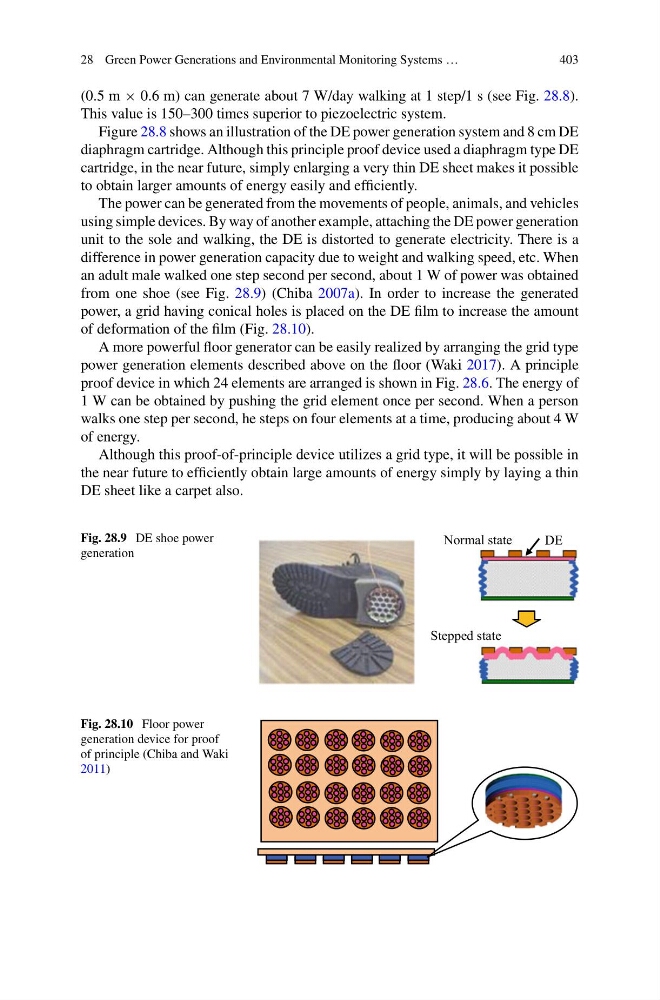
unit to the sole and walking, the DE is distorted to generate electricity. There is a
difference in power generation capacity due to weight and walking speed, etc. When
an adult male walked one step second per second, about 1 W of power was obtained
from one shoe (see Fig. 28.9) (Chiba 2007a). In order to increase the generated
power, a grid having conical holes is placed on the DE film to increase the amount
of deformation of the film (Fig. 28.10).
A more powerful floor generator can be easily realized by arranging the grid type
power generation elements described above on the floor (Waki 2017). A principle
proof device in which 24 elements are arranged is shown in Fig. 28.6. The energy of
1 W can be obtained by pushing the grid element once per second. When a person
walks one step per second, he steps on four elements at a time, producing about 4 W
of energy.
Although this proof-of-principle device utilizes a grid type, it will be possible in
the near future to efficiently obtain large amounts of energy simply by laying a thin
DE sheet like a carpet also.
Fig. 28.9 DE shoe power
generation
DE
Normal state
Stepped state
Fig. 28.10 Floor power
generation device for proof
of principle (Chiba and Waki
2011)
403
(0.5 m × 0.6 m) can generate about 7 W/day walking at 1 step/1 s (see Fig. 28.8).
This value is 150–300 times superior to piezoelectric system.
Figure 28.8 shows an illustration of the DE power generation system and 8 cm DE
diaphragm cartridge. Although this principle proof device used a diaphragm type DE
cartridge, in the near future, simply enlarging a very thin DE sheet makes it possible
to obtain larger amounts of energy easily and efficiently.
The power can be generated from the movements of people, animals, and vehicles
using simple devices. By way of another example, attaching the DE power generation
unit to the sole and walking, the DE is distorted to generate electricity. There is a
difference in power generation capacity due to weight and walking speed, etc. When
an adult male walked one step second per second, about 1 W of power was obtained
from one shoe (see Fig. 28.9) (Chiba 2007a). In order to increase the generated
power, a grid having conical holes is placed on the DE film to increase the amount
of deformation of the film (Fig. 28.10).
A more powerful floor generator can be easily realized by arranging the grid type
power generation elements described above on the floor (Waki 2017). A principle
proof device in which 24 elements are arranged is shown in Fig. 28.6. The energy of
1 W can be obtained by pushing the grid element once per second. When a person
walks one step per second, he steps on four elements at a time, producing about 4 W
of energy.
Although this proof-of-principle device utilizes a grid type, it will be possible in
the near future to efficiently obtain large amounts of energy simply by laying a thin
DE sheet like a carpet also.
Fig. 28.9 DE shoe power
generation
DE
Normal state
Stepped state
Fig. 28.10 Floor power
generation device for proof
of principle (Chiba and Waki
2011)