

350
T. Sugahara et al.
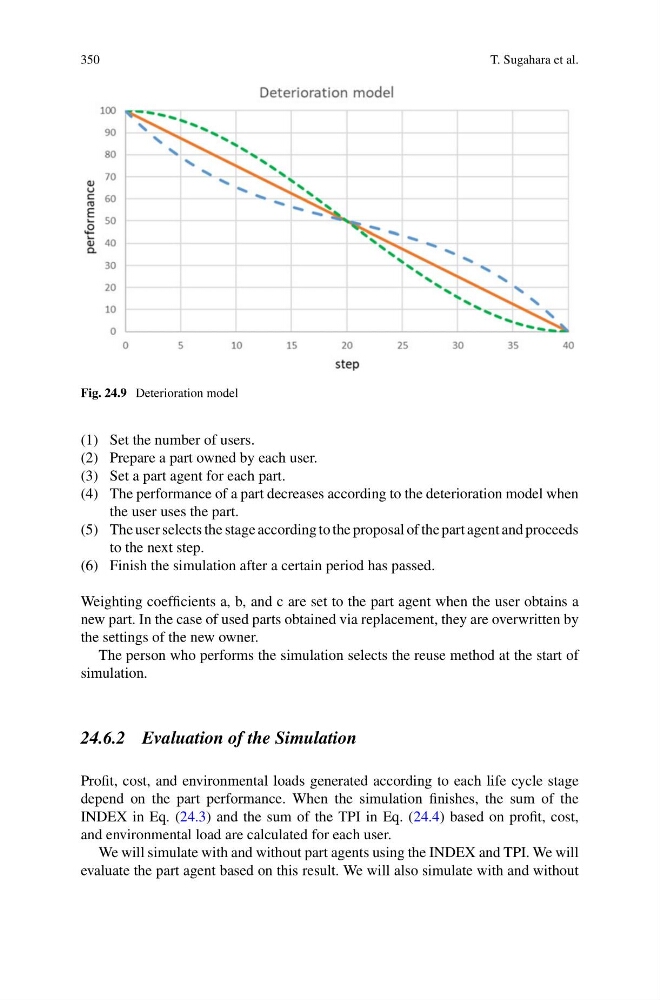
Fig. 24.9 Deterioration model
(1) Set the number of users.
(2) Prepare a part owned by each user.
(3) Set a part agent for each part.
(4) The performance of a part decreases according to the deterioration model when
the user uses the part.
(5) The user selects the stage according to the proposal of the part agent and proceeds
to the next step.
(6) Finish the simulation after a certain period has passed.
Weighting coefficients a, b, and c are set to the part agent when the user obtains a
new part. In the case of used parts obtained via replacement, they are overwritten by
the settings of the new owner.
The person who performs the simulation selects the reuse method at the start of
simulation.
24.6.2 Evaluation of the Simulation
Profit, cost, and environmental loads generated according to each life cycle stage
depend on the part performance. When the simulation finishes, the sum of the
INDEX in Eq. (24.3) and the sum of the TPI in Eq. (24.4) based on profit, cost,
and environmental load are calculated for each user.
We will simulate with and without part agents using the INDEX and TPI. We will
evaluate the part agent based on this result. We will also simulate with and without
T. Sugahara et al.
Fig. 24.9 Deterioration model
(1) Set the number of users.
(2) Prepare a part owned by each user.
(3) Set a part agent for each part.
(4) The performance of a part decreases according to the deterioration model when
the user uses the part.
(5) The user selects the stage according to the proposal of the part agent and proceeds
to the next step.
(6) Finish the simulation after a certain period has passed.
Weighting coefficients a, b, and c are set to the part agent when the user obtains a
new part. In the case of used parts obtained via replacement, they are overwritten by
the settings of the new owner.
The person who performs the simulation selects the reuse method at the start of
simulation.
24.6.2 Evaluation of the Simulation
Profit, cost, and environmental loads generated according to each life cycle stage
depend on the part performance. When the simulation finishes, the sum of the
INDEX in Eq. (24.3) and the sum of the TPI in Eq. (24.4) based on profit, cost,
and environmental load are calculated for each user.
We will simulate with and without part agents using the INDEX and TPI. We will
evaluate the part agent based on this result. We will also simulate with and without