

24 Life Cycle Simulation of Machine Parts with Part Agents
341
network. We chose an RFID tag for identification as RFIDs have a higher resistance
to smudging and discoloration than printed bar codes and will last for the entire life
of the part.
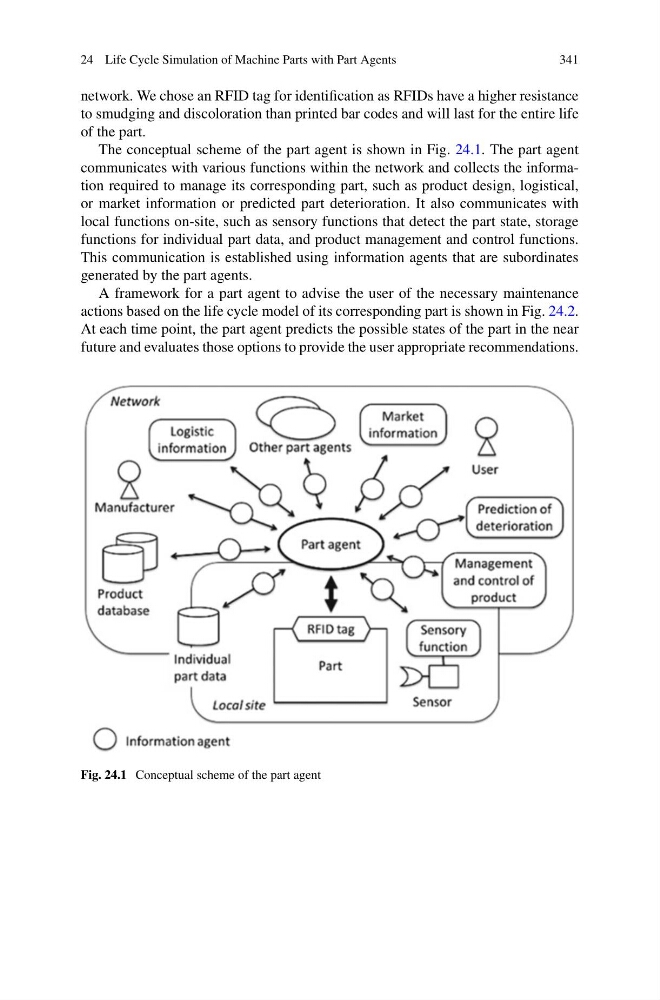
The conceptual scheme of the part agent is shown in Fig. 24.1. The part agent
communicates with various functions within the network and collects the information required to manage its corresponding part, such as product design, logistical,
or market information or predicted part deterioration. It also communicates with
local functions on-site, such as sensory functions that detect the part state, storage
functions for individual part data, and product management and control functions.
This communication is established using information agents that are subordinates
generated by the part agents.
A framework for a part agent to advise the user of the necessary maintenance
actions based on the life cycle model of its corresponding part is shown in Fig. 24.2.
At each time point, the part agent predicts the possible states of the part in the near
future and evaluates those options to provide the user appropriate recommendations.
Fig. 24.1 Conceptual scheme of the part agent
341
network. We chose an RFID tag for identification as RFIDs have a higher resistance
to smudging and discoloration than printed bar codes and will last for the entire life
of the part.
The conceptual scheme of the part agent is shown in Fig. 24.1. The part agent
communicates with various functions within the network and collects the information required to manage its corresponding part, such as product design, logistical,
or market information or predicted part deterioration. It also communicates with
local functions on-site, such as sensory functions that detect the part state, storage
functions for individual part data, and product management and control functions.
This communication is established using information agents that are subordinates
generated by the part agents.
A framework for a part agent to advise the user of the necessary maintenance
actions based on the life cycle model of its corresponding part is shown in Fig. 24.2.
At each time point, the part agent predicts the possible states of the part in the near
future and evaluates those options to provide the user appropriate recommendations.
Fig. 24.1 Conceptual scheme of the part agent