

14 Ecodesign and the Circular Economy: Conflicting …
191
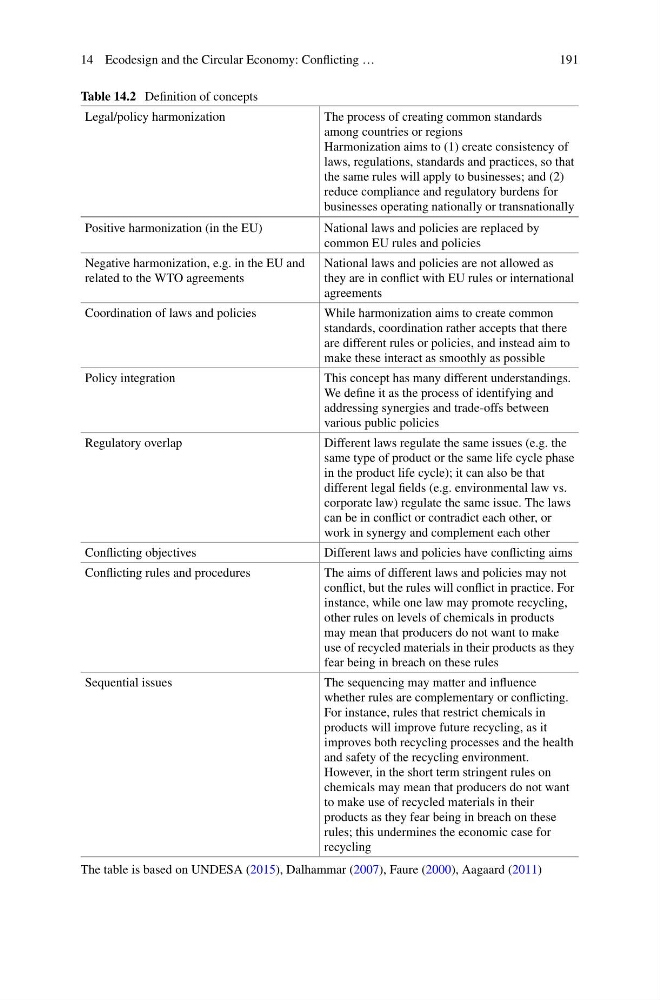
Table 14.2 Definition of concepts
Legal/policy harmonization
The process of creating common standards
among countries or regions
Harmonization aims to (1) create consistency of
laws, regulations, standards and practices, so that
the same rules will apply to businesses; and (2)
reduce compliance and regulatory burdens for
businesses operating nationally or transnationally
Positive harmonization (in the EU)
National laws and policies are replaced by
common EU rules and policies
Negative harmonization, e.g. in the EU and
related to the WTO agreements
National laws and policies are not allowed as
they are in conflict with EU rules or international
agreements
Coordination of laws and policies
While harmonization aims to create common
standards, coordination rather accepts that there
are different rules or policies, and instead aim to
make these interact as smoothly as possible
Policy integration
This concept has many different understandings.
We define it as the process of identifying and
addressing synergies and trade-offs between
various public policies
Regulatory overlap
Different laws regulate the same issues (e.g. the
same type of product or the same life cycle phase
in the product life cycle); it can also be that
different legal fields (e.g. environmental law vs.
corporate law) regulate the same issue. The laws
can be in conflict or contradict each other, or
work in synergy and complement each other
Conflicting objectives
Different laws and policies have conflicting aims
Conflicting rules and procedures
The aims of different laws and policies may not
conflict, but the rules will conflict in practice. For
instance, while one law may promote recycling,
other rules on levels of chemicals in products
may mean that producers do not want to make
use of recycled materials in their products as they
fear being in breach on these rules
Sequential issues
The sequencing may matter and influence
whether rules are complementary or conflicting.
For instance, rules that restrict chemicals in
products will improve future recycling, as it
improves both recycling processes and the health
and safety of the recycling environment.
However, in the short term stringent rules on
chemicals may mean that producers do not want
to make use of recycled materials in their
products as they fear being in breach on these
rules; this undermines the economic case for
recycling
The table is based on UNDESA (2015), Dalhammar (2007), Faure (2000), Aagaard (2011)
191
Table 14.2 Definition of concepts
Legal/policy harmonization
The process of creating common standards
among countries or regions
Harmonization aims to (1) create consistency of
laws, regulations, standards and practices, so that
the same rules will apply to businesses; and (2)
reduce compliance and regulatory burdens for
businesses operating nationally or transnationally
Positive harmonization (in the EU)
National laws and policies are replaced by
common EU rules and policies
Negative harmonization, e.g. in the EU and
related to the WTO agreements
National laws and policies are not allowed as
they are in conflict with EU rules or international
agreements
Coordination of laws and policies
While harmonization aims to create common
standards, coordination rather accepts that there
are different rules or policies, and instead aim to
make these interact as smoothly as possible
Policy integration
This concept has many different understandings.
We define it as the process of identifying and
addressing synergies and trade-offs between
various public policies
Regulatory overlap
Different laws regulate the same issues (e.g. the
same type of product or the same life cycle phase
in the product life cycle); it can also be that
different legal fields (e.g. environmental law vs.
corporate law) regulate the same issue. The laws
can be in conflict or contradict each other, or
work in synergy and complement each other
Conflicting objectives
Different laws and policies have conflicting aims
Conflicting rules and procedures
The aims of different laws and policies may not
conflict, but the rules will conflict in practice. For
instance, while one law may promote recycling,
other rules on levels of chemicals in products
may mean that producers do not want to make
use of recycled materials in their products as they
fear being in breach on these rules
Sequential issues
The sequencing may matter and influence
whether rules are complementary or conflicting.
For instance, rules that restrict chemicals in
products will improve future recycling, as it
improves both recycling processes and the health
and safety of the recycling environment.
However, in the short term stringent rules on
chemicals may mean that producers do not want
to make use of recycled materials in their
products as they fear being in breach on these
rules; this undermines the economic case for
recycling
The table is based on UNDESA (2015), Dalhammar (2007), Faure (2000), Aagaard (2011)