

182
J. Wang and N. Mishima
β P − c 1 + (2v − 3)
(3 − 2v)(P − c 1 − c 2 ) + β P − c 1
2(3 − 2v)
< 0,
v <
3(P − c 1 − c 2 ) − β P + c 1
2(P − c 1 − c 2 )
When
3(P−c 1 −c 2 )−β P+c 1
2(P−c 1 −c 2 )
≤ 1, then 0 < v <
3(P−c 1 −c 2 )−β P+c 1
2(P−c 1 −c 2 )
will be the range of
v to satisfy the condition of this case.
(2) When λ = 0,
P f =
β P−c 1
3−2v
, at this point, the informal collector will never send any collected WEEE
to the formal recycler. We do not go to the details considering the goal of this study.
In the following study, we will focus on the condition of (1), where 0 < v <
3(P−c 1 −c 2 )−β P+c 1
2(P−c 1 −c 2 )
, under which the following quantity can be derived:
q f =
(3 − 2v)(P − c 1 − c 2 ) − β P + c 1
4(1 − v)
q i =
(5 − 4v)(β P − c 1 ) − (3 − 2v)(P − c 1 − c 2 )
4(3 − 2v)(1 − v)
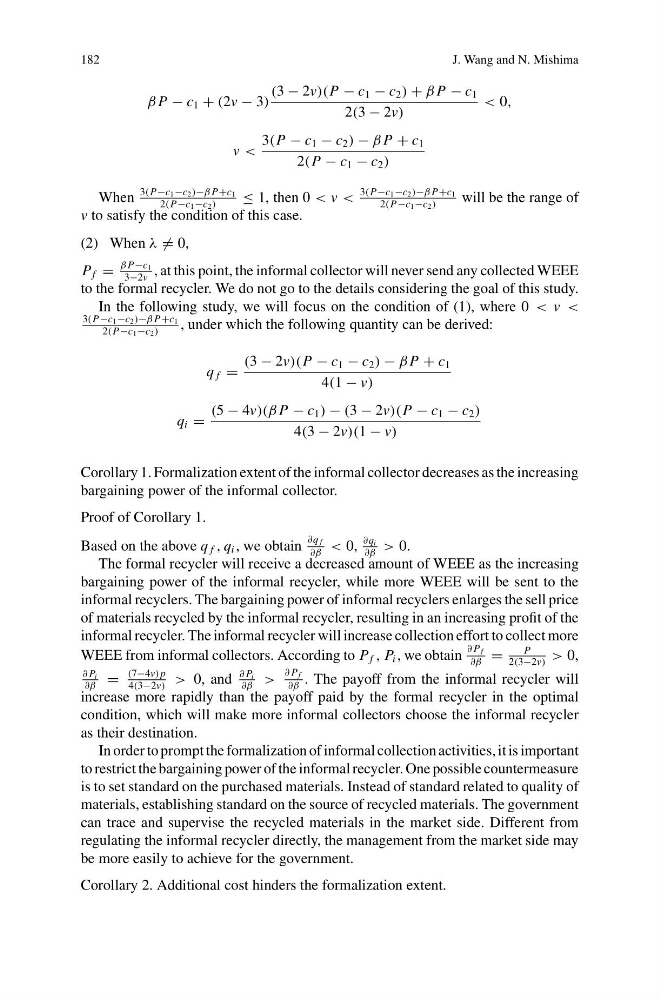
Corollary 1. Formalization extent of the informal collector decreases as the increasing
bargaining power of the informal collector.
Proof of Corollary 1.
Based on the above q f , q i , we obtain
∂q f
∂β
< 0,
∂q i
∂β
> 0.
The formal recycler will receive a decreased amount of WEEE as the increasing
bargaining power of the informal recycler, while more WEEE will be sent to the
informal recyclers. The bargaining power of informal recyclers enlarges the sell price
of materials recycled by the informal recycler, resulting in an increasing profit of the
informal recycler. The informal recycler will increase collection effort to collect more
WEEE from informal collectors. According to P f , P i , we obtain
∂ P f
∂β
=
P
2(3−2v)
> 0,
∂ P i
∂β
=
(7−4v) p
4(3−2v)
> 0, and
∂ P i
∂β
>
∂ P f
∂β
. The payoff from the informal recycler will
increase more rapidly than the payoff paid by the formal recycler in the optimal
condition, which will make more informal collectors choose the informal recycler
as their destination.
In order to prompt the formalization of informal collection activities, it is important
to restrict the bargaining power of the informal recycler. One possible countermeasure
is to set standard on the purchased materials. Instead of standard related to quality of
materials, establishing standard on the source of recycled materials. The government
can trace and supervise the recycled materials in the market side. Different from
regulating the informal recycler directly, the management from the market side may
be more easily to achieve for the government.
Corollary 2. Additional cost hinders the formalization extent.
J. Wang and N. Mishima
β P − c 1 + (2v − 3)
(3 − 2v)(P − c 1 − c 2 ) + β P − c 1
2(3 − 2v)
< 0,
v <
3(P − c 1 − c 2 ) − β P + c 1
2(P − c 1 − c 2 )
When
3(P−c 1 −c 2 )−β P+c 1
2(P−c 1 −c 2 )
≤ 1, then 0 < v <
3(P−c 1 −c 2 )−β P+c 1
2(P−c 1 −c 2 )
will be the range of
v to satisfy the condition of this case.
(2) When λ = 0,
P f =
β P−c 1
3−2v
, at this point, the informal collector will never send any collected WEEE
to the formal recycler. We do not go to the details considering the goal of this study.
In the following study, we will focus on the condition of (1), where 0 < v <
3(P−c 1 −c 2 )−β P+c 1
2(P−c 1 −c 2 )
, under which the following quantity can be derived:
q f =
(3 − 2v)(P − c 1 − c 2 ) − β P + c 1
4(1 − v)
q i =
(5 − 4v)(β P − c 1 ) − (3 − 2v)(P − c 1 − c 2 )
4(3 − 2v)(1 − v)
Corollary 1. Formalization extent of the informal collector decreases as the increasing
bargaining power of the informal collector.
Proof of Corollary 1.
Based on the above q f , q i , we obtain
∂q f
∂β
< 0,
∂q i
∂β
> 0.
The formal recycler will receive a decreased amount of WEEE as the increasing
bargaining power of the informal recycler, while more WEEE will be sent to the
informal recyclers. The bargaining power of informal recyclers enlarges the sell price
of materials recycled by the informal recycler, resulting in an increasing profit of the
informal recycler. The informal recycler will increase collection effort to collect more
WEEE from informal collectors. According to P f , P i , we obtain
∂ P f
∂β
=
P
2(3−2v)
> 0,
∂ P i
∂β
=
(7−4v) p
4(3−2v)
> 0, and
∂ P i
∂β
>
∂ P f
∂β
. The payoff from the informal recycler will
increase more rapidly than the payoff paid by the formal recycler in the optimal
condition, which will make more informal collectors choose the informal recycler
as their destination.
In order to prompt the formalization of informal collection activities, it is important
to restrict the bargaining power of the informal recycler. One possible countermeasure
is to set standard on the purchased materials. Instead of standard related to quality of
materials, establishing standard on the source of recycled materials. The government
can trace and supervise the recycled materials in the market side. Different from
regulating the informal recycler directly, the management from the market side may
be more easily to achieve for the government.
Corollary 2. Additional cost hinders the formalization extent.