

7 Material-service Systems for Sustainable Resource Management
99
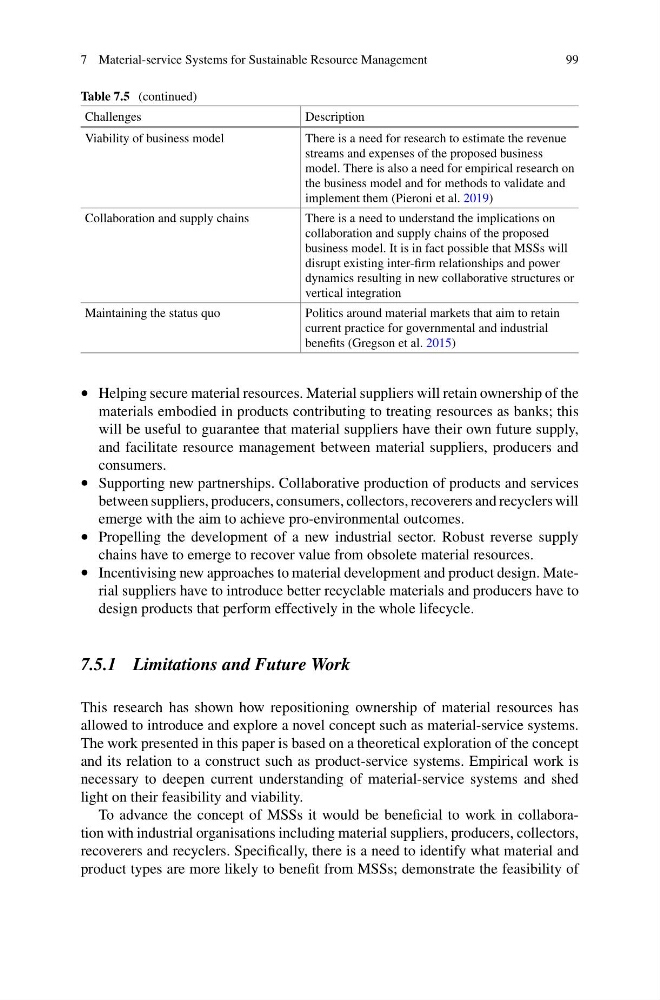
Table 7.5 (continued)
Challenges
Description
Viability of business model
There is a need for research to estimate the revenue
streams and expenses of the proposed business
model. There is also a need for empirical research on
the business model and for methods to validate and
implement them (Pieroni et al. 2019)
Collaboration and supply chains
There is a need to understand the implications on
collaboration and supply chains of the proposed
business model. It is in fact possible that MSSs will
disrupt existing inter-firm relationships and power
dynamics resulting in new collaborative structures or
vertical integration
Maintaining the status quo
Politics around material markets that aim to retain
current practice for governmental and industrial
benefits (Gregson et al. 2015)
• Helping secure material resources. Material suppliers will retain ownership of the
materials embodied in products contributing to treating resources as banks; this
will be useful to guarantee that material suppliers have their own future supply,
and facilitate resource management between material suppliers, producers and
consumers.
• Supporting new partnerships. Collaborative production of products and services
between suppliers, producers, consumers, collectors, recoverers and recyclers will
emerge with the aim to achieve pro-environmental outcomes.
• Propelling the development of a new industrial sector. Robust reverse supply
chains have to emerge to recover value from obsolete material resources.
• Incentivising new approaches to material development and product design. Material suppliers have to introduce better recyclable materials and producers have to
design products that perform effectively in the whole lifecycle.
7.5.1 Limitations and Future Work
This research has shown how repositioning ownership of material resources has
allowed to introduce and explore a novel concept such as material-service systems.
The work presented in this paper is based on a theoretical exploration of the concept
and its relation to a construct such as product-service systems. Empirical work is
necessary to deepen current understanding of material-service systems and shed
light on their feasibility and viability.
To advance the concept of MSSs it would be beneficial to work in collaboration with industrial organisations including material suppliers, producers, collectors,
recoverers and recyclers. Specifically, there is a need to identify what material and
product types are more likely to benefit from MSSs; demonstrate the feasibility of
99
Table 7.5 (continued)
Challenges
Description
Viability of business model
There is a need for research to estimate the revenue
streams and expenses of the proposed business
model. There is also a need for empirical research on
the business model and for methods to validate and
implement them (Pieroni et al. 2019)
Collaboration and supply chains
There is a need to understand the implications on
collaboration and supply chains of the proposed
business model. It is in fact possible that MSSs will
disrupt existing inter-firm relationships and power
dynamics resulting in new collaborative structures or
vertical integration
Maintaining the status quo
Politics around material markets that aim to retain
current practice for governmental and industrial
benefits (Gregson et al. 2015)
• Helping secure material resources. Material suppliers will retain ownership of the
materials embodied in products contributing to treating resources as banks; this
will be useful to guarantee that material suppliers have their own future supply,
and facilitate resource management between material suppliers, producers and
consumers.
• Supporting new partnerships. Collaborative production of products and services
between suppliers, producers, consumers, collectors, recoverers and recyclers will
emerge with the aim to achieve pro-environmental outcomes.
• Propelling the development of a new industrial sector. Robust reverse supply
chains have to emerge to recover value from obsolete material resources.
• Incentivising new approaches to material development and product design. Material suppliers have to introduce better recyclable materials and producers have to
design products that perform effectively in the whole lifecycle.
7.5.1 Limitations and Future Work
This research has shown how repositioning ownership of material resources has
allowed to introduce and explore a novel concept such as material-service systems.
The work presented in this paper is based on a theoretical exploration of the concept
and its relation to a construct such as product-service systems. Empirical work is
necessary to deepen current understanding of material-service systems and shed
light on their feasibility and viability.
To advance the concept of MSSs it would be beneficial to work in collaboration with industrial organisations including material suppliers, producers, collectors,
recoverers and recyclers. Specifically, there is a need to identify what material and
product types are more likely to benefit from MSSs; demonstrate the feasibility of