

98
M. Aurisicchio et al.
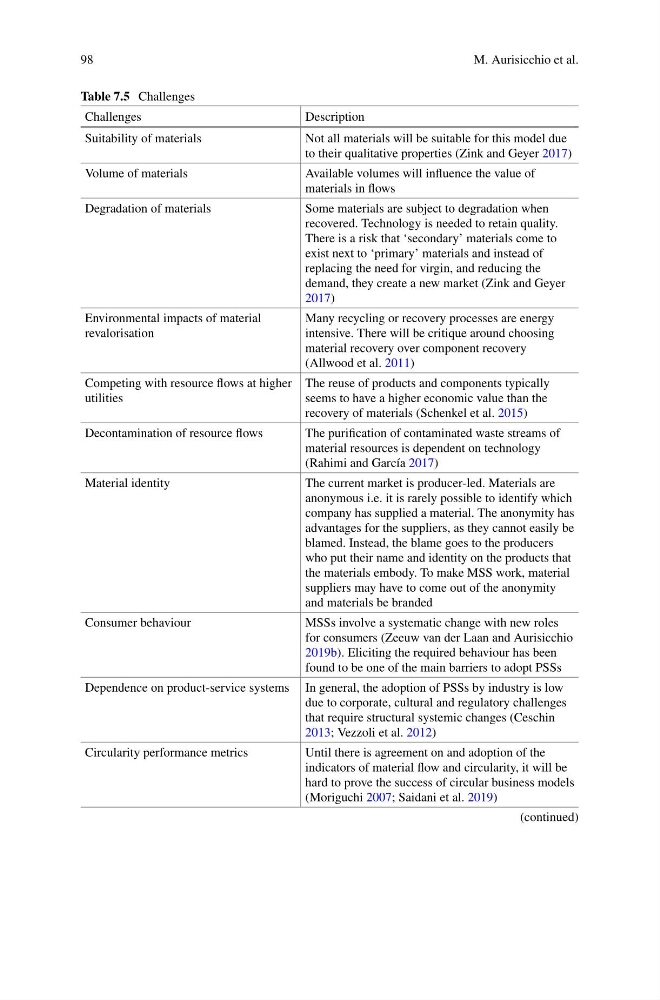
Table 7.5 Challenges
Challenges
Description
Suitability of materials
Not all materials will be suitable for this model due
to their qualitative properties (Zink and Geyer 2017)
Volume of materials
Available volumes will influence the value of
materials in flows
Degradation of materials
Some materials are subject to degradation when
recovered. Technology is needed to retain quality.
There is a risk that ‘secondary’ materials come to
exist next to ‘primary’ materials and instead of
replacing the need for virgin, and reducing the
demand, they create a new market (Zink and Geyer
2017)
Environmental impacts of material
revalorisation
Many recycling or recovery processes are energy
intensive. There will be critique around choosing
material recovery over component recovery
(Allwood et al. 2011)
Competing with resource flows at higher
utilities
The reuse of products and components typically
seems to have a higher economic value than the
recovery of materials (Schenkel et al. 2015)
Decontamination of resource flows
The purification of contaminated waste streams of
material resources is dependent on technology
(Rahimi and García 2017)
Material identity
The current market is producer-led. Materials are
anonymous i.e. it is rarely possible to identify which
company has supplied a material. The anonymity has
advantages for the suppliers, as they cannot easily be
blamed. Instead, the blame goes to the producers
who put their name and identity on the products that
the materials embody. To make MSS work, material
suppliers may have to come out of the anonymity
and materials be branded
Consumer behaviour
MSSs involve a systematic change with new roles
for consumers (Zeeuw van der Laan and Aurisicchio
2019b). Eliciting the required behaviour has been
found to be one of the main barriers to adopt PSSs
Dependence on product-service systems In general, the adoption of PSSs by industry is low
due to corporate, cultural and regulatory challenges
that require structural systemic changes (Ceschin
2013; Vezzoli et al. 2012)
Circularity performance metrics
Until there is agreement on and adoption of the
indicators of material flow and circularity, it will be
hard to prove the success of circular business models
(Moriguchi 2007; Saidani et al. 2019)
(continued)
M. Aurisicchio et al.
Table 7.5 Challenges
Challenges
Description
Suitability of materials
Not all materials will be suitable for this model due
to their qualitative properties (Zink and Geyer 2017)
Volume of materials
Available volumes will influence the value of
materials in flows
Degradation of materials
Some materials are subject to degradation when
recovered. Technology is needed to retain quality.
There is a risk that ‘secondary’ materials come to
exist next to ‘primary’ materials and instead of
replacing the need for virgin, and reducing the
demand, they create a new market (Zink and Geyer
2017)
Environmental impacts of material
revalorisation
Many recycling or recovery processes are energy
intensive. There will be critique around choosing
material recovery over component recovery
(Allwood et al. 2011)
Competing with resource flows at higher
utilities
The reuse of products and components typically
seems to have a higher economic value than the
recovery of materials (Schenkel et al. 2015)
Decontamination of resource flows
The purification of contaminated waste streams of
material resources is dependent on technology
(Rahimi and García 2017)
Material identity
The current market is producer-led. Materials are
anonymous i.e. it is rarely possible to identify which
company has supplied a material. The anonymity has
advantages for the suppliers, as they cannot easily be
blamed. Instead, the blame goes to the producers
who put their name and identity on the products that
the materials embody. To make MSS work, material
suppliers may have to come out of the anonymity
and materials be branded
Consumer behaviour
MSSs involve a systematic change with new roles
for consumers (Zeeuw van der Laan and Aurisicchio
2019b). Eliciting the required behaviour has been
found to be one of the main barriers to adopt PSSs
Dependence on product-service systems In general, the adoption of PSSs by industry is low
due to corporate, cultural and regulatory challenges
that require structural systemic changes (Ceschin
2013; Vezzoli et al. 2012)
Circularity performance metrics
Until there is agreement on and adoption of the
indicators of material flow and circularity, it will be
hard to prove the success of circular business models
(Moriguchi 2007; Saidani et al. 2019)
(continued)