

96
M. Aurisicchio et al.
Table 7.3 Expected benefits for producers
Benefits and incentives
Description
Ability to benefit from material services offered
by the supplier
Repairing, maintaining, replacing or
upgrading materials as part of contracted
services, and avoiding material disposal taxes
Incentive to set more ambitious sustainability
targets
Motivation, encouragement and opportunity to
set and achieve realistic sustainability targets
(Ellen MacArthur Foundation 2019)
Incentive to design circular products that can
be easily disassembled and in which materials
remain identifiable
Motivation and encouragement to design for
disassembly to suit the demand of suppliers
(Mestre and Cooper 2017)
Incentive to optimise the time spent with
resources
Motivation and encouragement for lean
consumption (Womack and Jones 2005) e.g.
timely delivery and collection of obsolete
resources from consumers, operating lean
disassembly processes and returning obsolete
resources to materials suppliers
Ability to lower social pressure
Mitigating the transfer of social pressure from
producers to material suppliers
7.4.5 Expected Benefits for Producers
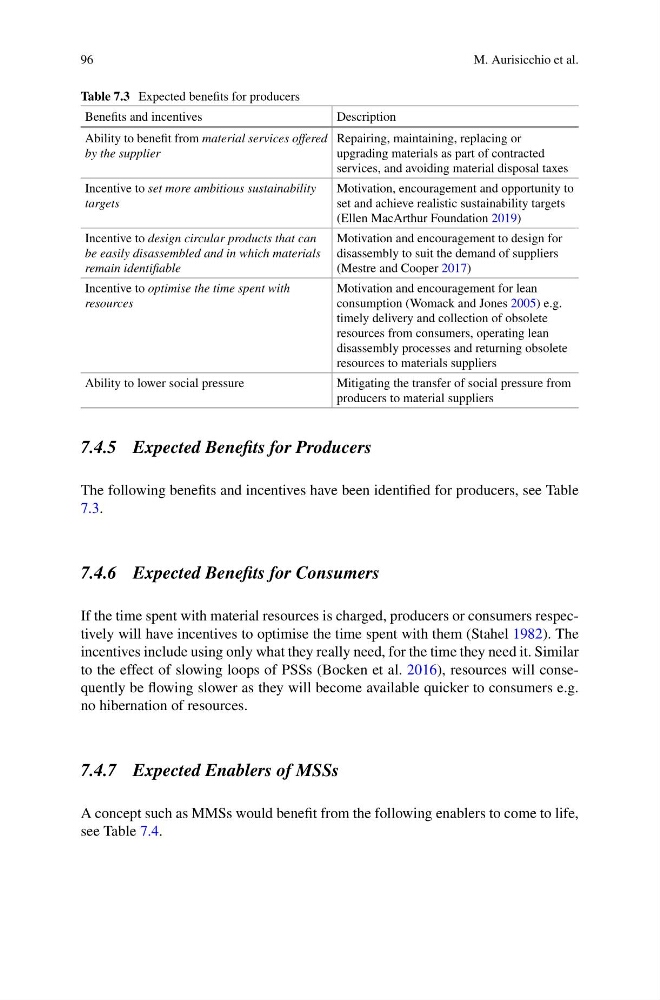
The following benefits and incentives have been identified for producers, see Table
7.3.
7.4.6 Expected Benefits for Consumers
If the time spent with material resources is charged, producers or consumers respectively will have incentives to optimise the time spent with them (Stahel 1982). The
incentives include using only what they really need, for the time they need it. Similar
to the effect of slowing loops of PSSs (Bocken et al. 2016), resources will consequently be flowing slower as they will become available quicker to consumers e.g.
no hibernation of resources.
7.4.7 Expected Enablers of MSSs
A concept such as MMSs would benefit from the following enablers to come to life,
see Table 7.4.
M. Aurisicchio et al.
Table 7.3 Expected benefits for producers
Benefits and incentives
Description
Ability to benefit from material services offered
by the supplier
Repairing, maintaining, replacing or
upgrading materials as part of contracted
services, and avoiding material disposal taxes
Incentive to set more ambitious sustainability
targets
Motivation, encouragement and opportunity to
set and achieve realistic sustainability targets
(Ellen MacArthur Foundation 2019)
Incentive to design circular products that can
be easily disassembled and in which materials
remain identifiable
Motivation and encouragement to design for
disassembly to suit the demand of suppliers
(Mestre and Cooper 2017)
Incentive to optimise the time spent with
resources
Motivation and encouragement for lean
consumption (Womack and Jones 2005) e.g.
timely delivery and collection of obsolete
resources from consumers, operating lean
disassembly processes and returning obsolete
resources to materials suppliers
Ability to lower social pressure
Mitigating the transfer of social pressure from
producers to material suppliers
7.4.5 Expected Benefits for Producers
The following benefits and incentives have been identified for producers, see Table
7.3.
7.4.6 Expected Benefits for Consumers
If the time spent with material resources is charged, producers or consumers respectively will have incentives to optimise the time spent with them (Stahel 1982). The
incentives include using only what they really need, for the time they need it. Similar
to the effect of slowing loops of PSSs (Bocken et al. 2016), resources will consequently be flowing slower as they will become available quicker to consumers e.g.
no hibernation of resources.
7.4.7 Expected Enablers of MSSs
A concept such as MMSs would benefit from the following enablers to come to life,
see Table 7.4.