

7 Material-service Systems for Sustainable Resource Management
95
7.4.4 Expected Benefits for Material Suppliers
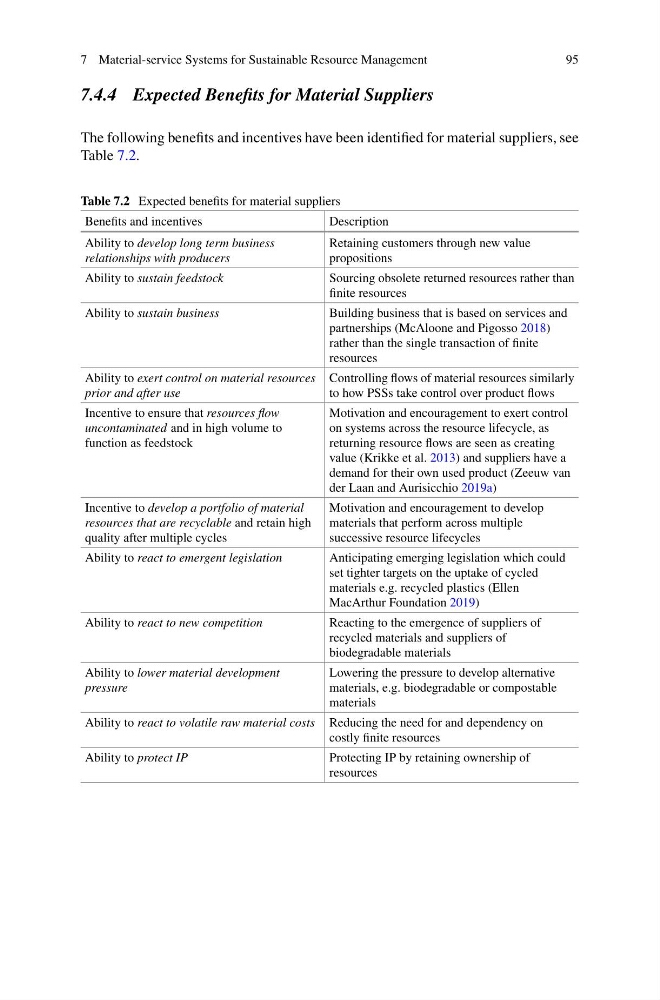
The following benefits and incentives have been identified for material suppliers, see
Table 7.2.
Table 7.2 Expected benefits for material suppliers
Benefits and incentives
Description
Ability to develop long term business
relationships with producers
Retaining customers through new value
propositions
Ability to sustain feedstock
Sourcing obsolete returned resources rather than
finite resources
Ability to sustain business
Building business that is based on services and
partnerships (McAloone and Pigosso 2018)
rather than the single transaction of finite
resources
Ability to exert control on material resources
prior and after use
Controlling flows of material resources similarly
to how PSSs take control over product flows
Incentive to ensure that resources flow
uncontaminated and in high volume to
function as feedstock
Motivation and encouragement to exert control
on systems across the resource lifecycle, as
returning resource flows are seen as creating
value (Krikke et al. 2013) and suppliers have a
demand for their own used product (Zeeuw van
der Laan and Aurisicchio 2019a)
Incentive to develop a portfolio of material
resources that are recyclable and retain high
quality after multiple cycles
Motivation and encouragement to develop
materials that perform across multiple
successive resource lifecycles
Ability to react to emergent legislation
Anticipating emerging legislation which could
set tighter targets on the uptake of cycled
materials e.g. recycled plastics (Ellen
MacArthur Foundation 2019)
Ability to react to new competition
Reacting to the emergence of suppliers of
recycled materials and suppliers of
biodegradable materials
Ability to lower material development
pressure
Lowering the pressure to develop alternative
materials, e.g. biodegradable or compostable
materials
Ability to react to volatile raw material costs Reducing the need for and dependency on
costly finite resources
Ability to protect IP
Protecting IP by retaining ownership of
resources
95
7.4.4 Expected Benefits for Material Suppliers
The following benefits and incentives have been identified for material suppliers, see
Table 7.2.
Table 7.2 Expected benefits for material suppliers
Benefits and incentives
Description
Ability to develop long term business
relationships with producers
Retaining customers through new value
propositions
Ability to sustain feedstock
Sourcing obsolete returned resources rather than
finite resources
Ability to sustain business
Building business that is based on services and
partnerships (McAloone and Pigosso 2018)
rather than the single transaction of finite
resources
Ability to exert control on material resources
prior and after use
Controlling flows of material resources similarly
to how PSSs take control over product flows
Incentive to ensure that resources flow
uncontaminated and in high volume to
function as feedstock
Motivation and encouragement to exert control
on systems across the resource lifecycle, as
returning resource flows are seen as creating
value (Krikke et al. 2013) and suppliers have a
demand for their own used product (Zeeuw van
der Laan and Aurisicchio 2019a)
Incentive to develop a portfolio of material
resources that are recyclable and retain high
quality after multiple cycles
Motivation and encouragement to develop
materials that perform across multiple
successive resource lifecycles
Ability to react to emergent legislation
Anticipating emerging legislation which could
set tighter targets on the uptake of cycled
materials e.g. recycled plastics (Ellen
MacArthur Foundation 2019)
Ability to react to new competition
Reacting to the emergence of suppliers of
recycled materials and suppliers of
biodegradable materials
Ability to lower material development
pressure
Lowering the pressure to develop alternative
materials, e.g. biodegradable or compostable
materials
Ability to react to volatile raw material costs Reducing the need for and dependency on
costly finite resources
Ability to protect IP
Protecting IP by retaining ownership of
resources