

227
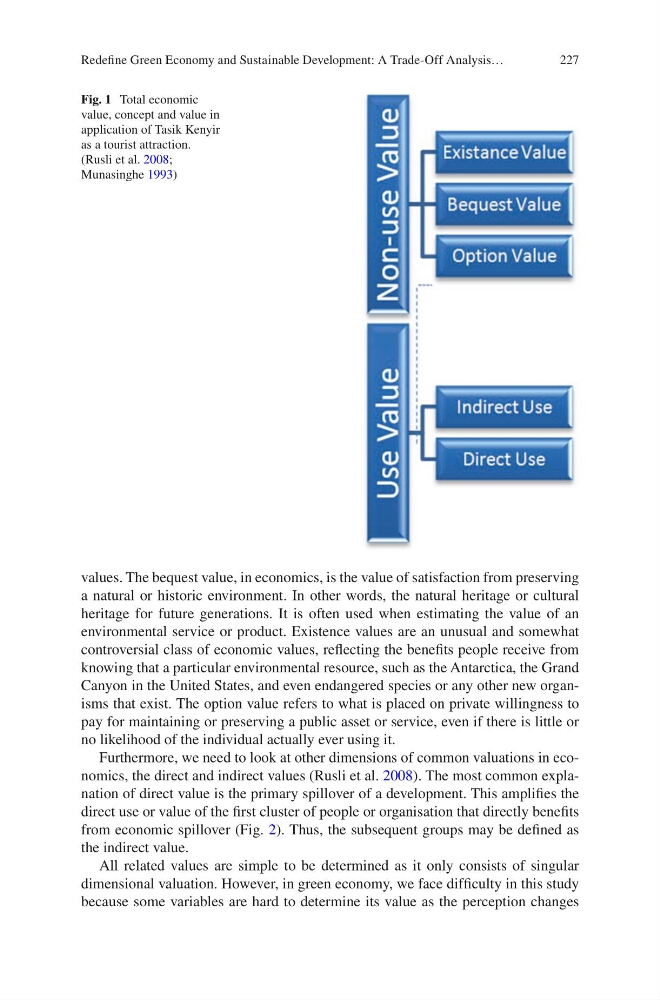
values. The bequest value, in economics, is the value of satisfaction from preserving
a natural or historic environment. In other words, the natural heritage or cultural
heritage for future generations. It is often used when estimating the value of an
environmental service or product. Existence values are an unusual and somewhat
controversial class of economic values, reflecting the benefits people receive from
knowing that a particular environmental resource, such as the Antarctica, the Grand
Canyon in the United States, and even endangered species or any other new organisms that exist. The option value refers to what is placed on private willingness to
pay for maintaining or preserving a public asset or service, even if there is little or
no likelihood of the individual actually ever using it.
Furthermore, we need to look at other dimensions of common valuations in economics, the direct and indirect values (Rusli et al. 2008). The most common explanation of direct value is the primary spillover of a development. This amplifies the
direct use or value of the first cluster of people or organisation that directly benefits
from economic spillover (Fig. 2). Thus, the subsequent groups may be defined as
the indirect value.
All related values are simple to be determined as it only consists of singular
dimensional valuation. However, in green economy, we face difficulty in this study
because some variables are hard to determine its value as the perception changes
Fig. 1 Total economic
value, concept and value in
application of Tasik Kenyir
as a tourist attraction.
(Rusli et al. 2008;
Munasinghe 1993)
Redefine Green Economy and Sustainable Development: A Trade-Off Analysis…
values. The bequest value, in economics, is the value of satisfaction from preserving
a natural or historic environment. In other words, the natural heritage or cultural
heritage for future generations. It is often used when estimating the value of an
environmental service or product. Existence values are an unusual and somewhat
controversial class of economic values, reflecting the benefits people receive from
knowing that a particular environmental resource, such as the Antarctica, the Grand
Canyon in the United States, and even endangered species or any other new organisms that exist. The option value refers to what is placed on private willingness to
pay for maintaining or preserving a public asset or service, even if there is little or
no likelihood of the individual actually ever using it.
Furthermore, we need to look at other dimensions of common valuations in economics, the direct and indirect values (Rusli et al. 2008). The most common explanation of direct value is the primary spillover of a development. This amplifies the
direct use or value of the first cluster of people or organisation that directly benefits
from economic spillover (Fig. 2). Thus, the subsequent groups may be defined as
the indirect value.
All related values are simple to be determined as it only consists of singular
dimensional valuation. However, in green economy, we face difficulty in this study
because some variables are hard to determine its value as the perception changes
Fig. 1 Total economic
value, concept and value in
application of Tasik Kenyir
as a tourist attraction.
(Rusli et al. 2008;
Munasinghe 1993)
Redefine Green Economy and Sustainable Development: A Trade-Off Analysis…