

208
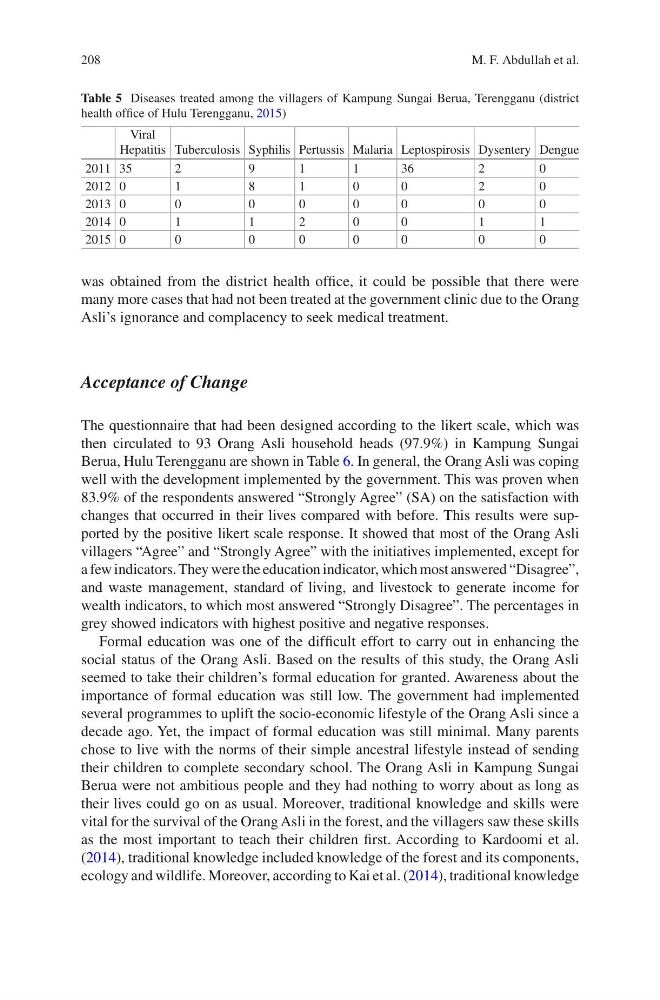
was obtained from the district health office, it could be possible that there were
many more cases that had not been treated at the government clinic due to the Orang
Asli’s ignorance and complacency to seek medical treatment.
Acceptance of Change
The questionnaire that had been designed according to the likert scale, which was
then circulated to 93 Orang Asli household heads (97.9%) in Kampung Sungai
Berua, Hulu Terengganu are shown in Table 6. In general, the Orang Asli was coping
well with the development implemented by the government. This was proven when
83.9% of the respondents answered “Strongly Agree” (SA) on the satisfaction with
changes that occurred in their lives compared with before. This results were supported by the positive likert scale response. It showed that most of the Orang Asli
villagers “Agree” and “Strongly Agree” with the initiatives implemented, except for
a few indicators. They were the education indicator, which most answered “Disagree”,
and waste management, standard of living, and livestock to generate income for
wealth indicators, to which most answered “Strongly Disagree”. The percentages in
grey showed indicators with highest positive and negative responses.
Formal education was one of the difficult effort to carry out in enhancing the
social status of the Orang Asli. Based on the results of this study, the Orang Asli
seemed to take their children’s formal education for granted. Awareness about the
importance of formal education was still low. The government had implemented
several programmes to uplift the socio-economic lifestyle of the Orang Asli since a
decade ago. Yet, the impact of formal education was still minimal. Many parents
chose to live with the norms of their simple ancestral lifestyle instead of sending
their children to complete secondary school. The Orang Asli in Kampung Sungai
Berua were not ambitious people and they had nothing to worry about as long as
their lives could go on as usual. Moreover, traditional knowledge and skills were
vital for the survival of the Orang Asli in the forest, and the villagers saw these skills
as the most important to teach their children first. According to Kardoomi et al.
(2014), traditional knowledge included knowledge of the forest and its components,
ecology and wildlife. Moreover, according to Kai et al. (2014), traditional knowledge
Table 5 Diseases treated among the villagers of Kampung Sungai Berua, Terengganu (district
health office of Hulu Terengganu, 2015)
Viral
Hepatitis Tuberculosis Syphilis Pertussis Malaria Leptospirosis Dysentery Dengue
2011 35
2
9
1
1
36
2
0
2012 0
1
8
1
0
0
2
0
2013 0
0
0
0
0
0
0
0
2014 0
1
1
2
0
0
1
1
2015 0
0
0
0
0
0
0
0
M. F. Abdullah et al.
was obtained from the district health office, it could be possible that there were
many more cases that had not been treated at the government clinic due to the Orang
Asli’s ignorance and complacency to seek medical treatment.
Acceptance of Change
The questionnaire that had been designed according to the likert scale, which was
then circulated to 93 Orang Asli household heads (97.9%) in Kampung Sungai
Berua, Hulu Terengganu are shown in Table 6. In general, the Orang Asli was coping
well with the development implemented by the government. This was proven when
83.9% of the respondents answered “Strongly Agree” (SA) on the satisfaction with
changes that occurred in their lives compared with before. This results were supported by the positive likert scale response. It showed that most of the Orang Asli
villagers “Agree” and “Strongly Agree” with the initiatives implemented, except for
a few indicators. They were the education indicator, which most answered “Disagree”,
and waste management, standard of living, and livestock to generate income for
wealth indicators, to which most answered “Strongly Disagree”. The percentages in
grey showed indicators with highest positive and negative responses.
Formal education was one of the difficult effort to carry out in enhancing the
social status of the Orang Asli. Based on the results of this study, the Orang Asli
seemed to take their children’s formal education for granted. Awareness about the
importance of formal education was still low. The government had implemented
several programmes to uplift the socio-economic lifestyle of the Orang Asli since a
decade ago. Yet, the impact of formal education was still minimal. Many parents
chose to live with the norms of their simple ancestral lifestyle instead of sending
their children to complete secondary school. The Orang Asli in Kampung Sungai
Berua were not ambitious people and they had nothing to worry about as long as
their lives could go on as usual. Moreover, traditional knowledge and skills were
vital for the survival of the Orang Asli in the forest, and the villagers saw these skills
as the most important to teach their children first. According to Kardoomi et al.
(2014), traditional knowledge included knowledge of the forest and its components,
ecology and wildlife. Moreover, according to Kai et al. (2014), traditional knowledge
Table 5 Diseases treated among the villagers of Kampung Sungai Berua, Terengganu (district
health office of Hulu Terengganu, 2015)
Viral
Hepatitis Tuberculosis Syphilis Pertussis Malaria Leptospirosis Dysentery Dengue
2011 35
2
9
1
1
36
2
0
2012 0
1
8
1
0
0
2
0
2013 0
0
0
0
0
0
0
0
2014 0
1
1
2
0
0
1
1
2015 0
0
0
0
0
0
0
0
M. F. Abdullah et al.