

206
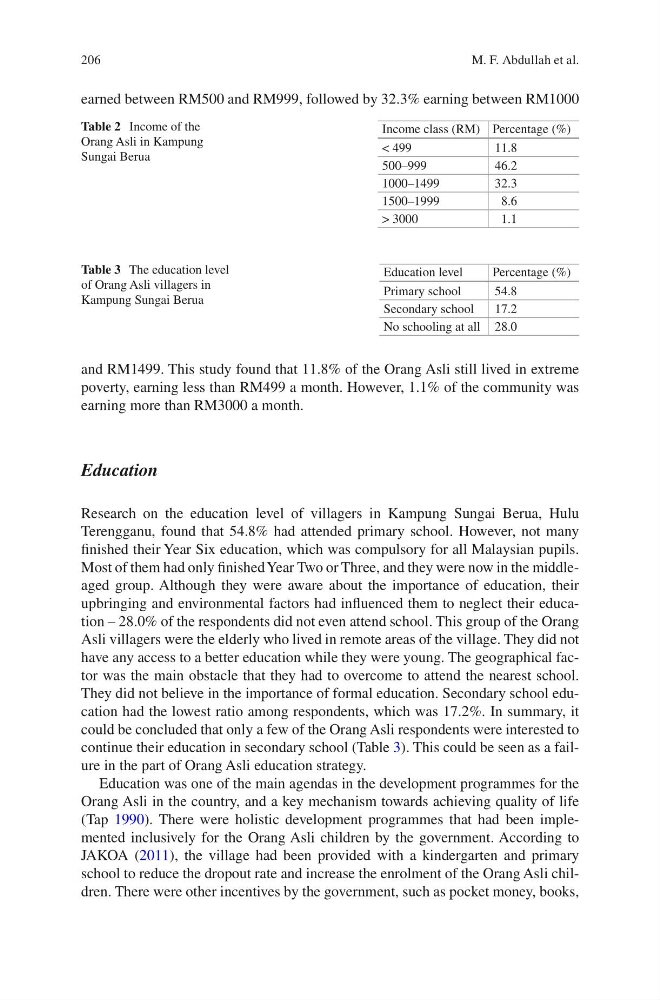
earned between RM500 and RM999, followed by 32.3% earning between RM1000
and RM1499. This study found that 11.8% of the Orang Asli still lived in extreme
poverty, earning less than RM499 a month. However, 1.1% of the community was
earning more than RM3000 a month.
Education
Research on the education level of villagers in Kampung Sungai Berua, Hulu
Terengganu, found that 54.8% had attended primary school. However, not many
finished their Year Six education, which was compulsory for all Malaysian pupils.
Most of them had only finished Year Two or Three, and they were now in the middleaged group. Although they were aware about the importance of education, their
upbringing and environmental factors had influenced them to neglect their education – 28.0% of the respondents did not even attend school. This group of the Orang
Asli villagers were the elderly who lived in remote areas of the village. They did not
have any access to a better education while they were young. The geographical factor was the main obstacle that they had to overcome to attend the nearest school.
They did not believe in the importance of formal education. Secondary school education had the lowest ratio among respondents, which was 17.2%. In summary, it
could be concluded that only a few of the Orang Asli respondents were interested to
continue their education in secondary school (Table 3). This could be seen as a failure in the part of Orang Asli education strategy.
Education was one of the main agendas in the development programmes for the
Orang Asli in the country, and a key mechanism towards achieving quality of life
(Tap 1990). There were holistic development programmes that had been implemented inclusively for the Orang Asli children by the government. According to
JAKOA (2011), the village had been provided with a kindergarten and primary
school to reduce the dropout rate and increase the enrolment of the Orang Asli children. There were other incentives by the government, such as pocket money, books,
Table 2 Income of the
Orang Asli in Kampung
Sungai Berua
Income class (RM) Percentage (%)
< 499
11.8
500–999
46.2
1000–1499
32.3
1500–1999
8.6
> 3000
1.1
Table 3 The education level
of Orang Asli villagers in
Kampung Sungai Berua
Education level
Percentage (%)
Primary school
54.8
Secondary school
17.2
No schooling at all 28.0
M. F. Abdullah et al.
earned between RM500 and RM999, followed by 32.3% earning between RM1000
and RM1499. This study found that 11.8% of the Orang Asli still lived in extreme
poverty, earning less than RM499 a month. However, 1.1% of the community was
earning more than RM3000 a month.
Education
Research on the education level of villagers in Kampung Sungai Berua, Hulu
Terengganu, found that 54.8% had attended primary school. However, not many
finished their Year Six education, which was compulsory for all Malaysian pupils.
Most of them had only finished Year Two or Three, and they were now in the middleaged group. Although they were aware about the importance of education, their
upbringing and environmental factors had influenced them to neglect their education – 28.0% of the respondents did not even attend school. This group of the Orang
Asli villagers were the elderly who lived in remote areas of the village. They did not
have any access to a better education while they were young. The geographical factor was the main obstacle that they had to overcome to attend the nearest school.
They did not believe in the importance of formal education. Secondary school education had the lowest ratio among respondents, which was 17.2%. In summary, it
could be concluded that only a few of the Orang Asli respondents were interested to
continue their education in secondary school (Table 3). This could be seen as a failure in the part of Orang Asli education strategy.
Education was one of the main agendas in the development programmes for the
Orang Asli in the country, and a key mechanism towards achieving quality of life
(Tap 1990). There were holistic development programmes that had been implemented inclusively for the Orang Asli children by the government. According to
JAKOA (2011), the village had been provided with a kindergarten and primary
school to reduce the dropout rate and increase the enrolment of the Orang Asli children. There were other incentives by the government, such as pocket money, books,
Table 2 Income of the
Orang Asli in Kampung
Sungai Berua
Income class (RM) Percentage (%)
< 499
11.8
500–999
46.2
1000–1499
32.3
1500–1999
8.6
> 3000
1.1
Table 3 The education level
of Orang Asli villagers in
Kampung Sungai Berua
Education level
Percentage (%)
Primary school
54.8
Secondary school
17.2
No schooling at all 28.0
M. F. Abdullah et al.