

205
perception towards development in their community. Qualitative approach was
done by interviewing and observing the activities of eight informants. They comprised JAKOA officers, government agencies, teachers at Sekolah Kebangsaan
Sungai Berua and Sekolah Menengah Kebangsaan Jenagor in Hulu Terengganu, and
health officers at the Sungai Berua clinic and Hulu Terengganu district health office.
Results and Discussion
Socio-economic Status
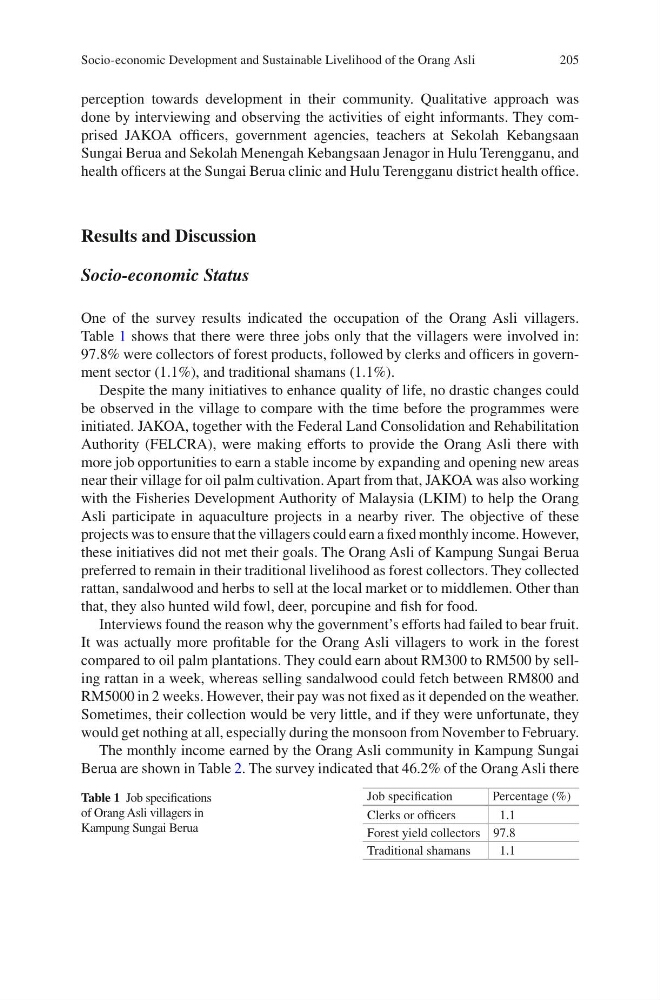
One of the survey results indicated the occupation of the Orang Asli villagers.
Table 1 shows that there were three jobs only that the villagers were involved in:
97.8% were collectors of forest products, followed by clerks and officers in government sector (1.1%), and traditional shamans (1.1%).
Despite the many initiatives to enhance quality of life, no drastic changes could
be observed in the village to compare with the time before the programmes were
initiated. JAKOA, together with the Federal Land Consolidation and Rehabilitation
Authority (FELCRA), were making efforts to provide the Orang Asli there with
more job opportunities to earn a stable income by expanding and opening new areas
near their village for oil palm cultivation. Apart from that, JAKOA was also working
with the Fisheries Development Authority of Malaysia (LKIM) to help the Orang
Asli participate in aquaculture projects in a nearby river. The objective of these
projects was to ensure that the villagers could earn a fixed monthly income. However,
these initiatives did not met their goals. The Orang Asli of Kampung Sungai Berua
preferred to remain in their traditional livelihood as forest collectors. They collected
rattan, sandalwood and herbs to sell at the local market or to middlemen. Other than
that, they also hunted wild fowl, deer, porcupine and fish for food.
Interviews found the reason why the government’s efforts had failed to bear fruit.
It was actually more profitable for the Orang Asli villagers to work in the forest
compared to oil palm plantations. They could earn about RM300 to RM500 by selling rattan in a week, whereas selling sandalwood could fetch between RM800 and
RM5000 in 2 weeks. However, their pay was not fixed as it depended on the weather.
Sometimes, their collection would be very little, and if they were unfortunate, they
would get nothing at all, especially during the monsoon from November to February.
The monthly income earned by the Orang Asli community in Kampung Sungai
Berua are shown in Table 2. The survey indicated that 46.2% of the Orang Asli there
Table 1 Job specifications
of Orang Asli villagers in
Kampung Sungai Berua
Job specification
Percentage (%)
Clerks or officers
1.1
Forest yield collectors 97.8
Traditional shamans
1.1
Socio-economic Development and Sustainable Livelihood of the Orang Asli
perception towards development in their community. Qualitative approach was
done by interviewing and observing the activities of eight informants. They comprised JAKOA officers, government agencies, teachers at Sekolah Kebangsaan
Sungai Berua and Sekolah Menengah Kebangsaan Jenagor in Hulu Terengganu, and
health officers at the Sungai Berua clinic and Hulu Terengganu district health office.
Results and Discussion
Socio-economic Status
One of the survey results indicated the occupation of the Orang Asli villagers.
Table 1 shows that there were three jobs only that the villagers were involved in:
97.8% were collectors of forest products, followed by clerks and officers in government sector (1.1%), and traditional shamans (1.1%).
Despite the many initiatives to enhance quality of life, no drastic changes could
be observed in the village to compare with the time before the programmes were
initiated. JAKOA, together with the Federal Land Consolidation and Rehabilitation
Authority (FELCRA), were making efforts to provide the Orang Asli there with
more job opportunities to earn a stable income by expanding and opening new areas
near their village for oil palm cultivation. Apart from that, JAKOA was also working
with the Fisheries Development Authority of Malaysia (LKIM) to help the Orang
Asli participate in aquaculture projects in a nearby river. The objective of these
projects was to ensure that the villagers could earn a fixed monthly income. However,
these initiatives did not met their goals. The Orang Asli of Kampung Sungai Berua
preferred to remain in their traditional livelihood as forest collectors. They collected
rattan, sandalwood and herbs to sell at the local market or to middlemen. Other than
that, they also hunted wild fowl, deer, porcupine and fish for food.
Interviews found the reason why the government’s efforts had failed to bear fruit.
It was actually more profitable for the Orang Asli villagers to work in the forest
compared to oil palm plantations. They could earn about RM300 to RM500 by selling rattan in a week, whereas selling sandalwood could fetch between RM800 and
RM5000 in 2 weeks. However, their pay was not fixed as it depended on the weather.
Sometimes, their collection would be very little, and if they were unfortunate, they
would get nothing at all, especially during the monsoon from November to February.
The monthly income earned by the Orang Asli community in Kampung Sungai
Berua are shown in Table 2. The survey indicated that 46.2% of the Orang Asli there
Table 1 Job specifications
of Orang Asli villagers in
Kampung Sungai Berua
Job specification
Percentage (%)
Clerks or officers
1.1
Forest yield collectors 97.8
Traditional shamans
1.1
Socio-economic Development and Sustainable Livelihood of the Orang Asli