

179
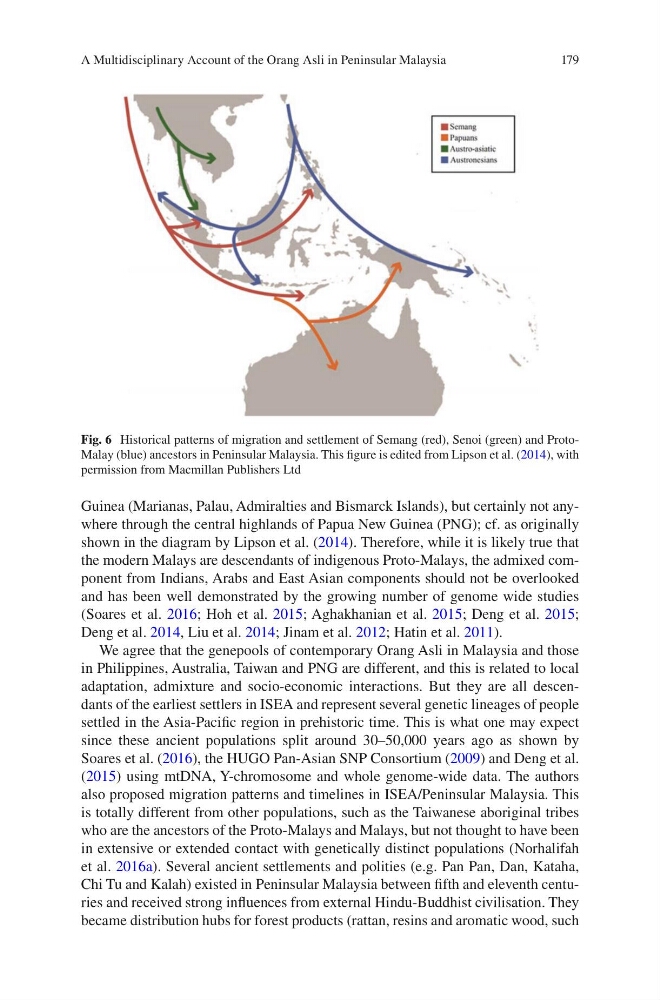
Guinea (Marianas, Palau, Admiralties and Bismarck Islands), but certainly not anywhere through the central highlands of Papua New Guinea (PNG); cf. as originally
shown in the diagram by Lipson et al. (2014). Therefore, while it is likely true that
the modern Malays are descendants of indigenous Proto-Malays, the admixed component from Indians, Arabs and East Asian components should not be overlooked
and has been well demonstrated by the growing number of genome wide studies
(Soares et al. 2016; Hoh et al. 2015; Aghakhanian et al. 2015; Deng et al. 2015;
Deng et al. 2014, Liu et al. 2014; Jinam et al. 2012; Hatin et al. 2011).
We agree that the genepools of contemporary Orang Asli in Malaysia and those
in Philippines, Australia, Taiwan and PNG are different, and this is related to local
adaptation, admixture and socio-economic interactions. But they are all descendants of the earliest settlers in ISEA and represent several genetic lineages of people
settled in the Asia-Pacific region in prehistoric time. This is what one may expect
since these ancient populations split around 30–50,000 years ago as shown by
Soares et al. (2016), the HUGO Pan-Asian SNP Consortium (2009) and Deng et al.
(2015) using mtDNA, Y-chromosome and whole genome-wide data. The authors
also proposed migration patterns and timelines in ISEA/Peninsular Malaysia. This
is totally different from other populations, such as the Taiwanese aboriginal tribes
who are the ancestors of the Proto-Malays and Malays, but not thought to have been
in extensive or extended contact with genetically distinct populations (Norhalifah
et al. 2016a). Several ancient settlements and polities (e.g. Pan Pan, Dan, Kataha,
Chi Tu and Kalah) existed in Peninsular Malaysia between fifth and eleventh centuries and received strong influences from external Hindu-Buddhist civilisation. They
became distribution hubs for forest products (rattan, resins and aromatic wood, such
Fig. 6 Historical patterns of migration and settlement of Semang (red), Senoi (green) and ProtoMalay (blue) ancestors in Peninsular Malaysia. This figure is edited from Lipson et al. (2014), with
permission from Macmillan Publishers Ltd
A Multidisciplinary Account of the Orang Asli in Peninsular Malaysia
Guinea (Marianas, Palau, Admiralties and Bismarck Islands), but certainly not anywhere through the central highlands of Papua New Guinea (PNG); cf. as originally
shown in the diagram by Lipson et al. (2014). Therefore, while it is likely true that
the modern Malays are descendants of indigenous Proto-Malays, the admixed component from Indians, Arabs and East Asian components should not be overlooked
and has been well demonstrated by the growing number of genome wide studies
(Soares et al. 2016; Hoh et al. 2015; Aghakhanian et al. 2015; Deng et al. 2015;
Deng et al. 2014, Liu et al. 2014; Jinam et al. 2012; Hatin et al. 2011).
We agree that the genepools of contemporary Orang Asli in Malaysia and those
in Philippines, Australia, Taiwan and PNG are different, and this is related to local
adaptation, admixture and socio-economic interactions. But they are all descendants of the earliest settlers in ISEA and represent several genetic lineages of people
settled in the Asia-Pacific region in prehistoric time. This is what one may expect
since these ancient populations split around 30–50,000 years ago as shown by
Soares et al. (2016), the HUGO Pan-Asian SNP Consortium (2009) and Deng et al.
(2015) using mtDNA, Y-chromosome and whole genome-wide data. The authors
also proposed migration patterns and timelines in ISEA/Peninsular Malaysia. This
is totally different from other populations, such as the Taiwanese aboriginal tribes
who are the ancestors of the Proto-Malays and Malays, but not thought to have been
in extensive or extended contact with genetically distinct populations (Norhalifah
et al. 2016a). Several ancient settlements and polities (e.g. Pan Pan, Dan, Kataha,
Chi Tu and Kalah) existed in Peninsular Malaysia between fifth and eleventh centuries and received strong influences from external Hindu-Buddhist civilisation. They
became distribution hubs for forest products (rattan, resins and aromatic wood, such
Fig. 6 Historical patterns of migration and settlement of Semang (red), Senoi (green) and ProtoMalay (blue) ancestors in Peninsular Malaysia. This figure is edited from Lipson et al. (2014), with
permission from Macmillan Publishers Ltd
A Multidisciplinary Account of the Orang Asli in Peninsular Malaysia