

116
associated with their hunting activities is the decreasing number of available species
and how abundant of each species is. The lifestyle explained here is almost similar
to the Semoq Beri people in Terengganu as narrated by Kuchikura (1988). Their
source of income is only from the trading of wildlife species (if any) and non-timber
forest products. Most of the individuals who have remained in this group have
barely received any formal education and depend largely on the informal survival
knowledge passed down from the elders.
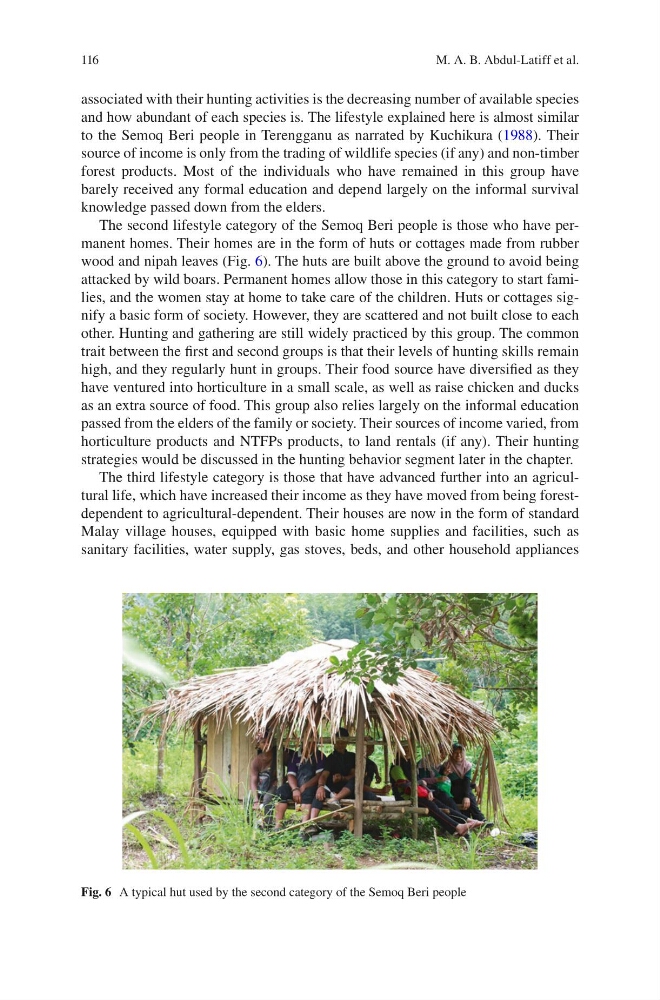
The second lifestyle category of the Semoq Beri people is those who have permanent homes. Their homes are in the form of huts or cottages made from rubber
wood and nipah leaves (Fig. 6). The huts are built above the ground to avoid being
attacked by wild boars. Permanent homes allow those in this category to start families, and the women stay at home to take care of the children. Huts or cottages signify a basic form of society. However, they are scattered and not built close to each
other. Hunting and gathering are still widely practiced by this group. The common
trait between the first and second groups is that their levels of hunting skills remain
high, and they regularly hunt in groups. Their food source have diversified as they
have ventured into horticulture in a small scale, as well as raise chicken and ducks
as an extra source of food. This group also relies largely on the informal education
passed from the elders of the family or society. Their sources of income varied, from
horticulture products and NTFPs products, to land rentals (if any). Their hunting
strategies would be discussed in the hunting behavior segment later in the chapter.
The third lifestyle category is those that have advanced further into an agricultural life, which have increased their income as they have moved from being forestdependent to agricultural-dependent. Their houses are now in the form of standard
Malay village houses, equipped with basic home supplies and facilities, such as
sanitary facilities, water supply, gas stoves, beds, and other household appliances
Fig. 6 A typical hut used by the second category of the Semoq Beri people
M. A. B. Abdul-Latiff et al.
associated with their hunting activities is the decreasing number of available species
and how abundant of each species is. The lifestyle explained here is almost similar
to the Semoq Beri people in Terengganu as narrated by Kuchikura (1988). Their
source of income is only from the trading of wildlife species (if any) and non-timber
forest products. Most of the individuals who have remained in this group have
barely received any formal education and depend largely on the informal survival
knowledge passed down from the elders.
The second lifestyle category of the Semoq Beri people is those who have permanent homes. Their homes are in the form of huts or cottages made from rubber
wood and nipah leaves (Fig. 6). The huts are built above the ground to avoid being
attacked by wild boars. Permanent homes allow those in this category to start families, and the women stay at home to take care of the children. Huts or cottages signify a basic form of society. However, they are scattered and not built close to each
other. Hunting and gathering are still widely practiced by this group. The common
trait between the first and second groups is that their levels of hunting skills remain
high, and they regularly hunt in groups. Their food source have diversified as they
have ventured into horticulture in a small scale, as well as raise chicken and ducks
as an extra source of food. This group also relies largely on the informal education
passed from the elders of the family or society. Their sources of income varied, from
horticulture products and NTFPs products, to land rentals (if any). Their hunting
strategies would be discussed in the hunting behavior segment later in the chapter.
The third lifestyle category is those that have advanced further into an agricultural life, which have increased their income as they have moved from being forestdependent to agricultural-dependent. Their houses are now in the form of standard
Malay village houses, equipped with basic home supplies and facilities, such as
sanitary facilities, water supply, gas stoves, beds, and other household appliances
Fig. 6 A typical hut used by the second category of the Semoq Beri people
M. A. B. Abdul-Latiff et al.