

480
Flavonoids are one of the most representative classes of secondary plant metabolism.
They are divided into two main groups: the flavonoids and isoflavonoids. Flavonoids
mixed biosynthesis products, include a basic molecular skeleton with fifteen carbon
atoms (C 6 C 3 C 6 ). The isoflavones are structurally distinct from the other flavonoid classes
because they contain a C15 skeleton based on 1,2-diphenylpropane, while the other
classes have 1,3-diphenylpropane. Isoflavones (IFs) are yellow pigments derived from
3-phenyl-benzopyrone (3-phenyl-chromone) structure. They are found in plants, mostly
as biologically inactive glycosides, namely 7-O-β-D-glycosides, 6″-O-acetyl-7-O-β-Dglucosides, and 6″-O-malonyl-7-O-β-D-glycosides (Tsao 2010; Bolca 2014). After
ingestion, glycosides are not bioavailable to be absorbed through enterocytes (Setchell
et al. 2002). They are hydrolyzed into bioactive aglycones by both intestinal mucosa and
bacterial β-glucosidases from the gut microbiota. Only these forms are absorbed into
systemic circulation directly or after subsequent metabolism in the bowel by intestinal
bacteria (Setchell et al. 2002). Soybeans incorporate predominantly genistin, daidzin,
and glycitin as inactive glycosides, which are hydrolyzed into their corresponding biologically active aglycones: genistein, daidzein (Fig. 22.1), and glycitein. Other isoflavones observed in legumes are ononin and sissotrin, with their aglycones, formononetin
and biochanin A, respectively.
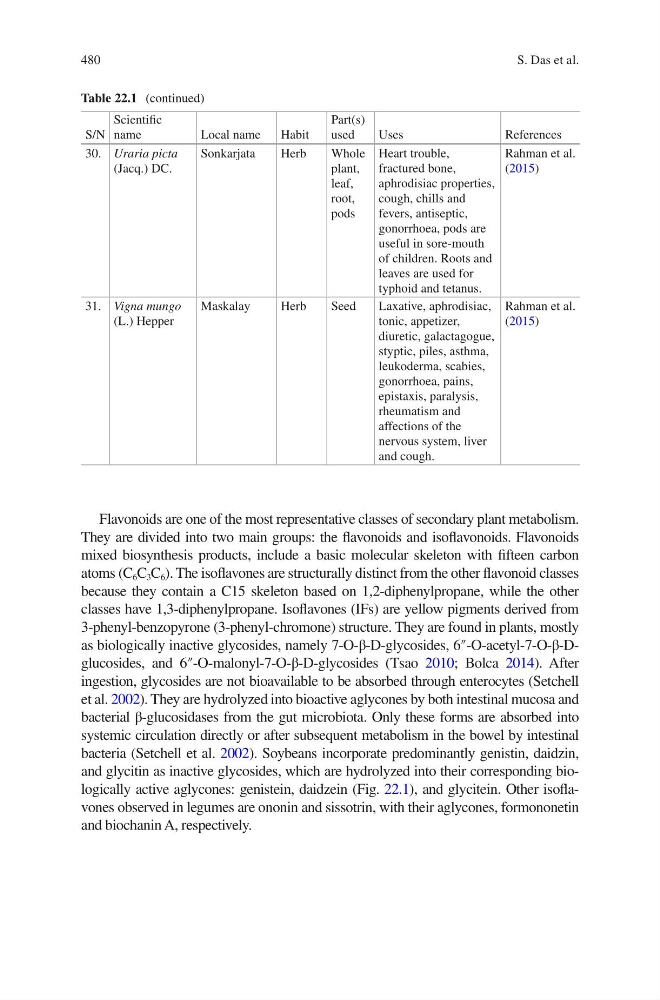
Table 22.1 (continued)
S/N
Scientific
name
Local name
Habit
Part(s)
used
Uses
References
30. Uraria picta
(Jacq.) DC.
Sonkarjata
Herb
Whole
plant,
leaf,
root,
pods
Heart trouble,
fractured bone,
aphrodisiac properties,
cough, chills and
fevers, antiseptic,
gonorrhoea, pods are
useful in sore-mouth
of children. Roots and
leaves are used for
typhoid and tetanus.
Rahman et al.
(2015)
31. Vigna mungo
(L.) Hepper
Maskalay
Herb
Seed
Laxative, aphrodisiac,
tonic, appetizer,
diuretic, galactagogue,
styptic, piles, asthma,
leukoderma, scabies,
gonorrhoea, pains,
epistaxis, paralysis,
rheumatism and
affections of the
nervous system, liver
and cough.
Rahman et al.
(2015)
S. Das et al.
Flavonoids are one of the most representative classes of secondary plant metabolism.
They are divided into two main groups: the flavonoids and isoflavonoids. Flavonoids
mixed biosynthesis products, include a basic molecular skeleton with fifteen carbon
atoms (C 6 C 3 C 6 ). The isoflavones are structurally distinct from the other flavonoid classes
because they contain a C15 skeleton based on 1,2-diphenylpropane, while the other
classes have 1,3-diphenylpropane. Isoflavones (IFs) are yellow pigments derived from
3-phenyl-benzopyrone (3-phenyl-chromone) structure. They are found in plants, mostly
as biologically inactive glycosides, namely 7-O-β-D-glycosides, 6″-O-acetyl-7-O-β-Dglucosides, and 6″-O-malonyl-7-O-β-D-glycosides (Tsao 2010; Bolca 2014). After
ingestion, glycosides are not bioavailable to be absorbed through enterocytes (Setchell
et al. 2002). They are hydrolyzed into bioactive aglycones by both intestinal mucosa and
bacterial β-glucosidases from the gut microbiota. Only these forms are absorbed into
systemic circulation directly or after subsequent metabolism in the bowel by intestinal
bacteria (Setchell et al. 2002). Soybeans incorporate predominantly genistin, daidzin,
and glycitin as inactive glycosides, which are hydrolyzed into their corresponding biologically active aglycones: genistein, daidzein (Fig. 22.1), and glycitein. Other isoflavones observed in legumes are ononin and sissotrin, with their aglycones, formononetin
and biochanin A, respectively.
Table 22.1 (continued)
S/N
Scientific
name
Local name
Habit
Part(s)
used
Uses
References
30. Uraria picta
(Jacq.) DC.
Sonkarjata
Herb
Whole
plant,
leaf,
root,
pods
Heart trouble,
fractured bone,
aphrodisiac properties,
cough, chills and
fevers, antiseptic,
gonorrhoea, pods are
useful in sore-mouth
of children. Roots and
leaves are used for
typhoid and tetanus.
Rahman et al.
(2015)
31. Vigna mungo
(L.) Hepper
Maskalay
Herb
Seed
Laxative, aphrodisiac,
tonic, appetizer,
diuretic, galactagogue,
styptic, piles, asthma,
leukoderma, scabies,
gonorrhoea, pains,
epistaxis, paralysis,
rheumatism and
affections of the
nervous system, liver
and cough.
Rahman et al.
(2015)
S. Das et al.