

479
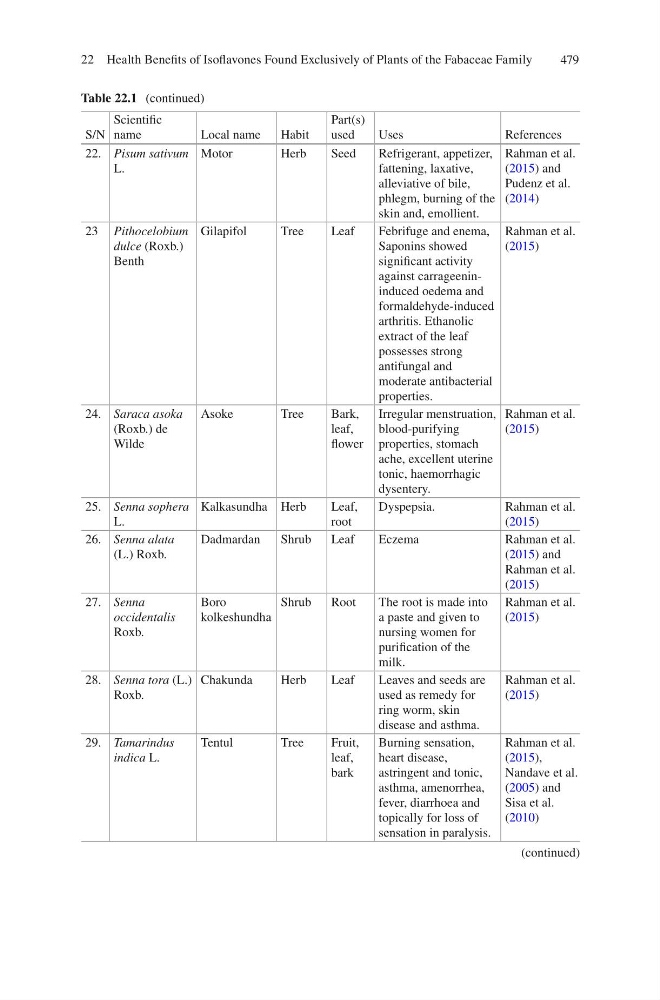
Table 22.1 (continued)
S/N
Scientific
name
Local name
Habit
Part(s)
used
Uses
References
22. Pisum sativum
L.
Motor
Herb
Seed
Refrigerant, appetizer,
fattening, laxative,
alleviative of bile,
phlegm, burning of the
skin and, emollient.
Rahman et al.
(2015) and
Pudenz et al.
(2014)
23 Pithocelobium
dulce (Roxb.)
Benth
Gilapifol
Tree
Leaf
Febrifuge and enema,
Saponins showed
significant activity
against carrageenininduced oedema and
formaldehyde-induced
arthritis. Ethanolic
extract of the leaf
possesses strong
antifungal and
moderate antibacterial
properties.
Rahman et al.
(2015)
24. Saraca asoka
(Roxb.) de
Wilde
Asoke
Tree
Bark,
leaf,
flower
Irregular menstruation,
blood-purifying
properties, stomach
ache, excellent uterine
tonic, haemorrhagic
dysentery.
Rahman et al.
(2015)
25. Senna sophera
L.
Kalkasundha Herb
Leaf,
root
Dyspepsia.
Rahman et al.
(2015)
26. Senna alata
(L.) Roxb.
Dadmardan
Shrub
Leaf
Eczema
Rahman et al.
(2015) and
Rahman et al.
(2015)
27. Senna
occidentalis
Roxb.
Boro
kolkeshundha
Shrub
Root
The root is made into
a paste and given to
nursing women for
purification of the
milk.
Rahman et al.
(2015)
28. Senna tora (L.)
Roxb.
Chakunda
Herb
Leaf
Leaves and seeds are
used as remedy for
ring worm, skin
disease and asthma.
Rahman et al.
(2015)
29. Tamarindus
indica L.
Tentul
Tree
Fruit,
leaf,
bark
Burning sensation,
heart disease,
astringent and tonic,
asthma, amenorrhea,
fever, diarrhoea and
topically for loss of
sensation in paralysis.
Rahman et al.
(2015),
Nandave et al.
(2005) and
Sisa et al.
(2010)
(continued)
22 Health Benefits of Isoflavones Found Exclusively of Plants of the Fabaceae Family
Table 22.1 (continued)
S/N
Scientific
name
Local name
Habit
Part(s)
used
Uses
References
22. Pisum sativum
L.
Motor
Herb
Seed
Refrigerant, appetizer,
fattening, laxative,
alleviative of bile,
phlegm, burning of the
skin and, emollient.
Rahman et al.
(2015) and
Pudenz et al.
(2014)
23 Pithocelobium
dulce (Roxb.)
Benth
Gilapifol
Tree
Leaf
Febrifuge and enema,
Saponins showed
significant activity
against carrageenininduced oedema and
formaldehyde-induced
arthritis. Ethanolic
extract of the leaf
possesses strong
antifungal and
moderate antibacterial
properties.
Rahman et al.
(2015)
24. Saraca asoka
(Roxb.) de
Wilde
Asoke
Tree
Bark,
leaf,
flower
Irregular menstruation,
blood-purifying
properties, stomach
ache, excellent uterine
tonic, haemorrhagic
dysentery.
Rahman et al.
(2015)
25. Senna sophera
L.
Kalkasundha Herb
Leaf,
root
Dyspepsia.
Rahman et al.
(2015)
26. Senna alata
(L.) Roxb.
Dadmardan
Shrub
Leaf
Eczema
Rahman et al.
(2015) and
Rahman et al.
(2015)
27. Senna
occidentalis
Roxb.
Boro
kolkeshundha
Shrub
Root
The root is made into
a paste and given to
nursing women for
purification of the
milk.
Rahman et al.
(2015)
28. Senna tora (L.)
Roxb.
Chakunda
Herb
Leaf
Leaves and seeds are
used as remedy for
ring worm, skin
disease and asthma.
Rahman et al.
(2015)
29. Tamarindus
indica L.
Tentul
Tree
Fruit,
leaf,
bark
Burning sensation,
heart disease,
astringent and tonic,
asthma, amenorrhea,
fever, diarrhoea and
topically for loss of
sensation in paralysis.
Rahman et al.
(2015),
Nandave et al.
(2005) and
Sisa et al.
(2010)
(continued)
22 Health Benefits of Isoflavones Found Exclusively of Plants of the Fabaceae Family