

461
21.5 Conclusion
Collectively, sulfur-containing plant-based secondary metabolites are known to
have therapeutic efficacy throughout the centuries. Organosulfur compounds are
very important part of human regular diet and contributed to health and well-being.
Thousands of years ago, beneficial properties and therapeutic applications of OSC
have been reported in folk and traditional system of medicine and practices. Clinical
trials and animal studies confirmed its traditional claims for the suppression and
treatment of various disease and disorders (possible mechanism). The present chapter covers the information on commonly known organosulfur compounds and their
therapeutic activities including antiplatelet, immunomodulatory, anti-ageing, antiinflammatory, antimicrobial, anti-parasitic, anti-hypertensive, anti-hyperlipidemic,
anti-atherosclerotic, and antioxidant activities. In view of promising outcomes,
additional efforts are required to explore its actual mechanism of action through
clinical trials for specific diseases and disorders.
References
Abramovitz D, Gavri S, Harats D et al (1999) Allicin-induced decrease in formation of fatty streaks
(atherosclerosis) in mice fed a cholesterol-rich diet. Coron Artery Dis 10:515–520. https://doi.
org/10.1097/00019501-199910000-00012
Adetumbi MA, Lau BH (1983) Alliumsativum (garlic)—A natural antibiotic. Med Hypotheses
12(3):227–237
Agarwal KC (1996) Therapeutic actions of garlic constituents. Med Res Rev 16:111–124. https://
doi.org/10.1002/(SICI)1098-1128(199601)16:1<111::AID-MED4>3.0.CO;2-5
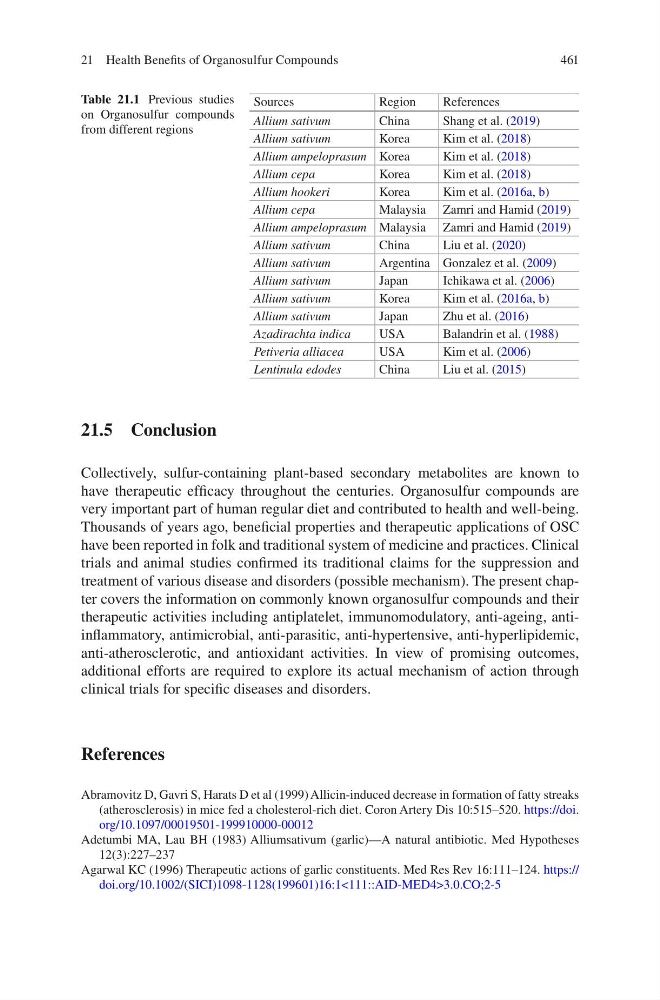
Table 21.1 Previous studies
on Organosulfur compounds
from different regions
Sources
Region
References
Allium sativum
China
Shang et al. (2019)
Allium sativum
Korea
Kim et al. (2018)
Allium ampeloprasum Korea
Kim et al. (2018)
Allium cepa
Korea
Kim et al. (2018)
Allium hookeri
Korea
Kim et al. (2016a, b)
Allium cepa
Malaysia Zamri and Hamid (2019)
Allium ampeloprasum Malaysia Zamri and Hamid (2019)
Allium sativum
China
Liu et al. (2020)
Allium sativum
Argentina Gonzalez et al. (2009)
Allium sativum
Japan
Ichikawa et al. (2006)
Allium sativum
Korea
Kim et al. (2016a, b)
Allium sativum
Japan
Zhu et al. (2016)
Azadirachta indica
USA
Balandrin et al. (1988)
Petiveria alliacea
USA
Kim et al. (2006)
Lentinula edodes
China
Liu et al. (2015)
21 Health Benefits of Organosulfur Compounds
21.5 Conclusion
Collectively, sulfur-containing plant-based secondary metabolites are known to
have therapeutic efficacy throughout the centuries. Organosulfur compounds are
very important part of human regular diet and contributed to health and well-being.
Thousands of years ago, beneficial properties and therapeutic applications of OSC
have been reported in folk and traditional system of medicine and practices. Clinical
trials and animal studies confirmed its traditional claims for the suppression and
treatment of various disease and disorders (possible mechanism). The present chapter covers the information on commonly known organosulfur compounds and their
therapeutic activities including antiplatelet, immunomodulatory, anti-ageing, antiinflammatory, antimicrobial, anti-parasitic, anti-hypertensive, anti-hyperlipidemic,
anti-atherosclerotic, and antioxidant activities. In view of promising outcomes,
additional efforts are required to explore its actual mechanism of action through
clinical trials for specific diseases and disorders.
References
Abramovitz D, Gavri S, Harats D et al (1999) Allicin-induced decrease in formation of fatty streaks
(atherosclerosis) in mice fed a cholesterol-rich diet. Coron Artery Dis 10:515–520. https://doi.
org/10.1097/00019501-199910000-00012
Adetumbi MA, Lau BH (1983) Alliumsativum (garlic)—A natural antibiotic. Med Hypotheses
12(3):227–237
Agarwal KC (1996) Therapeutic actions of garlic constituents. Med Res Rev 16:111–124. https://
doi.org/10.1002/(SICI)1098-1128(199601)16:1<111::AID-MED4>3.0.CO;2-5
Table 21.1 Previous studies
on Organosulfur compounds
from different regions
Sources
Region
References
Allium sativum
China
Shang et al. (2019)
Allium sativum
Korea
Kim et al. (2018)
Allium ampeloprasum Korea
Kim et al. (2018)
Allium cepa
Korea
Kim et al. (2018)
Allium hookeri
Korea
Kim et al. (2016a, b)
Allium cepa
Malaysia Zamri and Hamid (2019)
Allium ampeloprasum Malaysia Zamri and Hamid (2019)
Allium sativum
China
Liu et al. (2020)
Allium sativum
Argentina Gonzalez et al. (2009)
Allium sativum
Japan
Ichikawa et al. (2006)
Allium sativum
Korea
Kim et al. (2016a, b)
Allium sativum
Japan
Zhu et al. (2016)
Azadirachta indica
USA
Balandrin et al. (1988)
Petiveria alliacea
USA
Kim et al. (2006)
Lentinula edodes
China
Liu et al. (2015)
21 Health Benefits of Organosulfur Compounds