

430
ROO CAR ROO CAR
∗
−
∗+
+
→
+
(20.1)
ROO CAR ROOH CAR
∗
∗
+
→
+
(20.2)
ROO CAR ROO CAR
∗
∗
+
→
−
(20.3)
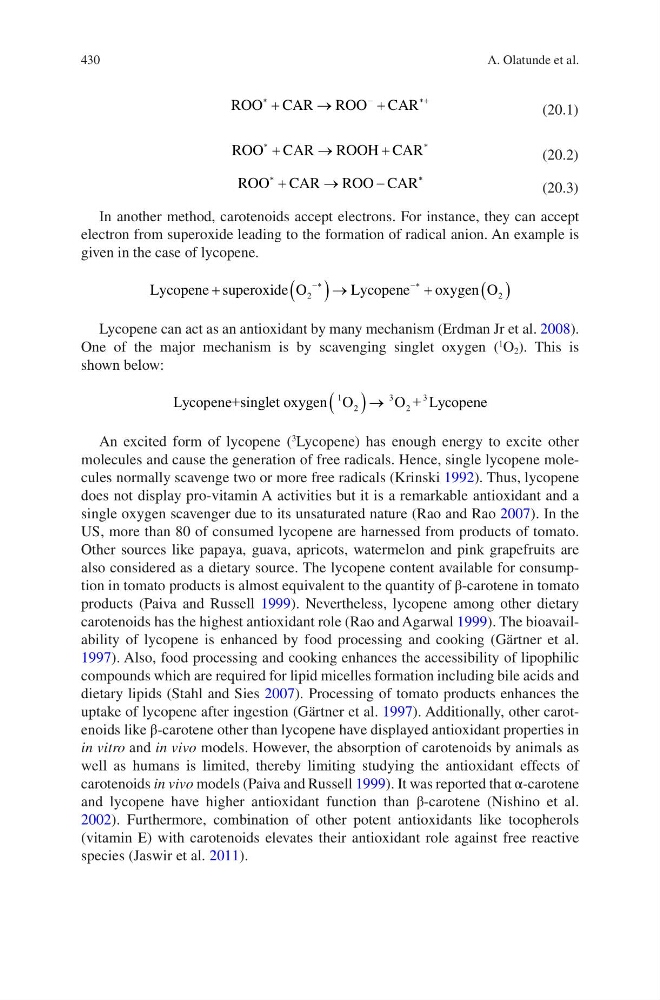
In another method, carotenoids accept electrons. For instance, they can accept
electron from superoxide leading to the formation of radical anion. An example is
given in the case of lycopene.
Lycopene superoxide O
Lycopene
oxygen O
+
( ) →
+
( )
−∗
−∗
2
2
Lycopene can act as an antioxidant by many mechanism (Erdman Jr et al. 2008).
One of the major mechanism is by scavenging singlet oxygen (
1
O 2 ). This is
shown below:
Lycopene+singlet oxygen O
O + Lycopene
1
2
3
2
3
( ) →
An excited form of lycopene (
3
Lycopene) has enough energy to excite other
molecules and cause the generation of free radicals. Hence, single lycopene molecules normally scavenge two or more free radicals (Krinski 1992). Thus, lycopene
does not display pro-vitamin A activities but it is a remarkable antioxidant and a
single oxygen scavenger due to its unsaturated nature (Rao and Rao 2007). In the
US, more than 80 of consumed lycopene are harnessed from products of tomato.
Other sources like papaya, guava, apricots, watermelon and pink grapefruits are
also considered as a dietary source. The lycopene content available for consumption in tomato products is almost equivalent to the quantity of β-carotene in tomato
products (Paiva and Russell 1999). Nevertheless, lycopene among other dietary
carotenoids has the highest antioxidant role (Rao and Agarwal 1999). The bioavailability of lycopene is enhanced by food processing and cooking (Gärtner et al.
1997). Also, food processing and cooking enhances the accessibility of lipophilic
compounds which are required for lipid micelles formation including bile acids and
dietary lipids (Stahl and Sies 2007). Processing of tomato products enhances the
uptake of lycopene after ingestion (Gärtner et al. 1997). Additionally, other carotenoids like β-carotene other than lycopene have displayed antioxidant properties in
in vitro and in vivo models. However, the absorption of carotenoids by animals as
well as humans is limited, thereby limiting studying the antioxidant effects of
carotenoids in vivo models (Paiva and Russell 1999). It was reported that α-carotene
and lycopene have higher antioxidant function than β-carotene (Nishino et al.
2002). Furthermore, combination of other potent antioxidants like tocopherols
(vitamin E) with carotenoids elevates their antioxidant role against free reactive
species (Jaswir et al. 2011).
A. Olatunde et al.
ROO CAR ROO CAR
∗
−
∗+
+
→
+
(20.1)
ROO CAR ROOH CAR
∗
∗
+
→
+
(20.2)
ROO CAR ROO CAR
∗
∗
+
→
−
(20.3)
In another method, carotenoids accept electrons. For instance, they can accept
electron from superoxide leading to the formation of radical anion. An example is
given in the case of lycopene.
Lycopene superoxide O
Lycopene
oxygen O
+
( ) →
+
( )
−∗
−∗
2
2
Lycopene can act as an antioxidant by many mechanism (Erdman Jr et al. 2008).
One of the major mechanism is by scavenging singlet oxygen (
1
O 2 ). This is
shown below:
Lycopene+singlet oxygen O
O + Lycopene
1
2
3
2
3
( ) →
An excited form of lycopene (
3
Lycopene) has enough energy to excite other
molecules and cause the generation of free radicals. Hence, single lycopene molecules normally scavenge two or more free radicals (Krinski 1992). Thus, lycopene
does not display pro-vitamin A activities but it is a remarkable antioxidant and a
single oxygen scavenger due to its unsaturated nature (Rao and Rao 2007). In the
US, more than 80 of consumed lycopene are harnessed from products of tomato.
Other sources like papaya, guava, apricots, watermelon and pink grapefruits are
also considered as a dietary source. The lycopene content available for consumption in tomato products is almost equivalent to the quantity of β-carotene in tomato
products (Paiva and Russell 1999). Nevertheless, lycopene among other dietary
carotenoids has the highest antioxidant role (Rao and Agarwal 1999). The bioavailability of lycopene is enhanced by food processing and cooking (Gärtner et al.
1997). Also, food processing and cooking enhances the accessibility of lipophilic
compounds which are required for lipid micelles formation including bile acids and
dietary lipids (Stahl and Sies 2007). Processing of tomato products enhances the
uptake of lycopene after ingestion (Gärtner et al. 1997). Additionally, other carotenoids like β-carotene other than lycopene have displayed antioxidant properties in
in vitro and in vivo models. However, the absorption of carotenoids by animals as
well as humans is limited, thereby limiting studying the antioxidant effects of
carotenoids in vivo models (Paiva and Russell 1999). It was reported that α-carotene
and lycopene have higher antioxidant function than β-carotene (Nishino et al.
2002). Furthermore, combination of other potent antioxidants like tocopherols
(vitamin E) with carotenoids elevates their antioxidant role against free reactive
species (Jaswir et al. 2011).
A. Olatunde et al.