

390
19.1 Introduction
Polyphenols are polyhydroxyphenols, which are structural class of compounds that
are mostly composed of natural compounds, and sometimes synthesized or semi
synthetic in nature (Cattani et al. 2012). These compounds have the characteristics
of multiple phenolic structural units in them, hence, the name polyphenols.
Polyphenols are mostly of plant origin and they are among the most studies class of
phytochemicals. These natural phytochemicals are readily available in the entire
plant kingdom and therefore find their way into human diet as they are found in
whole grains, legumes, cereals, coffee, wine and tea. They are also found in fruits
like grapes, pear, broccoli, apricot, orange, lemon, cherry and blueberry. More than
8000 of these polyphenolic compounds, including stilbenes, phenolic acids, lignans
and flavonoids have been identified in whole plant foods (Pandey and Rizvi 2009).
These phytochemicals are secondary metabolites found in plants, where they act as
antioxidants, anti-inflammatory, antimicrobial, protect the immune system, defend
against pathogens attack and ultraviolet radiations (Beckman 2000; Park et al. 2004;
Widyarini 2006; Andarwulan et al. 2010; Chen et al. 2016; Hisanaga et al. 2016).
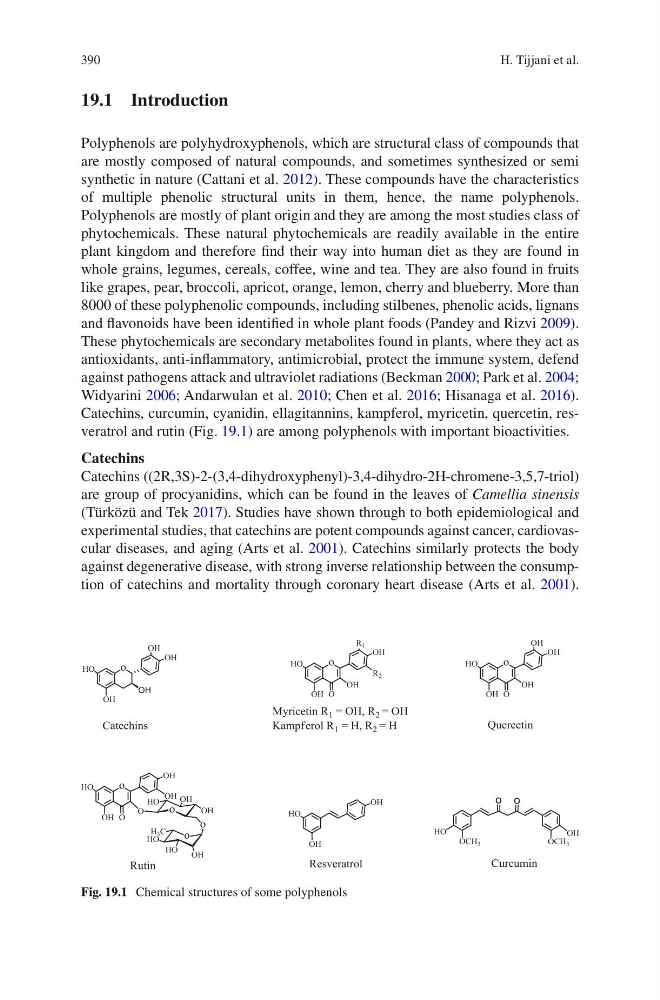
Catechins, curcumin, cyanidin, ellagitannins, kampferol, myricetin, quercetin, resveratrol and rutin (Fig. 19.1) are among polyphenols with important bioactivities.
Catechins
Catechins ((2R,3S)-2-(3,4-dihydroxyphenyl)-3,4-dihydro-2H-chromene-3,5,7- triol)
are group of procyanidins, which can be found in the leaves of Camellia sinensis
(Türközü and Tek 2017). Studies have shown through to both epidemiological and
experimental studies, that catechins are potent compounds against cancer, cardiovascular diseases, and aging (Arts et al. 2001). Catechins similarly protects the body
against degenerative disease, with strong inverse relationship between the consumption of catechins and mortality through coronary heart disease (Arts et al. 2001).
Fig. 19.1 Chemical structures of some polyphenols
H. Tijjani et al.
19.1 Introduction
Polyphenols are polyhydroxyphenols, which are structural class of compounds that
are mostly composed of natural compounds, and sometimes synthesized or semi
synthetic in nature (Cattani et al. 2012). These compounds have the characteristics
of multiple phenolic structural units in them, hence, the name polyphenols.
Polyphenols are mostly of plant origin and they are among the most studies class of
phytochemicals. These natural phytochemicals are readily available in the entire
plant kingdom and therefore find their way into human diet as they are found in
whole grains, legumes, cereals, coffee, wine and tea. They are also found in fruits
like grapes, pear, broccoli, apricot, orange, lemon, cherry and blueberry. More than
8000 of these polyphenolic compounds, including stilbenes, phenolic acids, lignans
and flavonoids have been identified in whole plant foods (Pandey and Rizvi 2009).
These phytochemicals are secondary metabolites found in plants, where they act as
antioxidants, anti-inflammatory, antimicrobial, protect the immune system, defend
against pathogens attack and ultraviolet radiations (Beckman 2000; Park et al. 2004;
Widyarini 2006; Andarwulan et al. 2010; Chen et al. 2016; Hisanaga et al. 2016).
Catechins, curcumin, cyanidin, ellagitannins, kampferol, myricetin, quercetin, resveratrol and rutin (Fig. 19.1) are among polyphenols with important bioactivities.
Catechins
Catechins ((2R,3S)-2-(3,4-dihydroxyphenyl)-3,4-dihydro-2H-chromene-3,5,7- triol)
are group of procyanidins, which can be found in the leaves of Camellia sinensis
(Türközü and Tek 2017). Studies have shown through to both epidemiological and
experimental studies, that catechins are potent compounds against cancer, cardiovascular diseases, and aging (Arts et al. 2001). Catechins similarly protects the body
against degenerative disease, with strong inverse relationship between the consumption of catechins and mortality through coronary heart disease (Arts et al. 2001).
Fig. 19.1 Chemical structures of some polyphenols
H. Tijjani et al.