

323
Ma et al. 2014; Meng et al. 2016; Rathore et al. 2017). Few polysaccharides have
also been discussed in the proximate analysis and mineral content section.
During last few decades researchers are more concerned about oxidative damage
because the risk of oxidative species, including free radicals is increasing constantly,
resulting from unhealthy habits and pollution exposure. A free radical is known as
any unstable molecule which are very reactive and cause oxidative stress to body,
resulting in growth of several fatal diseases like cancer, neurodegenerative disease,
cardiovascular disease, etc., (Carocho and Ferreira 2013; Gutteridge and Halliwell
2000). An anti-oxidant can stabilize these free radicals and help in preventing the
diseases caused by oxidative stress (Carocho and Ferreira 2013; Ferreira et al. 2009,
2015; Painuli et al. 2018, Painuli and Kumar 2016, Semwal and Painuli 2019; Stajic
et al. 2013). Although, human body can prevent oxidative stress by endogenous
antioxidant defense mechanism, we can also obtain anti-oxidants by inclusion of
healthy food in our diet (Ferreira et al. 2009).
In this view, mushrooms are considered to be a rich source of anti-oxidants and
have been extensively studied for their antioxidant properties. The antioxidants
reported in mushrooms are phenolic acids, tocopherols, terpenes, carotenoids,
steroids and ascorbic acid (Ferreira et al. 2009, 2015; Stajic et al. 2013). Alkaloid
is one of the important class of phenolic compounds. They possess immense therapeutic properties and have been used from a long back for curing diseases. In
past few years mushrooms are reported with significant content of alkaloids,
which are further studied for their bioactivity. Astraeus odoratus, Flammulina
velutipes, Ganoderma sinense, Hericium erinaceum, Macrolepiotaneo mastoidea, Pseudobaeospora pyrifera are examples of such mushrooms which possess
alkaloids with anti-tubercular activity, cytotoxic activity, anti-cholinesterase and
anti- mycobacterial activity (Arpha et al. 2012; Kim et al. 2012; Liu et al. 2010;
Rhee et al. 2001; Song et al. 2009).
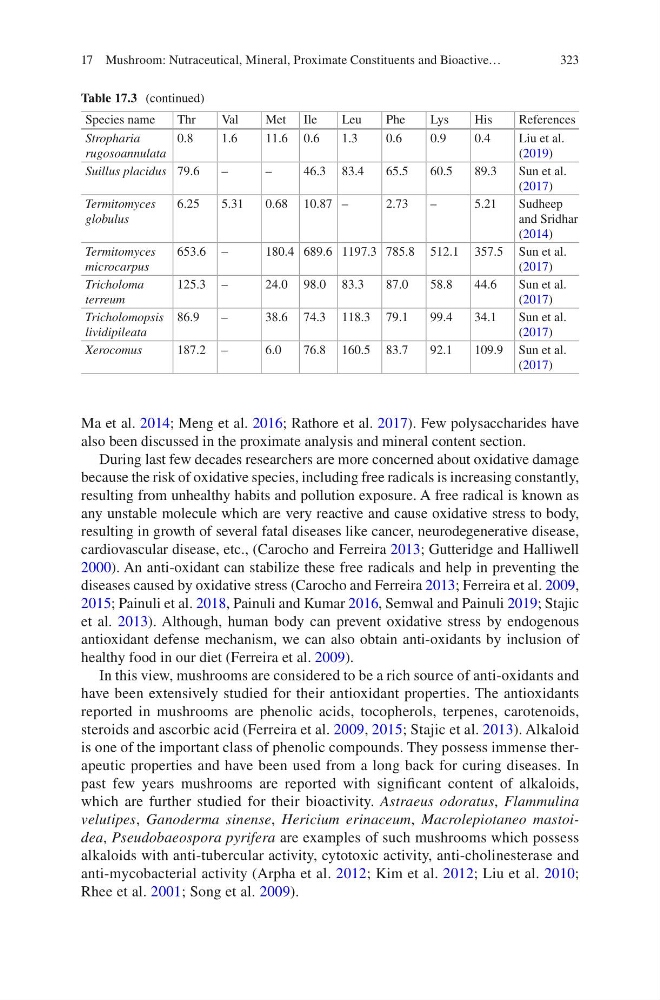
Table 17.3 (continued)
Species name
Thr
Val
Met Ile
Leu
Phe
Lys
His
References
Stropharia
rugosoannulata
0.8
1.6
11.6 0.6
1.3
0.6
0.9
0.4
Liu et al.
(2019)
Suillus placidus 79.6
–
–
46.3 83.4
65.5
60.5
89.3
Sun et al.
(2017)
Termitomyces
globulus
6.25
5.31
0.68 10.87 –
2.73
–
5.21
Sudheep
and Sridhar
(2014)
Termitomyces
microcarpus
653.6 –
180.4 689.6 1197.3 785.8 512.1 357.5 Sun et al.
(2017)
Tricholoma
terreum
125.3 –
24.0 98.0 83.3
87.0
58.8
44.6
Sun et al.
(2017)
Tricholomopsis
lividipileata
86.9
–
38.6 74.3 118.3 79.1
99.4
34.1
Sun et al.
(2017)
Xerocomus
187.2 –
6.0
76.8 160.5 83.7
92.1
109.9 Sun et al.
(2017)
17 Mushroom: Nutraceutical, Mineral, Proximate Constituents and Bioactive…
Ma et al. 2014; Meng et al. 2016; Rathore et al. 2017). Few polysaccharides have
also been discussed in the proximate analysis and mineral content section.
During last few decades researchers are more concerned about oxidative damage
because the risk of oxidative species, including free radicals is increasing constantly,
resulting from unhealthy habits and pollution exposure. A free radical is known as
any unstable molecule which are very reactive and cause oxidative stress to body,
resulting in growth of several fatal diseases like cancer, neurodegenerative disease,
cardiovascular disease, etc., (Carocho and Ferreira 2013; Gutteridge and Halliwell
2000). An anti-oxidant can stabilize these free radicals and help in preventing the
diseases caused by oxidative stress (Carocho and Ferreira 2013; Ferreira et al. 2009,
2015; Painuli et al. 2018, Painuli and Kumar 2016, Semwal and Painuli 2019; Stajic
et al. 2013). Although, human body can prevent oxidative stress by endogenous
antioxidant defense mechanism, we can also obtain anti-oxidants by inclusion of
healthy food in our diet (Ferreira et al. 2009).
In this view, mushrooms are considered to be a rich source of anti-oxidants and
have been extensively studied for their antioxidant properties. The antioxidants
reported in mushrooms are phenolic acids, tocopherols, terpenes, carotenoids,
steroids and ascorbic acid (Ferreira et al. 2009, 2015; Stajic et al. 2013). Alkaloid
is one of the important class of phenolic compounds. They possess immense therapeutic properties and have been used from a long back for curing diseases. In
past few years mushrooms are reported with significant content of alkaloids,
which are further studied for their bioactivity. Astraeus odoratus, Flammulina
velutipes, Ganoderma sinense, Hericium erinaceum, Macrolepiotaneo mastoidea, Pseudobaeospora pyrifera are examples of such mushrooms which possess
alkaloids with anti-tubercular activity, cytotoxic activity, anti-cholinesterase and
anti- mycobacterial activity (Arpha et al. 2012; Kim et al. 2012; Liu et al. 2010;
Rhee et al. 2001; Song et al. 2009).
Table 17.3 (continued)
Species name
Thr
Val
Met Ile
Leu
Phe
Lys
His
References
Stropharia
rugosoannulata
0.8
1.6
11.6 0.6
1.3
0.6
0.9
0.4
Liu et al.
(2019)
Suillus placidus 79.6
–
–
46.3 83.4
65.5
60.5
89.3
Sun et al.
(2017)
Termitomyces
globulus
6.25
5.31
0.68 10.87 –
2.73
–
5.21
Sudheep
and Sridhar
(2014)
Termitomyces
microcarpus
653.6 –
180.4 689.6 1197.3 785.8 512.1 357.5 Sun et al.
(2017)
Tricholoma
terreum
125.3 –
24.0 98.0 83.3
87.0
58.8
44.6
Sun et al.
(2017)
Tricholomopsis
lividipileata
86.9
–
38.6 74.3 118.3 79.1
99.4
34.1
Sun et al.
(2017)
Xerocomus
187.2 –
6.0
76.8 160.5 83.7
92.1
109.9 Sun et al.
(2017)
17 Mushroom: Nutraceutical, Mineral, Proximate Constituents and Bioactive…