

297
reduced which could be credited to the increased activity of endogenous enzyme
phytase, which hydrolyzes phytic acid (Pawar et al. 2006). The level of the phytate
breakdown depends upon several factors like grain variety, germination stage, pH,
moisture level, temperature, solubility of phytate and the presence of certain inhibitors (Egli et al. 2002). In a study conducted by Liukkonen et al. (2003) rye grains
were germinated for 6 days at different temperatures like 5, 10 and 25 °C all treatments exhibited an increment in methanol-extractable phenolic compounds but
highest increase was observed in samples germinated at 25 °C. The reason suggested
for this increase was that synthesis or activation of a variety of hydrolytic enzymes
started in grains through germination which caused different alterations in structure
or synthesis of new compounds having high bioactivity and nutritional value (Wang
et al. 2014).
In other study Tian et al. (2004) found that during germination for 24 h in brown
rice main soluble phenolic compounds including 6-O-feruloylsucrose and
6-O-sinapoylsucrose were decreased, while the free compounds including ferulic
acid and sinapinic acid increased significantly. In soybean and mung bean after
germination total phenolics content in seeds and sprouts expressed on a fresh weight
basis (Shohag et al. 2012) decreased compared with other seed contents due to dilution effect of phenolics after imbibition and growth, and due to increased water
absorption. While in case of dry weight basis the total phenolics content increased
with germination time, because moisture content is eliminated (Cevallos-Casals and
Cisneros-Zevallos 2010).
Total antioxidant activity has been generally associated with increased antioxidant activity in a variety of grains (Imam et al. 2012). Avenanthramides are phenolic
compounds exclusively found in oats. They have been reported to contribute to the
fresh taste of oat products. An increase in these compounds by about 20% upon
germination was reported (Skoglund et al. 2008). Tannins, phenolic compounds
with high molecular weight, have traditionally been nutritionally negative, as they
can form insoluble complexes with proteins and can complex minerals. On a positive note, they contribute to the antioxidant activity and the breakdown products
also have antioxidant properties. During germination, tannins are partially broken
down, as reported for millet (Hemalatha et al. 2007), and sorghum (Dicko et al. 2005).
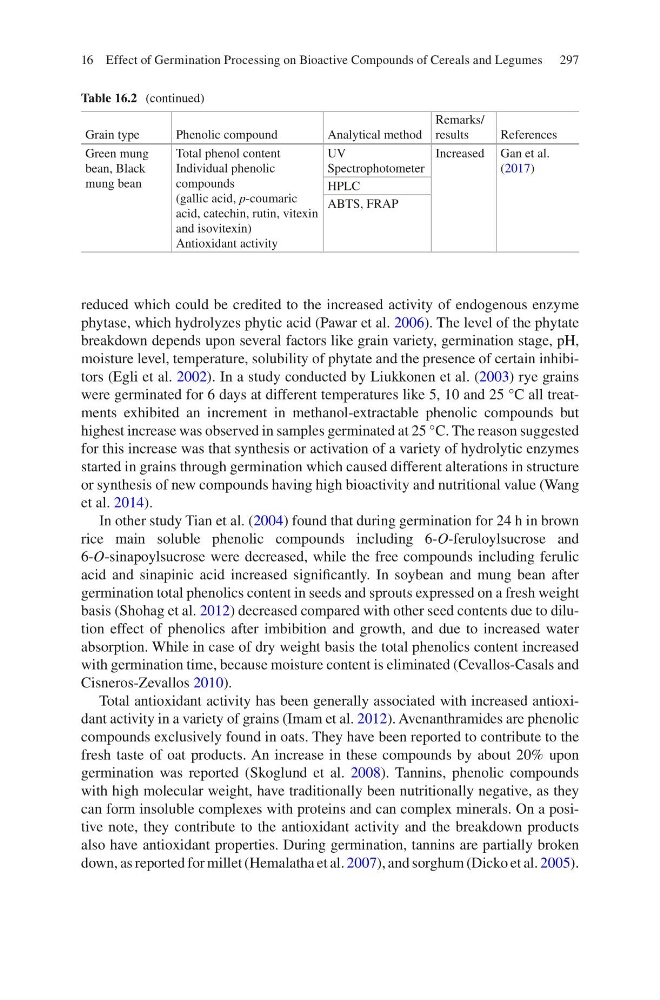
Table 16.2 (continued)
Grain type
Phenolic compound
Analytical method
Remarks/
results
References
Green mung
bean, Black
mung bean
Total phenol content
Individual phenolic
compounds
(gallic acid, p-coumaric
acid, catechin, rutin, vitexin
and isovitexin)
Antioxidant activity
UV
Spectrophotometer
Increased Gan et al.
(2017)
HPLC
ABTS, FRAP
16 Effect of Germination Processing on Bioactive Compounds of Cereals and Legumes
reduced which could be credited to the increased activity of endogenous enzyme
phytase, which hydrolyzes phytic acid (Pawar et al. 2006). The level of the phytate
breakdown depends upon several factors like grain variety, germination stage, pH,
moisture level, temperature, solubility of phytate and the presence of certain inhibitors (Egli et al. 2002). In a study conducted by Liukkonen et al. (2003) rye grains
were germinated for 6 days at different temperatures like 5, 10 and 25 °C all treatments exhibited an increment in methanol-extractable phenolic compounds but
highest increase was observed in samples germinated at 25 °C. The reason suggested
for this increase was that synthesis or activation of a variety of hydrolytic enzymes
started in grains through germination which caused different alterations in structure
or synthesis of new compounds having high bioactivity and nutritional value (Wang
et al. 2014).
In other study Tian et al. (2004) found that during germination for 24 h in brown
rice main soluble phenolic compounds including 6-O-feruloylsucrose and
6-O-sinapoylsucrose were decreased, while the free compounds including ferulic
acid and sinapinic acid increased significantly. In soybean and mung bean after
germination total phenolics content in seeds and sprouts expressed on a fresh weight
basis (Shohag et al. 2012) decreased compared with other seed contents due to dilution effect of phenolics after imbibition and growth, and due to increased water
absorption. While in case of dry weight basis the total phenolics content increased
with germination time, because moisture content is eliminated (Cevallos-Casals and
Cisneros-Zevallos 2010).
Total antioxidant activity has been generally associated with increased antioxidant activity in a variety of grains (Imam et al. 2012). Avenanthramides are phenolic
compounds exclusively found in oats. They have been reported to contribute to the
fresh taste of oat products. An increase in these compounds by about 20% upon
germination was reported (Skoglund et al. 2008). Tannins, phenolic compounds
with high molecular weight, have traditionally been nutritionally negative, as they
can form insoluble complexes with proteins and can complex minerals. On a positive note, they contribute to the antioxidant activity and the breakdown products
also have antioxidant properties. During germination, tannins are partially broken
down, as reported for millet (Hemalatha et al. 2007), and sorghum (Dicko et al. 2005).
Table 16.2 (continued)
Grain type
Phenolic compound
Analytical method
Remarks/
results
References
Green mung
bean, Black
mung bean
Total phenol content
Individual phenolic
compounds
(gallic acid, p-coumaric
acid, catechin, rutin, vitexin
and isovitexin)
Antioxidant activity
UV
Spectrophotometer
Increased Gan et al.
(2017)
HPLC
ABTS, FRAP
16 Effect of Germination Processing on Bioactive Compounds of Cereals and Legumes