

224
13.1.2 Omega-3 Fatty Acids
The importance of seafood in the human diet is due to the presence of naturally
occurring fatty acids such as omega-3 PUFAs (EPA and DHA), which possess multiple beneficial health effects. The highest ratio of fatty acids, such as EPA and
DHA, in the food chain is found in the marine phytoplankton. The overall content
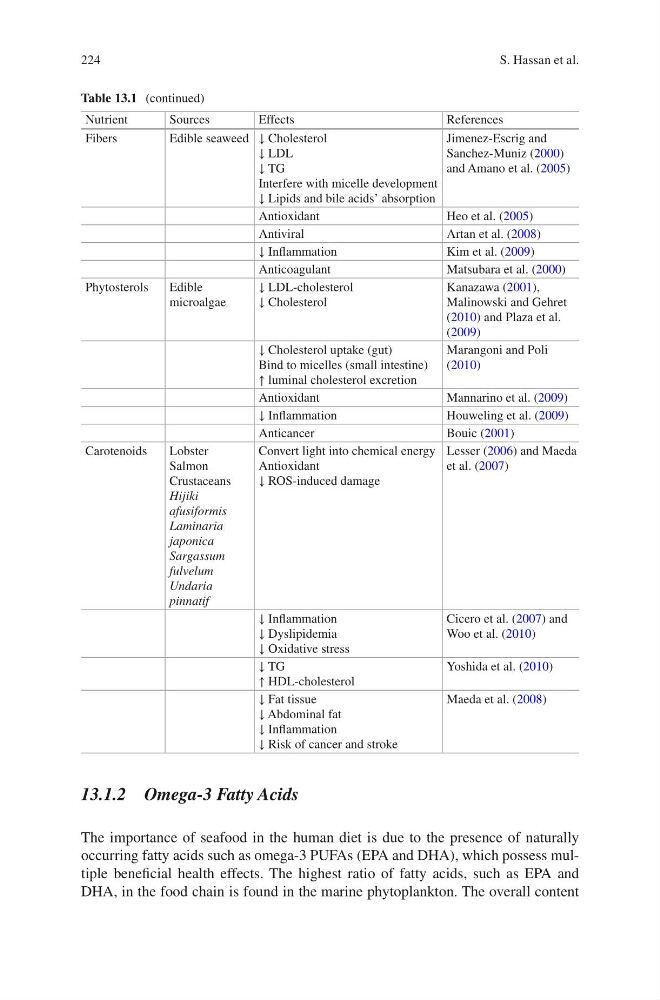
Table 13.1 (continued)
Nutrient
Sources
Effects
References
Fibers
Edible seaweed ↓ Cholesterol
↓ LDL
↓ TG
Interfere with micelle development
↓ Lipids and bile acids’ absorption
Jimenez-Escrig and
Sanchez-Muniz (2000)
and Amano et al. (2005)
Antioxidant
Heo et al. (2005)
Antiviral
Artan et al. (2008)
↓ Inflammation
Kim et al. (2009)
Anticoagulant
Matsubara et al. (2000)
Phytosterols
Edible
microalgae
↓ LDL-cholesterol
↓ Cholesterol
Kanazawa (2001),
Malinowski and Gehret
(2010) and Plaza et al.
(2009)
↓ Cholesterol uptake (gut)
Bind to micelles (small intestine)
↑ luminal cholesterol excretion
Marangoni and Poli
(2010)
Antioxidant
Mannarino et al. (2009)
↓ Inflammation
Houweling et al. (2009)
Anticancer
Bouic (2001)
Carotenoids
Lobster
Salmon
Crustaceans
Hijiki
afusiformis
Laminaria
japonica
Sargassum
fulvelum
Undaria
pinnatif
Convert light into chemical energy
Antioxidant
↓ ROS-induced damage
Lesser (2006) and Maeda
et al. (2007)
↓ Inflammation
↓ Dyslipidemia
↓ Oxidative stress
Cicero et al. (2007) and
Woo et al. (2010)
↓ TG
↑ HDL-cholesterol
Yoshida et al. (2010)
↓ Fat tissue
↓ Abdominal fat
↓ Inflammation
↓ Risk of cancer and stroke
Maeda et al. (2008)
S. Hassan et al.
13.1.2 Omega-3 Fatty Acids
The importance of seafood in the human diet is due to the presence of naturally
occurring fatty acids such as omega-3 PUFAs (EPA and DHA), which possess multiple beneficial health effects. The highest ratio of fatty acids, such as EPA and
DHA, in the food chain is found in the marine phytoplankton. The overall content
Table 13.1 (continued)
Nutrient
Sources
Effects
References
Fibers
Edible seaweed ↓ Cholesterol
↓ LDL
↓ TG
Interfere with micelle development
↓ Lipids and bile acids’ absorption
Jimenez-Escrig and
Sanchez-Muniz (2000)
and Amano et al. (2005)
Antioxidant
Heo et al. (2005)
Antiviral
Artan et al. (2008)
↓ Inflammation
Kim et al. (2009)
Anticoagulant
Matsubara et al. (2000)
Phytosterols
Edible
microalgae
↓ LDL-cholesterol
↓ Cholesterol
Kanazawa (2001),
Malinowski and Gehret
(2010) and Plaza et al.
(2009)
↓ Cholesterol uptake (gut)
Bind to micelles (small intestine)
↑ luminal cholesterol excretion
Marangoni and Poli
(2010)
Antioxidant
Mannarino et al. (2009)
↓ Inflammation
Houweling et al. (2009)
Anticancer
Bouic (2001)
Carotenoids
Lobster
Salmon
Crustaceans
Hijiki
afusiformis
Laminaria
japonica
Sargassum
fulvelum
Undaria
pinnatif
Convert light into chemical energy
Antioxidant
↓ ROS-induced damage
Lesser (2006) and Maeda
et al. (2007)
↓ Inflammation
↓ Dyslipidemia
↓ Oxidative stress
Cicero et al. (2007) and
Woo et al. (2010)
↓ TG
↑ HDL-cholesterol
Yoshida et al. (2010)
↓ Fat tissue
↓ Abdominal fat
↓ Inflammation
↓ Risk of cancer and stroke
Maeda et al. (2008)
S. Hassan et al.