

213
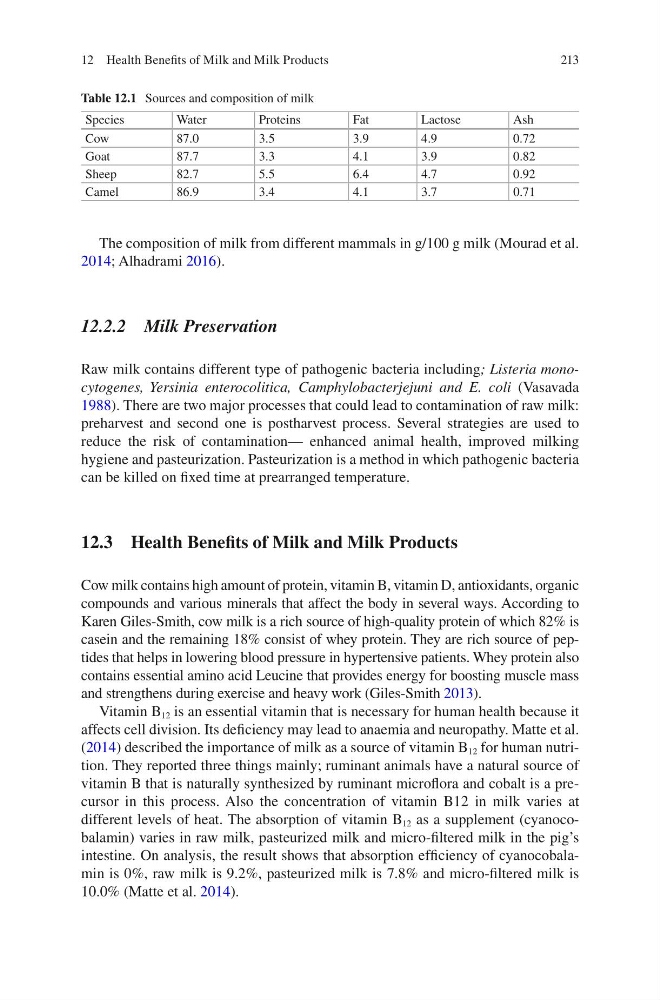
The composition of milk from different mammals in g/100 g milk (Mourad et al.
2014; Alhadrami 2016).
12.2.2 Milk Preservation
Raw milk contains different type of pathogenic bacteria including; Listeria monocytogenes, Yersinia enterocolitica, Camphylobacterjejuni and E. coli (Vasavada
1988). There are two major processes that could lead to contamination of raw milk:
preharvest and second one is postharvest process. Several strategies are used to
reduce the risk of contamination— enhanced animal health, improved milking
hygiene and pasteurization. Pasteurization is a method in which pathogenic bacteria
can be killed on fixed time at prearranged temperature.
12.3 Health Benefits of Milk and Milk Products
Cow milk contains high amount of protein, vitamin B, vitamin D, antioxidants, organic
compounds and various minerals that affect the body in several ways. According to
Karen Giles-Smith, cow milk is a rich source of high-quality protein of which 82% is
casein and the remaining 18% consist of whey protein. They are rich source of peptides that helps in lowering blood pressure in hypertensive patients. Whey protein also
contains essential amino acid Leucine that provides energy for boosting muscle mass
and strengthens during exercise and heavy work (Giles- Smith 2013).
Vitamin B 12 is an essential vitamin that is necessary for human health because it
affects cell division. Its deficiency may lead to anaemia and neuropathy. Matte et al.
(2014) described the importance of milk as a source of vitamin B 12 for human nutrition. They reported three things mainly; ruminant animals have a natural source of
vitamin B that is naturally synthesized by ruminant microflora and cobalt is a precursor in this process. Also the concentration of vitamin B12 in milk varies at
different levels of heat. The absorption of vitamin B 12 as a supplement (cyanocobalamin) varies in raw milk, pasteurized milk and micro-filtered milk in the pig’s
intestine. On analysis, the result shows that absorption efficiency of cyanocobalamin is 0%, raw milk is 9.2%, pasteurized milk is 7.8% and micro-filtered milk is
10.0% (Matte et al. 2014).
Table 12.1 Sources and composition of milk
Species
Water
Proteins
Fat
Lactose
Ash
Cow
87.0
3.5
3.9
4.9
0.72
Goat
87.7
3.3
4.1
3.9
0.82
Sheep
82.7
5.5
6.4
4.7
0.92
Camel
86.9
3.4
4.1
3.7
0.71
12 Health Benefits of Milk and Milk Products
The composition of milk from different mammals in g/100 g milk (Mourad et al.
2014; Alhadrami 2016).
12.2.2 Milk Preservation
Raw milk contains different type of pathogenic bacteria including; Listeria monocytogenes, Yersinia enterocolitica, Camphylobacterjejuni and E. coli (Vasavada
1988). There are two major processes that could lead to contamination of raw milk:
preharvest and second one is postharvest process. Several strategies are used to
reduce the risk of contamination— enhanced animal health, improved milking
hygiene and pasteurization. Pasteurization is a method in which pathogenic bacteria
can be killed on fixed time at prearranged temperature.
12.3 Health Benefits of Milk and Milk Products
Cow milk contains high amount of protein, vitamin B, vitamin D, antioxidants, organic
compounds and various minerals that affect the body in several ways. According to
Karen Giles-Smith, cow milk is a rich source of high-quality protein of which 82% is
casein and the remaining 18% consist of whey protein. They are rich source of peptides that helps in lowering blood pressure in hypertensive patients. Whey protein also
contains essential amino acid Leucine that provides energy for boosting muscle mass
and strengthens during exercise and heavy work (Giles- Smith 2013).
Vitamin B 12 is an essential vitamin that is necessary for human health because it
affects cell division. Its deficiency may lead to anaemia and neuropathy. Matte et al.
(2014) described the importance of milk as a source of vitamin B 12 for human nutrition. They reported three things mainly; ruminant animals have a natural source of
vitamin B that is naturally synthesized by ruminant microflora and cobalt is a precursor in this process. Also the concentration of vitamin B12 in milk varies at
different levels of heat. The absorption of vitamin B 12 as a supplement (cyanocobalamin) varies in raw milk, pasteurized milk and micro-filtered milk in the pig’s
intestine. On analysis, the result shows that absorption efficiency of cyanocobalamin is 0%, raw milk is 9.2%, pasteurized milk is 7.8% and micro-filtered milk is
10.0% (Matte et al. 2014).
Table 12.1 Sources and composition of milk
Species
Water
Proteins
Fat
Lactose
Ash
Cow
87.0
3.5
3.9
4.9
0.72
Goat
87.7
3.3
4.1
3.9
0.82
Sheep
82.7
5.5
6.4
4.7
0.92
Camel
86.9
3.4
4.1
3.7
0.71
12 Health Benefits of Milk and Milk Products