

212
Milk is a probiotic compound because it contains viable bacteria that are beneficial for human health (Roberfroid 2000). Milk is white (yellow-white or bluishwhite) liquid secreted by the mammary gland of female mammals. Humans use this
as food especially for the nourishment of their offspring. Milk is an important source
of energy which contains water, milk sugar (lactose), fat, protein, vitamins and minerals (Soliman 2005). Quantitatively, four components are dominant: water, fat, protein and lactose; while minerals, enzymes, vitamins, and dissolved gases constitute
the minor constituents (Mourad et al. 2014). The misconception that milk and milk
products contain fatty content that causes obesity and heart diseases could be
responsible for the less intake of milk. This chapter succinctly reviews the composition, source and health benefits of milk and milk products in clear perspectives.
12.2 Sources, Composition and Preservation of Milk
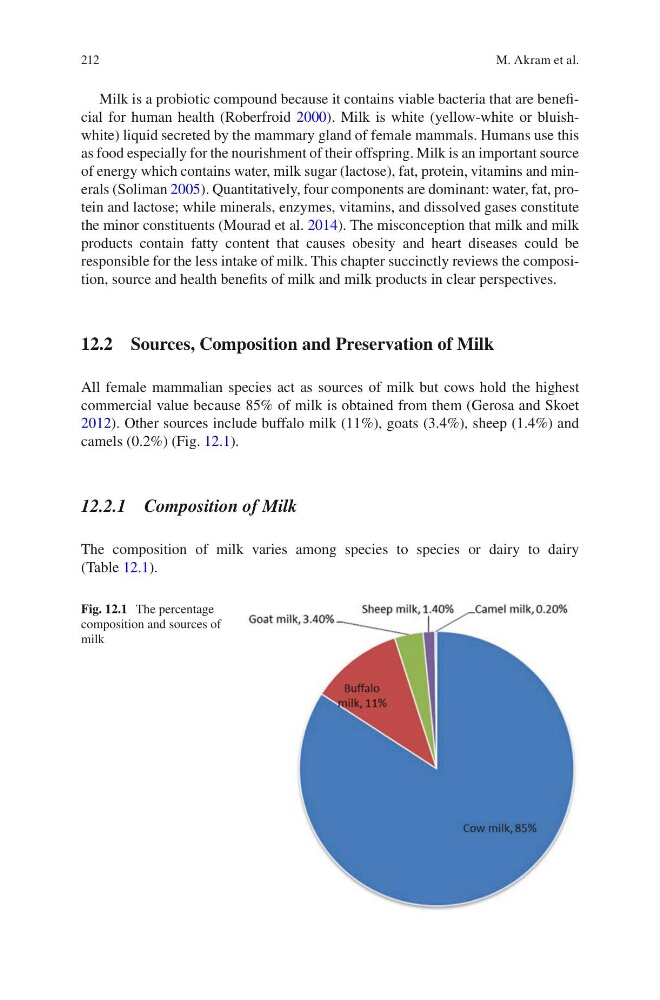
All female mammalian species act as sources of milk but cows hold the highest
commercial value because 85% of milk is obtained from them (Gerosa and Skoet
2012). Other sources include buffalo milk (11%), goats (3.4%), sheep (1.4%) and
camels (0.2%) (Fig. 12.1).
12.2.1 Composition of Milk
The composition of milk varies among species to species or dairy to dairy
(Table 12.1).
Fig. 12.1 The percentage
composition and sources of
milk
M. Akram et al.
Milk is a probiotic compound because it contains viable bacteria that are beneficial for human health (Roberfroid 2000). Milk is white (yellow-white or bluishwhite) liquid secreted by the mammary gland of female mammals. Humans use this
as food especially for the nourishment of their offspring. Milk is an important source
of energy which contains water, milk sugar (lactose), fat, protein, vitamins and minerals (Soliman 2005). Quantitatively, four components are dominant: water, fat, protein and lactose; while minerals, enzymes, vitamins, and dissolved gases constitute
the minor constituents (Mourad et al. 2014). The misconception that milk and milk
products contain fatty content that causes obesity and heart diseases could be
responsible for the less intake of milk. This chapter succinctly reviews the composition, source and health benefits of milk and milk products in clear perspectives.
12.2 Sources, Composition and Preservation of Milk
All female mammalian species act as sources of milk but cows hold the highest
commercial value because 85% of milk is obtained from them (Gerosa and Skoet
2012). Other sources include buffalo milk (11%), goats (3.4%), sheep (1.4%) and
camels (0.2%) (Fig. 12.1).
12.2.1 Composition of Milk
The composition of milk varies among species to species or dairy to dairy
(Table 12.1).
Fig. 12.1 The percentage
composition and sources of
milk
M. Akram et al.