

176
characterization of safety and probiotic attributes; (3) Health benefits validation;
and (4) Labeling of potency claims and compositions for the entire shelf life. WHO,
FAO, and EFSA (the European Food Safety Authority) suggested that probiotic
strains in their selection process, must meet both safety and functionality criteria, as
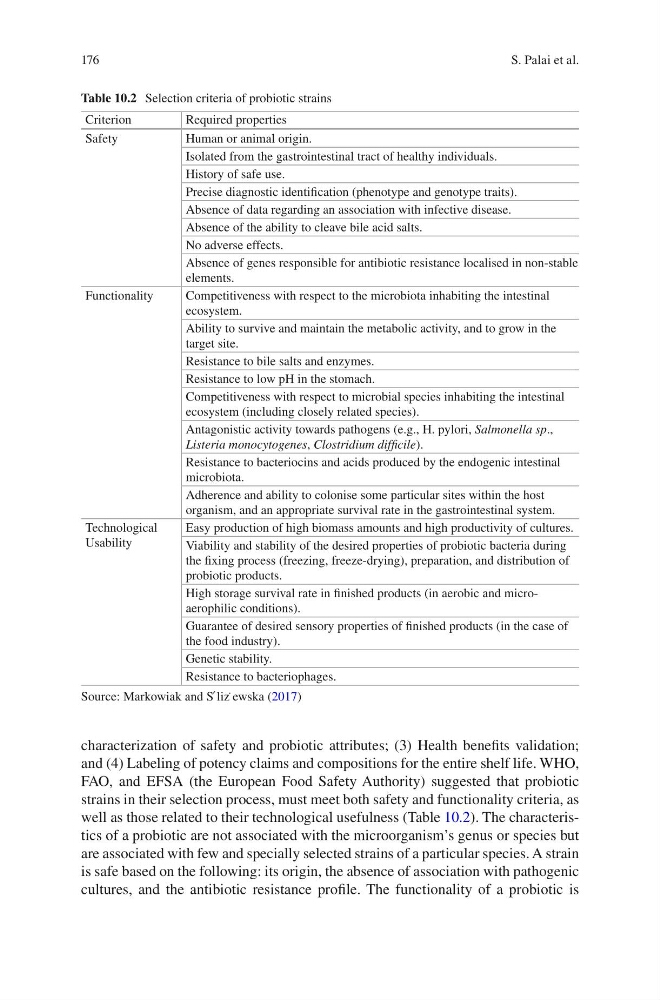
well as those related to their technological usefulness (Table 10.2). The characteristics of a probiotic are not associated with the microorganism’s genus or species but
are associated with few and specially selected strains of a particular species. A strain
is safe based on the following: its origin, the absence of association with pathogenic
cultures, and the antibiotic resistance profile. The functionality of a probiotic is
Table 10.2 Selection criteria of probiotic strains
Criterion
Required properties
Safety
Human or animal origin.
Isolated from the gastrointestinal tract of healthy individuals.
History of safe use.
Precise diagnostic identification (phenotype and genotype traits).
Absence of data regarding an association with infective disease.
Absence of the ability to cleave bile acid salts.
No adverse effects.
Absence of genes responsible for antibiotic resistance localised in non-stable
elements.
Functionality
Competitiveness with respect to the microbiota inhabiting the intestinal
ecosystem.
Ability to survive and maintain the metabolic activity, and to grow in the
target site.
Resistance to bile salts and enzymes.
Resistance to low pH in the stomach.
Competitiveness with respect to microbial species inhabiting the intestinal
ecosystem (including closely related species).
Antagonistic activity towards pathogens (e.g., H. pylori, Salmonella sp.,
Listeria monocytogenes, Clostridium difficile).
Resistance to bacteriocins and acids produced by the endogenic intestinal
microbiota.
Adherence and ability to colonise some particular sites within the host
organism, and an appropriate survival rate in the gastrointestinal system.
Technological
Usability
Easy production of high biomass amounts and high productivity of cultures.
Viability and stability of the desired properties of probiotic bacteria during
the fixing process (freezing, freeze-drying), preparation, and distribution of
probiotic products.
High storage survival rate in finished products (in aerobic and microaerophilic conditions).
Guarantee of desired sensory properties of finished products (in the case of
the food industry).
Genetic stability.
Resistance to bacteriophages.
Source: Markowiak and S ́ liz ̇ ewska (2017)
S. Palai et al.
characterization of safety and probiotic attributes; (3) Health benefits validation;
and (4) Labeling of potency claims and compositions for the entire shelf life. WHO,
FAO, and EFSA (the European Food Safety Authority) suggested that probiotic
strains in their selection process, must meet both safety and functionality criteria, as
well as those related to their technological usefulness (Table 10.2). The characteristics of a probiotic are not associated with the microorganism’s genus or species but
are associated with few and specially selected strains of a particular species. A strain
is safe based on the following: its origin, the absence of association with pathogenic
cultures, and the antibiotic resistance profile. The functionality of a probiotic is
Table 10.2 Selection criteria of probiotic strains
Criterion
Required properties
Safety
Human or animal origin.
Isolated from the gastrointestinal tract of healthy individuals.
History of safe use.
Precise diagnostic identification (phenotype and genotype traits).
Absence of data regarding an association with infective disease.
Absence of the ability to cleave bile acid salts.
No adverse effects.
Absence of genes responsible for antibiotic resistance localised in non-stable
elements.
Functionality
Competitiveness with respect to the microbiota inhabiting the intestinal
ecosystem.
Ability to survive and maintain the metabolic activity, and to grow in the
target site.
Resistance to bile salts and enzymes.
Resistance to low pH in the stomach.
Competitiveness with respect to microbial species inhabiting the intestinal
ecosystem (including closely related species).
Antagonistic activity towards pathogens (e.g., H. pylori, Salmonella sp.,
Listeria monocytogenes, Clostridium difficile).
Resistance to bacteriocins and acids produced by the endogenic intestinal
microbiota.
Adherence and ability to colonise some particular sites within the host
organism, and an appropriate survival rate in the gastrointestinal system.
Technological
Usability
Easy production of high biomass amounts and high productivity of cultures.
Viability and stability of the desired properties of probiotic bacteria during
the fixing process (freezing, freeze-drying), preparation, and distribution of
probiotic products.
High storage survival rate in finished products (in aerobic and microaerophilic conditions).
Guarantee of desired sensory properties of finished products (in the case of
the food industry).
Genetic stability.
Resistance to bacteriophages.
Source: Markowiak and S ́ liz ̇ ewska (2017)
S. Palai et al.