

175
10.2.1 Classification and Selection Criteria
Probiotics are known by genus, species, and strain. The strain designation is important because same species will have different strains, hence, different health effects.
Dose should also be considered because a probiotic consumed at a higher dose will
not always mean that it will have a greater health benefit than one given at a lower
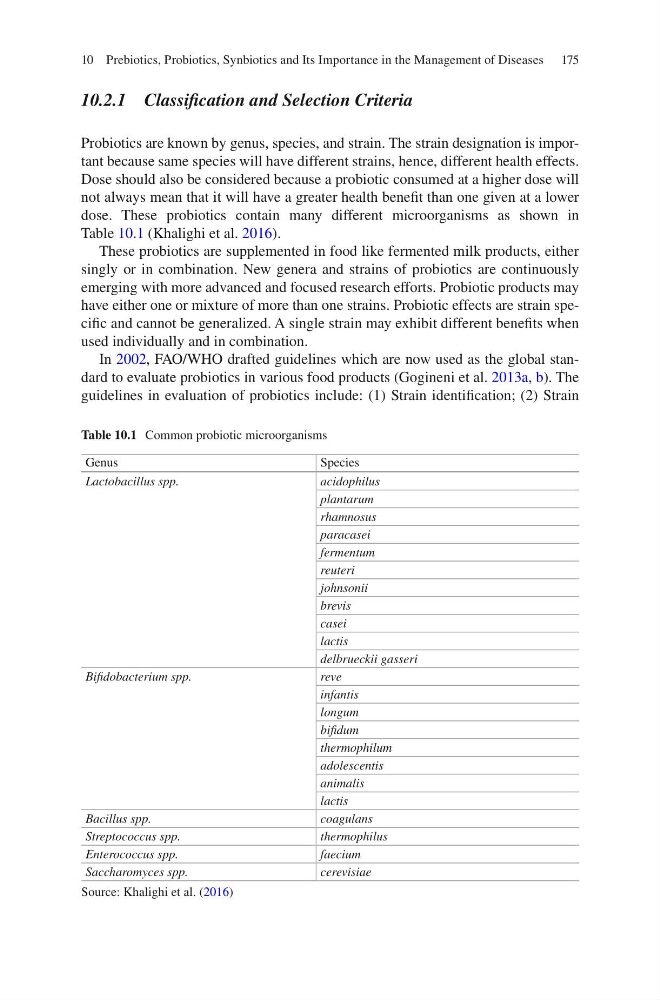
dose. These probiotics contain many different microorganisms as shown in
Table 10.1 (Khalighi et al. 2016).
These probiotics are supplemented in food like fermented milk products, either
singly or in combination. New genera and strains of probiotics are continuously
emerging with more advanced and focused research efforts. Probiotic products may
have either one or mixture of more than one strains. Probiotic effects are strain specific and cannot be generalized. A single strain may exhibit different benefits when
used individually and in combination.
In 2002, FAO/WHO drafted guidelines which are now used as the global standard to evaluate probiotics in various food products (Gogineni et al. 2013a, b). The
guidelines in evaluation of probiotics include: (1) Strain identification; (2) Strain
Table 10.1 Common probiotic microorganisms
Genus
Species
Lactobacillus spp.
acidophilus
plantarum
rhamnosus
paracasei
fermentum
reuteri
johnsonii
brevis
casei
lactis
delbrueckii gasseri
Bifidobacterium spp.
reve
infantis
longum
bifidum
thermophilum
adolescentis
animalis
lactis
Bacillus spp.
coagulans
Streptococcus spp.
thermophilus
Enterococcus spp.
faecium
Saccharomyces spp.
cerevisiae
Source: Khalighi et al. (2016)
10 Prebiotics, Probiotics, Synbiotics and Its Importance in the Management of Diseases
10.2.1 Classification and Selection Criteria
Probiotics are known by genus, species, and strain. The strain designation is important because same species will have different strains, hence, different health effects.
Dose should also be considered because a probiotic consumed at a higher dose will
not always mean that it will have a greater health benefit than one given at a lower
dose. These probiotics contain many different microorganisms as shown in
Table 10.1 (Khalighi et al. 2016).
These probiotics are supplemented in food like fermented milk products, either
singly or in combination. New genera and strains of probiotics are continuously
emerging with more advanced and focused research efforts. Probiotic products may
have either one or mixture of more than one strains. Probiotic effects are strain specific and cannot be generalized. A single strain may exhibit different benefits when
used individually and in combination.
In 2002, FAO/WHO drafted guidelines which are now used as the global standard to evaluate probiotics in various food products (Gogineni et al. 2013a, b). The
guidelines in evaluation of probiotics include: (1) Strain identification; (2) Strain
Table 10.1 Common probiotic microorganisms
Genus
Species
Lactobacillus spp.
acidophilus
plantarum
rhamnosus
paracasei
fermentum
reuteri
johnsonii
brevis
casei
lactis
delbrueckii gasseri
Bifidobacterium spp.
reve
infantis
longum
bifidum
thermophilum
adolescentis
animalis
lactis
Bacillus spp.
coagulans
Streptococcus spp.
thermophilus
Enterococcus spp.
faecium
Saccharomyces spp.
cerevisiae
Source: Khalighi et al. (2016)
10 Prebiotics, Probiotics, Synbiotics and Its Importance in the Management of Diseases