

163
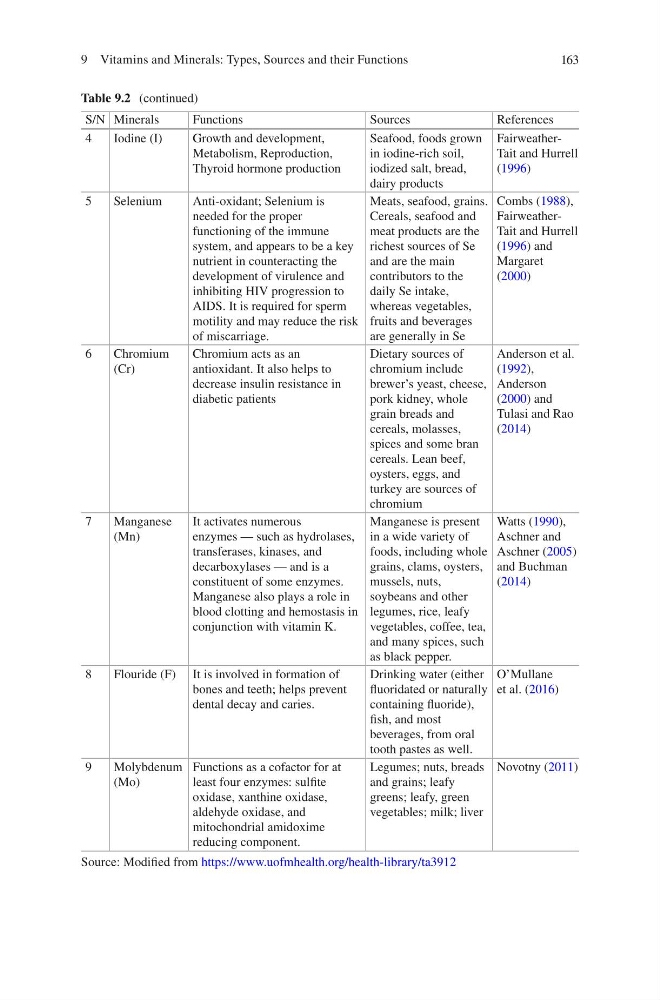
Table 9.2 (continued)
S/N Minerals
Functions
Sources
References
4
Iodine (I)
Growth and development,
Metabolism, Reproduction,
Thyroid hormone production
Seafood, foods grown
in iodine-rich soil,
iodized salt, bread,
dairy products
FairweatherTait and Hurrell
(1996)
5
Selenium
Anti-oxidant; Selenium is
needed for the proper
functioning of the immune
system, and appears to be a key
nutrient in counteracting the
development of virulence and
inhibiting HIV progression to
AIDS. It is required for sperm
motility and may reduce the risk
of miscarriage.
Meats, seafood, grains.
Cereals, seafood and
meat products are the
richest sources of Se
and are the main
contributors to the
daily Se intake,
whereas vegetables,
fruits and beverages
are generally in Se
Combs (1988),
FairweatherTait and Hurrell
(1996) and
Margaret
(2000)
6
Chromium
(Cr)
Chromium acts as an
antioxidant. It also helps to
decrease insulin resistance in
diabetic patients
Dietary sources of
chromium include
brewer’s yeast, cheese,
pork kidney, whole
grain breads and
cereals, molasses,
spices and some bran
cereals. Lean beef,
oysters, eggs, and
turkey are sources of
chromium
Anderson et al.
(1992),
Anderson
(2000) and
Tulasi and Rao
(2014)
7
Manganese
(Mn)
It activates numerous
enzymes — such as hydrolases,
transferases, kinases, and
decarboxylases — and is a
constituent of some enzymes.
Manganese also plays a role in
blood clotting and hemostasis in
conjunction with vitamin K.
Manganese is present
in a wide variety of
foods, including whole
grains, clams, oysters,
mussels, nuts,
soybeans and other
legumes, rice, leafy
vegetables, coffee, tea,
and many spices, such
as black pepper.
Watts (1990),
Aschner and
Aschner (2005)
and Buchman
(2014)
8
Flouride (F) It is involved in formation of
bones and teeth; helps prevent
dental decay and caries.
Drinking water (either
fluoridated or naturally
containing fluoride),
fish, and most
beverages, from oral
tooth pastes as well.
O’Mullane
et al. (2016)
9
Molybdenum
(Mo)
Functions as a cofactor for at
least four enzymes: sulfite
oxidase, xanthine oxidase,
aldehyde oxidase, and
mitochondrial amidoxime
reducing component.
Legumes; nuts, breads
and grains; leafy
greens; leafy, green
vegetables; milk; liver
Novotny (2011)
Source: Modified from https://www.uofmhealth.org/health-library/ta3912
9 Vitamins and Minerals: Types, Sources and their Functions
Table 9.2 (continued)
S/N Minerals
Functions
Sources
References
4
Iodine (I)
Growth and development,
Metabolism, Reproduction,
Thyroid hormone production
Seafood, foods grown
in iodine-rich soil,
iodized salt, bread,
dairy products
FairweatherTait and Hurrell
(1996)
5
Selenium
Anti-oxidant; Selenium is
needed for the proper
functioning of the immune
system, and appears to be a key
nutrient in counteracting the
development of virulence and
inhibiting HIV progression to
AIDS. It is required for sperm
motility and may reduce the risk
of miscarriage.
Meats, seafood, grains.
Cereals, seafood and
meat products are the
richest sources of Se
and are the main
contributors to the
daily Se intake,
whereas vegetables,
fruits and beverages
are generally in Se
Combs (1988),
FairweatherTait and Hurrell
(1996) and
Margaret
(2000)
6
Chromium
(Cr)
Chromium acts as an
antioxidant. It also helps to
decrease insulin resistance in
diabetic patients
Dietary sources of
chromium include
brewer’s yeast, cheese,
pork kidney, whole
grain breads and
cereals, molasses,
spices and some bran
cereals. Lean beef,
oysters, eggs, and
turkey are sources of
chromium
Anderson et al.
(1992),
Anderson
(2000) and
Tulasi and Rao
(2014)
7
Manganese
(Mn)
It activates numerous
enzymes — such as hydrolases,
transferases, kinases, and
decarboxylases — and is a
constituent of some enzymes.
Manganese also plays a role in
blood clotting and hemostasis in
conjunction with vitamin K.
Manganese is present
in a wide variety of
foods, including whole
grains, clams, oysters,
mussels, nuts,
soybeans and other
legumes, rice, leafy
vegetables, coffee, tea,
and many spices, such
as black pepper.
Watts (1990),
Aschner and
Aschner (2005)
and Buchman
(2014)
8
Flouride (F) It is involved in formation of
bones and teeth; helps prevent
dental decay and caries.
Drinking water (either
fluoridated or naturally
containing fluoride),
fish, and most
beverages, from oral
tooth pastes as well.
O’Mullane
et al. (2016)
9
Molybdenum
(Mo)
Functions as a cofactor for at
least four enzymes: sulfite
oxidase, xanthine oxidase,
aldehyde oxidase, and
mitochondrial amidoxime
reducing component.
Legumes; nuts, breads
and grains; leafy
greens; leafy, green
vegetables; milk; liver
Novotny (2011)
Source: Modified from https://www.uofmhealth.org/health-library/ta3912
9 Vitamins and Minerals: Types, Sources and their Functions