

162
Because humans are omnivorous, trace element deficiencies are unlikely to develop.
Studies have shown that mineral deficiencies are not more frequent among vegetarians than among non-vegetarians. In fact, man’s need for trace elements has not yet
been precisely determined. Trace elements should not be used as dietary supplements, since excessive amounts can have injurious effects. Phosphorus is involved
in the formation of bone and teeth, ATP, GTP and UTP. It is a component of DNA
and RNA, it is present in phospholipids and it forms part of cell membranes.
Hyperphosphatemia can occur in renal failure (Arai and Sakuma 2015).
9.4.2 Trace Elements
As the name implies, trace elements are essential group of minerals, which are
needed, in small quantity for the day-to-day metabolic processes in man. They are
regarded, as trace elements because their daily requirement should be below 100 mg,
above which can be toxic to health. However, the deficiency of any of these trace
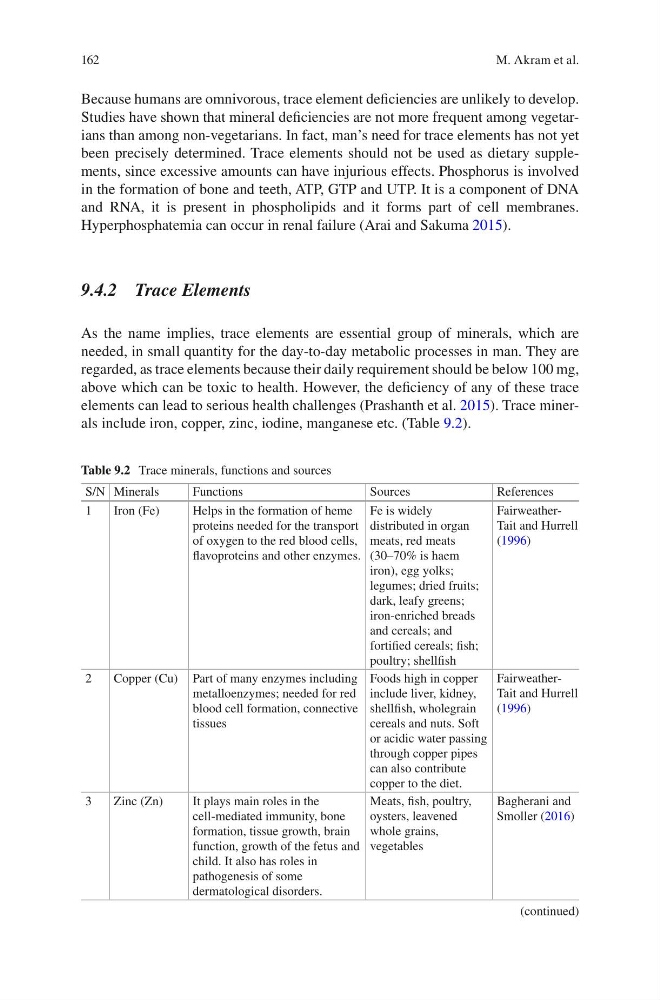
elements can lead to serious health challenges (Prashanth et al. 2015). Trace minerals include iron, copper, zinc, iodine, manganese etc. (Table 9.2).
Table 9.2 Trace minerals, functions and sources
S/N Minerals
Functions
Sources
References
1
Iron (Fe)
Helps in the formation of heme
proteins needed for the transport
of oxygen to the red blood cells,
flavoproteins and other enzymes.
Fe is widely
distributed in organ
meats, red meats
(30–70% is haem
iron), egg yolks;
legumes; dried fruits;
dark, leafy greens;
iron-enriched breads
and cereals; and
fortified cereals; fish;
poultry; shellfish
FairweatherTait and Hurrell
(1996)
2
Copper (Cu) Part of many enzymes including
metalloenzymes; needed for red
blood cell formation, connective
tissues
Foods high in copper
include liver, kidney,
shellfish, wholegrain
cereals and nuts. Soft
or acidic water passing
through copper pipes
can also contribute
copper to the diet.
FairweatherTait and Hurrell
(1996)
3
Zinc (Zn)
It plays main roles in the
cell-mediated immunity, bone
formation, tissue growth, brain
function, growth of the fetus and
child. It also has roles in
pathogenesis of some
dermatological disorders.
Meats, fish, poultry,
oysters, leavened
whole grains,
vegetables
Bagherani and
Smoller (2016)
(continued)
M. Akram et al.
Because humans are omnivorous, trace element deficiencies are unlikely to develop.
Studies have shown that mineral deficiencies are not more frequent among vegetarians than among non-vegetarians. In fact, man’s need for trace elements has not yet
been precisely determined. Trace elements should not be used as dietary supplements, since excessive amounts can have injurious effects. Phosphorus is involved
in the formation of bone and teeth, ATP, GTP and UTP. It is a component of DNA
and RNA, it is present in phospholipids and it forms part of cell membranes.
Hyperphosphatemia can occur in renal failure (Arai and Sakuma 2015).
9.4.2 Trace Elements
As the name implies, trace elements are essential group of minerals, which are
needed, in small quantity for the day-to-day metabolic processes in man. They are
regarded, as trace elements because their daily requirement should be below 100 mg,
above which can be toxic to health. However, the deficiency of any of these trace
elements can lead to serious health challenges (Prashanth et al. 2015). Trace minerals include iron, copper, zinc, iodine, manganese etc. (Table 9.2).
Table 9.2 Trace minerals, functions and sources
S/N Minerals
Functions
Sources
References
1
Iron (Fe)
Helps in the formation of heme
proteins needed for the transport
of oxygen to the red blood cells,
flavoproteins and other enzymes.
Fe is widely
distributed in organ
meats, red meats
(30–70% is haem
iron), egg yolks;
legumes; dried fruits;
dark, leafy greens;
iron-enriched breads
and cereals; and
fortified cereals; fish;
poultry; shellfish
FairweatherTait and Hurrell
(1996)
2
Copper (Cu) Part of many enzymes including
metalloenzymes; needed for red
blood cell formation, connective
tissues
Foods high in copper
include liver, kidney,
shellfish, wholegrain
cereals and nuts. Soft
or acidic water passing
through copper pipes
can also contribute
copper to the diet.
FairweatherTait and Hurrell
(1996)
3
Zinc (Zn)
It plays main roles in the
cell-mediated immunity, bone
formation, tissue growth, brain
function, growth of the fetus and
child. It also has roles in
pathogenesis of some
dermatological disorders.
Meats, fish, poultry,
oysters, leavened
whole grains,
vegetables
Bagherani and
Smoller (2016)
(continued)
M. Akram et al.