

classification in the traditional economy as: primary or secondary. It is important to
note that these segments are structured according to the methodology of means to
take advantage of the bioeconomy, proposed by the Inter-American Institute for
Cooperation on Agriculture (IICA by its Spanish acronym) (IICA 2019).
Hence, the bioagriculture segment is linked to traditional agricultural activities
that produce goods and services derived from the direct use and sustainable transformation of biological resources. These are classified as primary economic
activities, which are highly employment-generating but less capital-intensive.
Within this segment, the main focus is on the use of resource biodiversity through
innovation and the development of domestic markets, as well as sustainable intensification through agricultural practices that raise production levels while maintaining
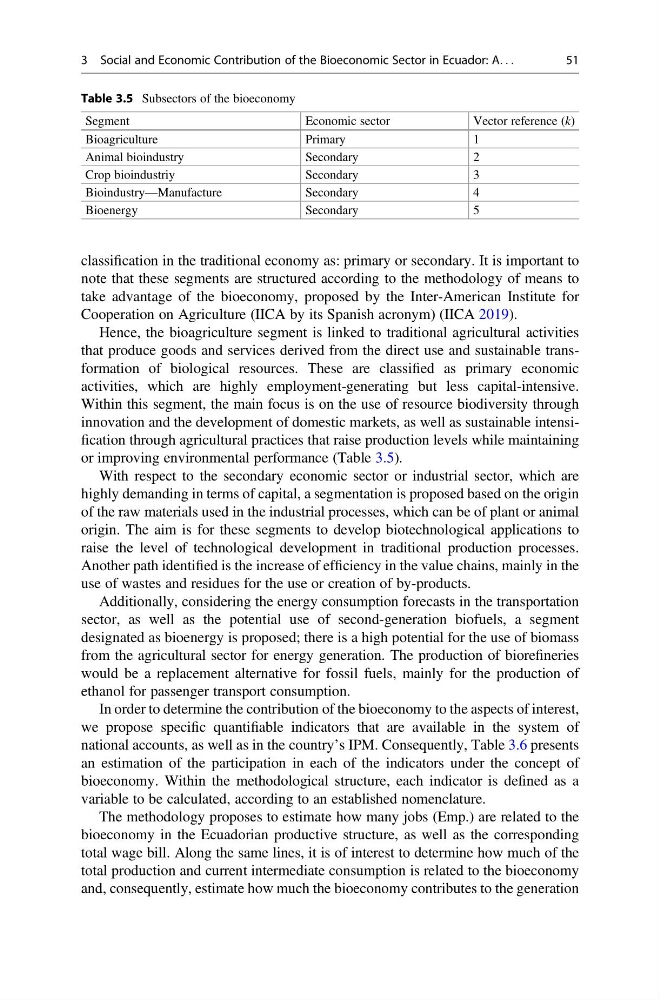
or improving environmental performance (Table 3.5).
With respect to the secondary economic sector or industrial sector, which are
highly demanding in terms of capital, a segmentation is proposed based on the origin
of the raw materials used in the industrial processes, which can be of plant or animal
origin. The aim is for these segments to develop biotechnological applications to
raise the level of technological development in traditional production processes.
Another path identified is the increase of efficiency in the value chains, mainly in the
use of wastes and residues for the use or creation of by-products.
Additionally, considering the energy consumption forecasts in the transportation
sector, as well as the potential use of second-generation biofuels, a segment
designated as bioenergy is proposed; there is a high potential for the use of biomass
from the agricultural sector for energy generation. The production of biorefineries
would be a replacement alternative for fossil fuels, mainly for the production of
ethanol for passenger transport consumption.
In order to determine the contribution of the bioeconomy to the aspects of interest,
we propose specific quantifiable indicators that are available in the system of
national accounts, as well as in the country’s IPM. Consequently, Table 3.6 presents
an estimation of the participation in each of the indicators under the concept of
bioeconomy. Within the methodological structure, each indicator is defined as a
variable to be calculated, according to an established nomenclature.
The methodology proposes to estimate how many jobs (Emp.) are related to the
bioeconomy in the Ecuadorian productive structure, as well as the corresponding
total wage bill. Along the same lines, it is of interest to determine how much of the
total production and current intermediate consumption is related to the bioeconomy
and, consequently, estimate how much the bioeconomy contributes to the generation
Table 3.5 Subsectors of the bioeconomy
Segment
Economic sector
Vector reference (k)
Bioagriculture
Primary
1
Animal bioindustry
Secondary
2
Crop bioindustriy
Secondary
3
Bioindustry—Manufacture
Secondary
4
Bioenergy
Secondary
5
3 Social and Economic Contribution of the Bioeconomic Sector in Ecuador: A. . .
51
note that these segments are structured according to the methodology of means to
take advantage of the bioeconomy, proposed by the Inter-American Institute for
Cooperation on Agriculture (IICA by its Spanish acronym) (IICA 2019).
Hence, the bioagriculture segment is linked to traditional agricultural activities
that produce goods and services derived from the direct use and sustainable transformation of biological resources. These are classified as primary economic
activities, which are highly employment-generating but less capital-intensive.
Within this segment, the main focus is on the use of resource biodiversity through
innovation and the development of domestic markets, as well as sustainable intensification through agricultural practices that raise production levels while maintaining
or improving environmental performance (Table 3.5).
With respect to the secondary economic sector or industrial sector, which are
highly demanding in terms of capital, a segmentation is proposed based on the origin
of the raw materials used in the industrial processes, which can be of plant or animal
origin. The aim is for these segments to develop biotechnological applications to
raise the level of technological development in traditional production processes.
Another path identified is the increase of efficiency in the value chains, mainly in the
use of wastes and residues for the use or creation of by-products.
Additionally, considering the energy consumption forecasts in the transportation
sector, as well as the potential use of second-generation biofuels, a segment
designated as bioenergy is proposed; there is a high potential for the use of biomass
from the agricultural sector for energy generation. The production of biorefineries
would be a replacement alternative for fossil fuels, mainly for the production of
ethanol for passenger transport consumption.
In order to determine the contribution of the bioeconomy to the aspects of interest,
we propose specific quantifiable indicators that are available in the system of
national accounts, as well as in the country’s IPM. Consequently, Table 3.6 presents
an estimation of the participation in each of the indicators under the concept of
bioeconomy. Within the methodological structure, each indicator is defined as a
variable to be calculated, according to an established nomenclature.
The methodology proposes to estimate how many jobs (Emp.) are related to the
bioeconomy in the Ecuadorian productive structure, as well as the corresponding
total wage bill. Along the same lines, it is of interest to determine how much of the
total production and current intermediate consumption is related to the bioeconomy
and, consequently, estimate how much the bioeconomy contributes to the generation
Table 3.5 Subsectors of the bioeconomy
Segment
Economic sector
Vector reference (k)
Bioagriculture
Primary
1
Animal bioindustry
Secondary
2
Crop bioindustriy
Secondary
3
Bioindustry—Manufacture
Secondary
4
Bioenergy
Secondary
5
3 Social and Economic Contribution of the Bioeconomic Sector in Ecuador: A. . .
51