

15.2.5 Estimation of Outflow of K
The principle which applied to compute inflows was used to estimate outflows of
various form of losses and crop uptake method. Uptake of nutrients differs among
crops and type of land. Based on available uptake coefficient (kg per year) of K, the
amount of depletion was assessed by crop removals, i.e. crop yield. Leaching of K
was assumed as 15% of the K input (Regmi et al. 2002).
15.2.6 Period of Study and Sources of Data
The study used both cross-sectional (districts) and time series data (1990–1991 to
2012–2013). Secondary data were collected on area, production and productivity of
irrigated and unirrigated crops, major nutrient (K) supply, livestock population and
climate variables. Season and Crop Reports published by Department of Economics
and Statistics, Government of Tamil Nadu were the main sources for data for crops,
area, production and productivity. District wise supply of fertilizers and livestock
data were gathered from Economic Appraisal of Tamil Nadu and Statistical Abstract
of Tamil Nadu for the above period. The collected data were compiled and analysed
for composite districts. Conversion factors of nutrients for various formulations of
fertilizers and nutrient sources were derived from literature previously published.
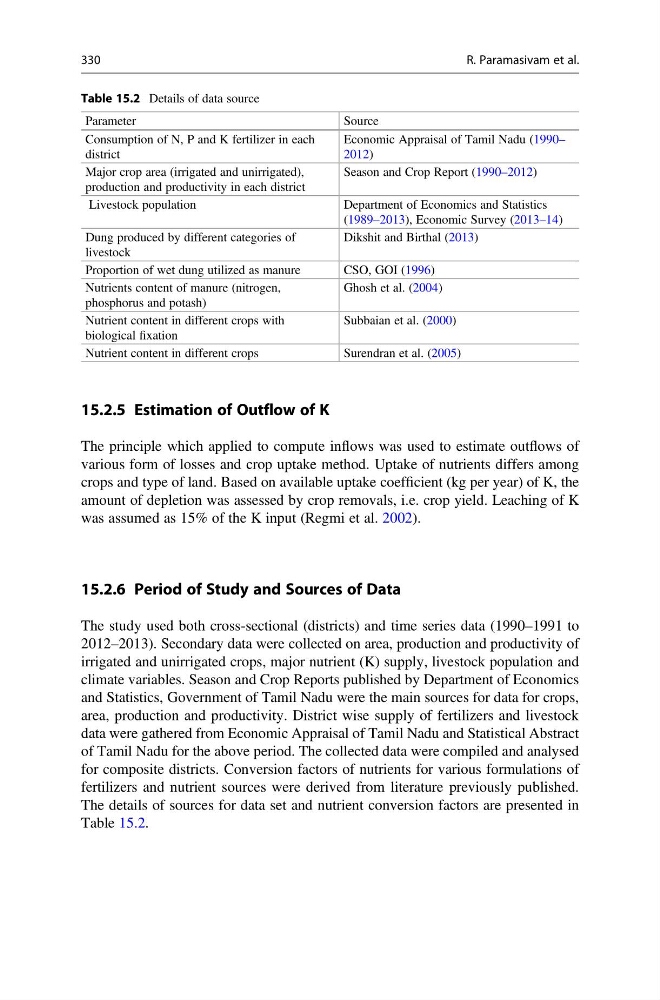
The details of sources for data set and nutrient conversion factors are presented in
Table 15.2.
Table 15.2 Details of data source
Parameter
Source
Consumption of N, P and K fertilizer in each
district
Economic Appraisal of Tamil Nadu (1990–
2012)
Major crop area (irrigated and unirrigated),
production and productivity in each district
Season and Crop Report (1990–2012)
Livestock population
Department of Economics and Statistics
(1989–2013), Economic Survey (2013–14)
Dung produced by different categories of
livestock
Dikshit and Birthal (2013)
Proportion of wet dung utilized as manure
CSO, GOI (1996)
Nutrients content of manure (nitrogen,
phosphorus and potash)
Ghosh et al. (2004)
Nutrient content in different crops with
biological fixation
Subbaian et al. (2000)
Nutrient content in different crops
Surendran et al. (2005)
330
R. Paramasivam et al.
The principle which applied to compute inflows was used to estimate outflows of
various form of losses and crop uptake method. Uptake of nutrients differs among
crops and type of land. Based on available uptake coefficient (kg per year) of K, the
amount of depletion was assessed by crop removals, i.e. crop yield. Leaching of K
was assumed as 15% of the K input (Regmi et al. 2002).
15.2.6 Period of Study and Sources of Data
The study used both cross-sectional (districts) and time series data (1990–1991 to
2012–2013). Secondary data were collected on area, production and productivity of
irrigated and unirrigated crops, major nutrient (K) supply, livestock population and
climate variables. Season and Crop Reports published by Department of Economics
and Statistics, Government of Tamil Nadu were the main sources for data for crops,
area, production and productivity. District wise supply of fertilizers and livestock
data were gathered from Economic Appraisal of Tamil Nadu and Statistical Abstract
of Tamil Nadu for the above period. The collected data were compiled and analysed
for composite districts. Conversion factors of nutrients for various formulations of
fertilizers and nutrient sources were derived from literature previously published.
The details of sources for data set and nutrient conversion factors are presented in
Table 15.2.
Table 15.2 Details of data source
Parameter
Source
Consumption of N, P and K fertilizer in each
district
Economic Appraisal of Tamil Nadu (1990–
2012)
Major crop area (irrigated and unirrigated),
production and productivity in each district
Season and Crop Report (1990–2012)
Livestock population
Department of Economics and Statistics
(1989–2013), Economic Survey (2013–14)
Dung produced by different categories of
livestock
Dikshit and Birthal (2013)
Proportion of wet dung utilized as manure
CSO, GOI (1996)
Nutrients content of manure (nitrogen,
phosphorus and potash)
Ghosh et al. (2004)
Nutrient content in different crops with
biological fixation
Subbaian et al. (2000)
Nutrient content in different crops
Surendran et al. (2005)
330
R. Paramasivam et al.