

12.3.5 Bioenergy
Sustainable bioenergy is a versatile source of low-carbon energy, which plays a
crucial role in meeting carbon budgets. Bioenergy that comes from the conversion of
biological resources is a highly flexible option for decarbonizing the economy,
spanning a wide range of fuel feedstocks, conversion technologies, and end-use
applications. There are several large-scale commercial deployments already in
progress, including bioethanol production and the use of biomass in co-firing and
dedicated combustion. A mixed portfolio of bioenergy supply must be maintained at
this time, ensuring the development of competitive and secure bioenergy and a firm
research base for future large-scale deployments (Winskel et al. 2009).
Bioenergy is often considered carbon neutral, as the carbon dioxide released in
combustion is assumed to be compensated by the CO 2 absorbed during the growth of
trees or other plants. Global sustainable bioenergy potential has been estimated to be
between 200 and 500 EJ/year in 2050. Currently, agricultural crop residues and
municipal wastes are the primary feedstocks for the electricity generation and heat
energy production. Further, “a small share of sugar, grain, and vegetable oil crops”
are used as feedstocks for the production of liquid biofuels (Prasad et al. 2012).
Ethanol production from biomass such as sugar-containing materials like sugarcane
or sweet sorghum syrup/juice is the most straightforward route for producing
biofuels (Prasad et al. 2006, 2009, 2013).
The biochemical conversion of biomass into ethanol happens in three steps:
pretreatment, enzymatic hydrolysis, and fermentation (Prasad et al. 2019a, b).
Pretreatment weakens the plant wall, then acid or enzymatic hydrolysis separates
the cellulose into sugars, and lastly, fermentation converts the sugars into ethanol
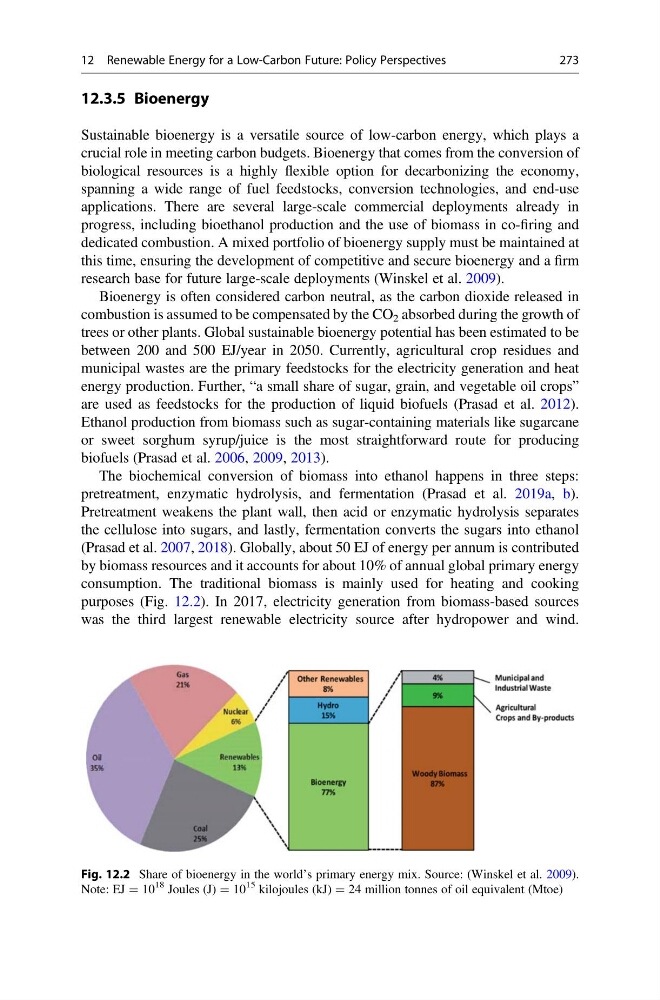
(Prasad et al. 2007, 2018). Globally, about 50 EJ of energy per annum is contributed
by biomass resources and it accounts for about 10% of annual global primary energy
consumption. The traditional biomass is mainly used for heating and cooking
purposes (Fig. 12.2). In 2017, electricity generation from biomass-based sources
was the third largest renewable electricity source after hydropower and wind.
Fig. 12.2 Share of bioenergy in the world’s primary energy mix. Source: (Winskel et al. 2009).
Note: EJ ¼ 10
18 Joules (J) ¼ 10
15 kilojoules (kJ) ¼ 24 million tonnes of oil equivalent (Mtoe)
12 Renewable Energy for a Low-Carbon Future: Policy Perspectives
273
Sustainable bioenergy is a versatile source of low-carbon energy, which plays a
crucial role in meeting carbon budgets. Bioenergy that comes from the conversion of
biological resources is a highly flexible option for decarbonizing the economy,
spanning a wide range of fuel feedstocks, conversion technologies, and end-use
applications. There are several large-scale commercial deployments already in
progress, including bioethanol production and the use of biomass in co-firing and
dedicated combustion. A mixed portfolio of bioenergy supply must be maintained at
this time, ensuring the development of competitive and secure bioenergy and a firm
research base for future large-scale deployments (Winskel et al. 2009).
Bioenergy is often considered carbon neutral, as the carbon dioxide released in
combustion is assumed to be compensated by the CO 2 absorbed during the growth of
trees or other plants. Global sustainable bioenergy potential has been estimated to be
between 200 and 500 EJ/year in 2050. Currently, agricultural crop residues and
municipal wastes are the primary feedstocks for the electricity generation and heat
energy production. Further, “a small share of sugar, grain, and vegetable oil crops”
are used as feedstocks for the production of liquid biofuels (Prasad et al. 2012).
Ethanol production from biomass such as sugar-containing materials like sugarcane
or sweet sorghum syrup/juice is the most straightforward route for producing
biofuels (Prasad et al. 2006, 2009, 2013).
The biochemical conversion of biomass into ethanol happens in three steps:
pretreatment, enzymatic hydrolysis, and fermentation (Prasad et al. 2019a, b).
Pretreatment weakens the plant wall, then acid or enzymatic hydrolysis separates
the cellulose into sugars, and lastly, fermentation converts the sugars into ethanol
(Prasad et al. 2007, 2018). Globally, about 50 EJ of energy per annum is contributed
by biomass resources and it accounts for about 10% of annual global primary energy
consumption. The traditional biomass is mainly used for heating and cooking
purposes (Fig. 12.2). In 2017, electricity generation from biomass-based sources
was the third largest renewable electricity source after hydropower and wind.
Fig. 12.2 Share of bioenergy in the world’s primary energy mix. Source: (Winskel et al. 2009).
Note: EJ ¼ 10
18 Joules (J) ¼ 10
15 kilojoules (kJ) ¼ 24 million tonnes of oil equivalent (Mtoe)
12 Renewable Energy for a Low-Carbon Future: Policy Perspectives
273