

2.2
Consumption and Economic Growth
Cultural orientation toward consumption implicitly surfaces the perception of the
human relationship with the environment as either one of symbiosis or dominion. In
the case of the former, arguably stewardship would prevail. In the context of
perceived dominion, the economic system would likely fail to assess intrinsic
value of resources, as resource value would be dictated based on the value of the
natural resource to the human system. Further and significant, the inclusion of time
effects as they relate to the preservation and or regeneration of resources would
determine if one period’s stewardship or dominion impacted future access, availability, and viability of a resource.
Our present global society builds on an institutionalized western perspective of
the environment as a resource for human use; this in turn is implicit to global
economic systems and their focus on GDP. GDP is embedded within the prevailing
neoclassical discussion of the production possibilities frontier (PPF)
1 and similarly,
our policy interest in ensuring that we seek to maximize production subject to
resource constraints at any given point in time. In the case of production, this
conforms to policy, monetary, and fiscal that seeks to maintain or establish the
economy at its peak in business cycle terms, which is equitable to the attainment of
potential GDP.
The underlying and guiding assumption of production and consumption decisions
is premised on neoclassical consumer theory, which defines individuals in an
economy as having insatiable desires to consume. This assumption is reflected in
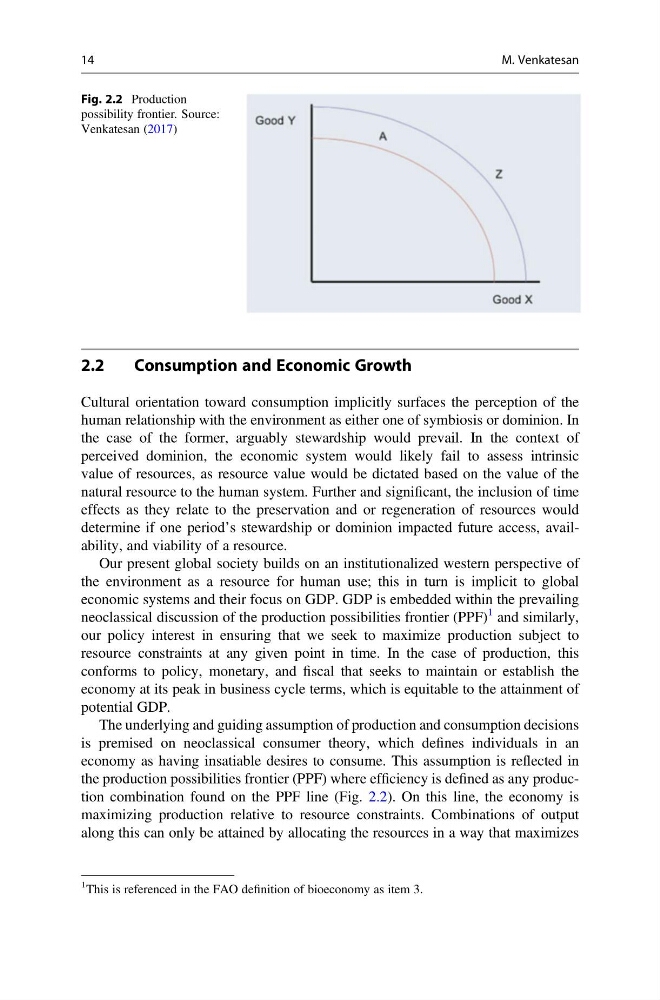
the production possibilities frontier (PPF) where efficiency is defined as any production combination found on the PPF line (Fig. 2.2). On this line, the economy is
maximizing production relative to resource constraints. Combinations of output
along this can only be attained by allocating the resources in a way that maximizes
Fig. 2.2 Production
possibility frontier. Source:
Venkatesan (2017)
1 This is referenced in the FAO definition of bioeconomy as item 3.
14
M. Venkatesan
Consumption and Economic Growth
Cultural orientation toward consumption implicitly surfaces the perception of the
human relationship with the environment as either one of symbiosis or dominion. In
the case of the former, arguably stewardship would prevail. In the context of
perceived dominion, the economic system would likely fail to assess intrinsic
value of resources, as resource value would be dictated based on the value of the
natural resource to the human system. Further and significant, the inclusion of time
effects as they relate to the preservation and or regeneration of resources would
determine if one period’s stewardship or dominion impacted future access, availability, and viability of a resource.
Our present global society builds on an institutionalized western perspective of
the environment as a resource for human use; this in turn is implicit to global
economic systems and their focus on GDP. GDP is embedded within the prevailing
neoclassical discussion of the production possibilities frontier (PPF)
1 and similarly,
our policy interest in ensuring that we seek to maximize production subject to
resource constraints at any given point in time. In the case of production, this
conforms to policy, monetary, and fiscal that seeks to maintain or establish the
economy at its peak in business cycle terms, which is equitable to the attainment of
potential GDP.
The underlying and guiding assumption of production and consumption decisions
is premised on neoclassical consumer theory, which defines individuals in an
economy as having insatiable desires to consume. This assumption is reflected in
the production possibilities frontier (PPF) where efficiency is defined as any production combination found on the PPF line (Fig. 2.2). On this line, the economy is
maximizing production relative to resource constraints. Combinations of output
along this can only be attained by allocating the resources in a way that maximizes
Fig. 2.2 Production
possibility frontier. Source:
Venkatesan (2017)
1 This is referenced in the FAO definition of bioeconomy as item 3.
14
M. Venkatesan