

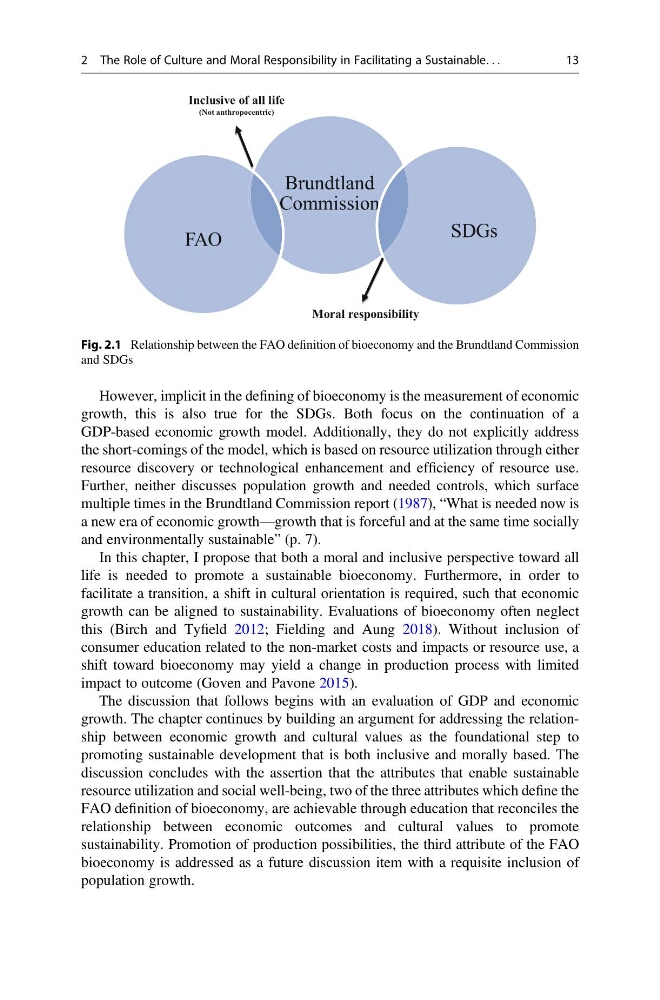
However, implicit in the defining of bioeconomy is the measurement of economic
growth, this is also true for the SDGs. Both focus on the continuation of a
GDP-based economic growth model. Additionally, they do not explicitly address
the short-comings of the model, which is based on resource utilization through either
resource discovery or technological enhancement and efficiency of resource use.
Further, neither discusses population growth and needed controls, which surface
multiple times in the Brundtland Commission report (1987), “What is needed now is
a new era of economic growth—growth that is forceful and at the same time socially
and environmentally sustainable” (p. 7).
In this chapter, I propose that both a moral and inclusive perspective toward all
life is needed to promote a sustainable bioeconomy. Furthermore, in order to
facilitate a transition, a shift in cultural orientation is required, such that economic
growth can be aligned to sustainability. Evaluations of bioeconomy often neglect
this (Birch and Tyfield 2012; Fielding and Aung 2018). Without inclusion of
consumer education related to the non-market costs and impacts or resource use, a
shift toward bioeconomy may yield a change in production process with limited
impact to outcome (Goven and Pavone 2015).
The discussion that follows begins with an evaluation of GDP and economic
growth. The chapter continues by building an argument for addressing the relationship between economic growth and cultural values as the foundational step to
promoting sustainable development that is both inclusive and morally based. The
discussion concludes with the assertion that the attributes that enable sustainable
resource utilization and social well-being, two of the three attributes which define the
FAO definition of bioeconomy, are achievable through education that reconciles the
relationship between economic outcomes and cultural values to promote
sustainability. Promotion of production possibilities, the third attribute of the FAO
bioeconomy is addressed as a future discussion item with a requisite inclusion of
population growth.
Brundtland
Commission
SDGs
FAO
Inclusive of all life
(Not anthropocentric)
Moral responsibility
Fig. 2.1 Relationship between the FAO definition of bioeconomy and the Brundtland Commission
and SDGs
2 The Role of Culture and Moral Responsibility in Facilitating a Sustainable. . .
13
growth, this is also true for the SDGs. Both focus on the continuation of a
GDP-based economic growth model. Additionally, they do not explicitly address
the short-comings of the model, which is based on resource utilization through either
resource discovery or technological enhancement and efficiency of resource use.
Further, neither discusses population growth and needed controls, which surface
multiple times in the Brundtland Commission report (1987), “What is needed now is
a new era of economic growth—growth that is forceful and at the same time socially
and environmentally sustainable” (p. 7).
In this chapter, I propose that both a moral and inclusive perspective toward all
life is needed to promote a sustainable bioeconomy. Furthermore, in order to
facilitate a transition, a shift in cultural orientation is required, such that economic
growth can be aligned to sustainability. Evaluations of bioeconomy often neglect
this (Birch and Tyfield 2012; Fielding and Aung 2018). Without inclusion of
consumer education related to the non-market costs and impacts or resource use, a
shift toward bioeconomy may yield a change in production process with limited
impact to outcome (Goven and Pavone 2015).
The discussion that follows begins with an evaluation of GDP and economic
growth. The chapter continues by building an argument for addressing the relationship between economic growth and cultural values as the foundational step to
promoting sustainable development that is both inclusive and morally based. The
discussion concludes with the assertion that the attributes that enable sustainable
resource utilization and social well-being, two of the three attributes which define the
FAO definition of bioeconomy, are achievable through education that reconciles the
relationship between economic outcomes and cultural values to promote
sustainability. Promotion of production possibilities, the third attribute of the FAO
bioeconomy is addressed as a future discussion item with a requisite inclusion of
population growth.
Brundtland
Commission
SDGs
FAO
Inclusive of all life
(Not anthropocentric)
Moral responsibility
Fig. 2.1 Relationship between the FAO definition of bioeconomy and the Brundtland Commission
and SDGs
2 The Role of Culture and Moral Responsibility in Facilitating a Sustainable. . .
13