

11.8 Protozoans as Biopesticides
Protozoans are also referred to as microsporidians. Microsporidia are ubiquitous,
obligate intracellular parasites have the potential to attack lepidopteran and orthopteran insects hence can be used as a component of integrated pest management
program, e.g. Nosema sp. and Vairimorpha sp. Although, they are pest-specific,
slow-acting, induce chronic and debilitating effects on targets, the use of protozoa as
biopesticides is not very successful compared to other organisms such as bacteria,
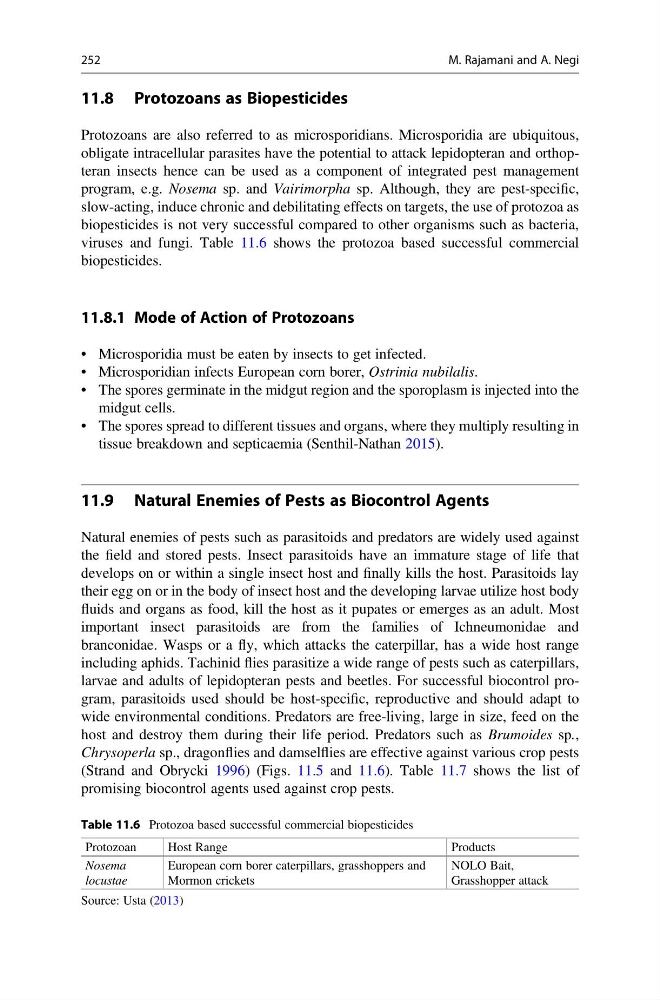
viruses and fungi. Table 11.6 shows the protozoa based successful commercial
biopesticides.
11.8.1 Mode of Action of Protozoans
• Microsporidia must be eaten by insects to get infected.
• Microsporidian infects European corn borer, Ostrinia nubilalis.
• The spores germinate in the midgut region and the sporoplasm is injected into the
midgut cells.
• The spores spread to different tissues and organs, where they multiply resulting in
tissue breakdown and septicaemia (Senthil-Nathan 2015).
11.9 Natural Enemies of Pests as Biocontrol Agents
Natural enemies of pests such as parasitoids and predators are widely used against
the field and stored pests. Insect parasitoids have an immature stage of life that
develops on or within a single insect host and finally kills the host. Parasitoids lay
their egg on or in the body of insect host and the developing larvae utilize host body
fluids and organs as food, kill the host as it pupates or emerges as an adult. Most
important insect parasitoids are from the families of Ichneumonidae and
branconidae. Wasps or a fly, which attacks the caterpillar, has a wide host range
including aphids. Tachinid flies parasitize a wide range of pests such as caterpillars,
larvae and adults of lepidopteran pests and beetles. For successful biocontrol program, parasitoids used should be host-specific, reproductive and should adapt to
wide environmental conditions. Predators are free-living, large in size, feed on the
host and destroy them during their life period. Predators such as Brumoides sp.,
Chrysoperla sp., dragonflies and damselflies are effective against various crop pests
(Strand and Obrycki 1996) (Figs. 11.5 and 11.6). Table 11.7 shows the list of
promising biocontrol agents used against crop pests.
Table 11.6 Protozoa based successful commercial biopesticides
Protozoan
Host Range
Products
Nosema
locustae
European corn borer caterpillars, grasshoppers and
Mormon crickets
NOLO Bait,
Grasshopper attack
Source: Usta (2013)
252
M. Rajamani and A. Negi
Protozoans are also referred to as microsporidians. Microsporidia are ubiquitous,
obligate intracellular parasites have the potential to attack lepidopteran and orthopteran insects hence can be used as a component of integrated pest management
program, e.g. Nosema sp. and Vairimorpha sp. Although, they are pest-specific,
slow-acting, induce chronic and debilitating effects on targets, the use of protozoa as
biopesticides is not very successful compared to other organisms such as bacteria,
viruses and fungi. Table 11.6 shows the protozoa based successful commercial
biopesticides.
11.8.1 Mode of Action of Protozoans
• Microsporidia must be eaten by insects to get infected.
• Microsporidian infects European corn borer, Ostrinia nubilalis.
• The spores germinate in the midgut region and the sporoplasm is injected into the
midgut cells.
• The spores spread to different tissues and organs, where they multiply resulting in
tissue breakdown and septicaemia (Senthil-Nathan 2015).
11.9 Natural Enemies of Pests as Biocontrol Agents
Natural enemies of pests such as parasitoids and predators are widely used against
the field and stored pests. Insect parasitoids have an immature stage of life that
develops on or within a single insect host and finally kills the host. Parasitoids lay
their egg on or in the body of insect host and the developing larvae utilize host body
fluids and organs as food, kill the host as it pupates or emerges as an adult. Most
important insect parasitoids are from the families of Ichneumonidae and
branconidae. Wasps or a fly, which attacks the caterpillar, has a wide host range
including aphids. Tachinid flies parasitize a wide range of pests such as caterpillars,
larvae and adults of lepidopteran pests and beetles. For successful biocontrol program, parasitoids used should be host-specific, reproductive and should adapt to
wide environmental conditions. Predators are free-living, large in size, feed on the
host and destroy them during their life period. Predators such as Brumoides sp.,
Chrysoperla sp., dragonflies and damselflies are effective against various crop pests
(Strand and Obrycki 1996) (Figs. 11.5 and 11.6). Table 11.7 shows the list of
promising biocontrol agents used against crop pests.
Table 11.6 Protozoa based successful commercial biopesticides
Protozoan
Host Range
Products
Nosema
locustae
European corn borer caterpillars, grasshoppers and
Mormon crickets
NOLO Bait,
Grasshopper attack
Source: Usta (2013)
252
M. Rajamani and A. Negi