

Removing the assumption of horizontal supply of the recycled product does not
change the outcome substantially. If the line had a positive slope, there would be two
options. If it is always above S, the result will be similar to the case RS 1 , i.e., the
recycled technology is never profitable. If it crosses S, it will have an effect only if
the crossing point is “south west” of P*Q*. The result, however, is then the same of
the horizontal recycling cost assumed above.
Another option is possible, notably in the case of marginal cost increase because
the natural resource has become scarcer, which reflects in a move upwards of the
supply function S. The outcome, in this case may again be that the recycling
technology becomes used, in a context of higher market prices and lower use of
the resources altogether.
A similar situation can also occur due to the changes in demand. In particular, if
demand of the good grows, the demand function will move upward, leading to a
potential use of even RS 1 technology, when P* becomes higher than RS 1 . There will
be an optimal level of recycling and the share of recycled vs. harvested will depend
again on the level of prices. The overall situation will be the opposite of the previous
hypotheses, as the use of the resource increases.
A problem is that of failures in the markets of recyclable materials. These may be
due not only to environmental externalities, but also to imperfect and asymmetric
information and technological and consumption externalities. Nicolli et al. (2012)
review the nature of such failures and how they may affect markets for certain
recyclable materials. They also discuss how these failures can be overcome by
technological innovation and the role for policy measures in this innovation in the
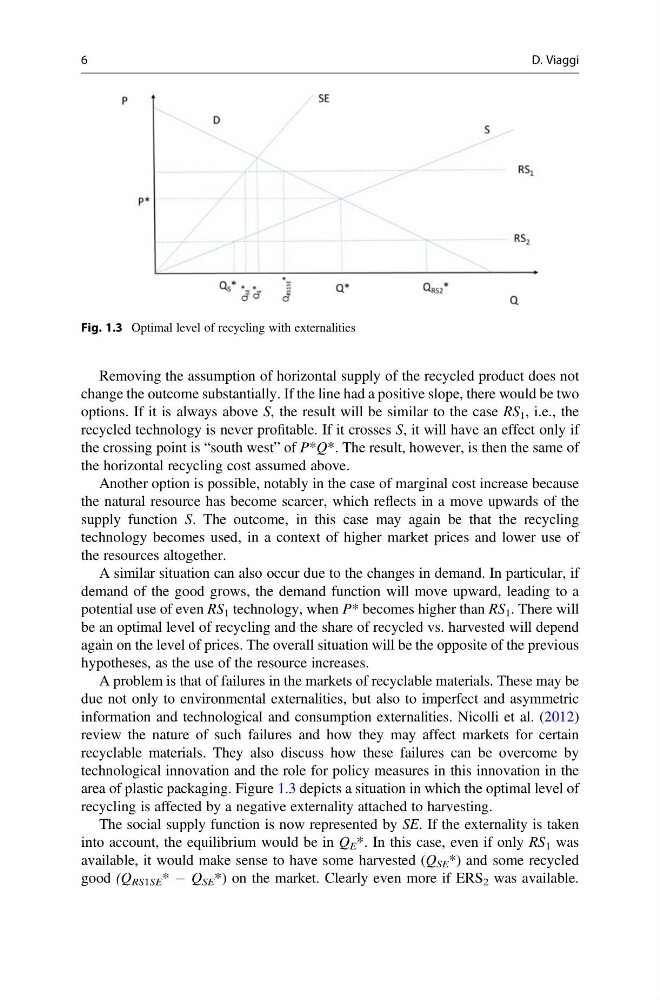
area of plastic packaging. Figure 1.3 depicts a situation in which the optimal level of
recycling is affected by a negative externality attached to harvesting.
The social supply function is now represented by SE. If the externality is taken
into account, the equilibrium would be in Q E *. In this case, even if only RS 1 was
available, it would make sense to have some harvested (Q SE *) and some recycled
good (Q RS1SE * À Q SE *) on the market. Clearly even more if ERS 2 was available.
Fig. 1.3 Optimal level of recycling with externalities
6
D. Viaggi
change the outcome substantially. If the line had a positive slope, there would be two
options. If it is always above S, the result will be similar to the case RS 1 , i.e., the
recycled technology is never profitable. If it crosses S, it will have an effect only if
the crossing point is “south west” of P*Q*. The result, however, is then the same of
the horizontal recycling cost assumed above.
Another option is possible, notably in the case of marginal cost increase because
the natural resource has become scarcer, which reflects in a move upwards of the
supply function S. The outcome, in this case may again be that the recycling
technology becomes used, in a context of higher market prices and lower use of
the resources altogether.
A similar situation can also occur due to the changes in demand. In particular, if
demand of the good grows, the demand function will move upward, leading to a
potential use of even RS 1 technology, when P* becomes higher than RS 1 . There will
be an optimal level of recycling and the share of recycled vs. harvested will depend
again on the level of prices. The overall situation will be the opposite of the previous
hypotheses, as the use of the resource increases.
A problem is that of failures in the markets of recyclable materials. These may be
due not only to environmental externalities, but also to imperfect and asymmetric
information and technological and consumption externalities. Nicolli et al. (2012)
review the nature of such failures and how they may affect markets for certain
recyclable materials. They also discuss how these failures can be overcome by
technological innovation and the role for policy measures in this innovation in the
area of plastic packaging. Figure 1.3 depicts a situation in which the optimal level of
recycling is affected by a negative externality attached to harvesting.
The social supply function is now represented by SE. If the externality is taken
into account, the equilibrium would be in Q E *. In this case, even if only RS 1 was
available, it would make sense to have some harvested (Q SE *) and some recycled
good (Q RS1SE * À Q SE *) on the market. Clearly even more if ERS 2 was available.
Fig. 1.3 Optimal level of recycling with externalities
6
D. Viaggi